
For builders and node operators, the key distinction in Bitcoin Core’s November 11, 2026 disclosure is that the three security flaws had already been patched. The issues affected block-template creation, block processing and Tor peer permissions under different conditions.
Mining node could lose the ability to build valid blocks
The high-severity flaw, CVE-2025-62861, affected Bitcoin Core versions 28.0–28.2 and 29.0–29.1. Niklas Goegge reported it on September 26, 2025.
After a chain reorganization—a change to which blocks form the accepted chain—TRUC “sibling eviction” rules could incorrectly apply to transactions returning to the mempool, where unconfirmed transactions wait. A transaction could be evicted while its descendants remained, leaving the mempool inconsistent. Affected miners had to restart their nodes before they could create valid block templates again.
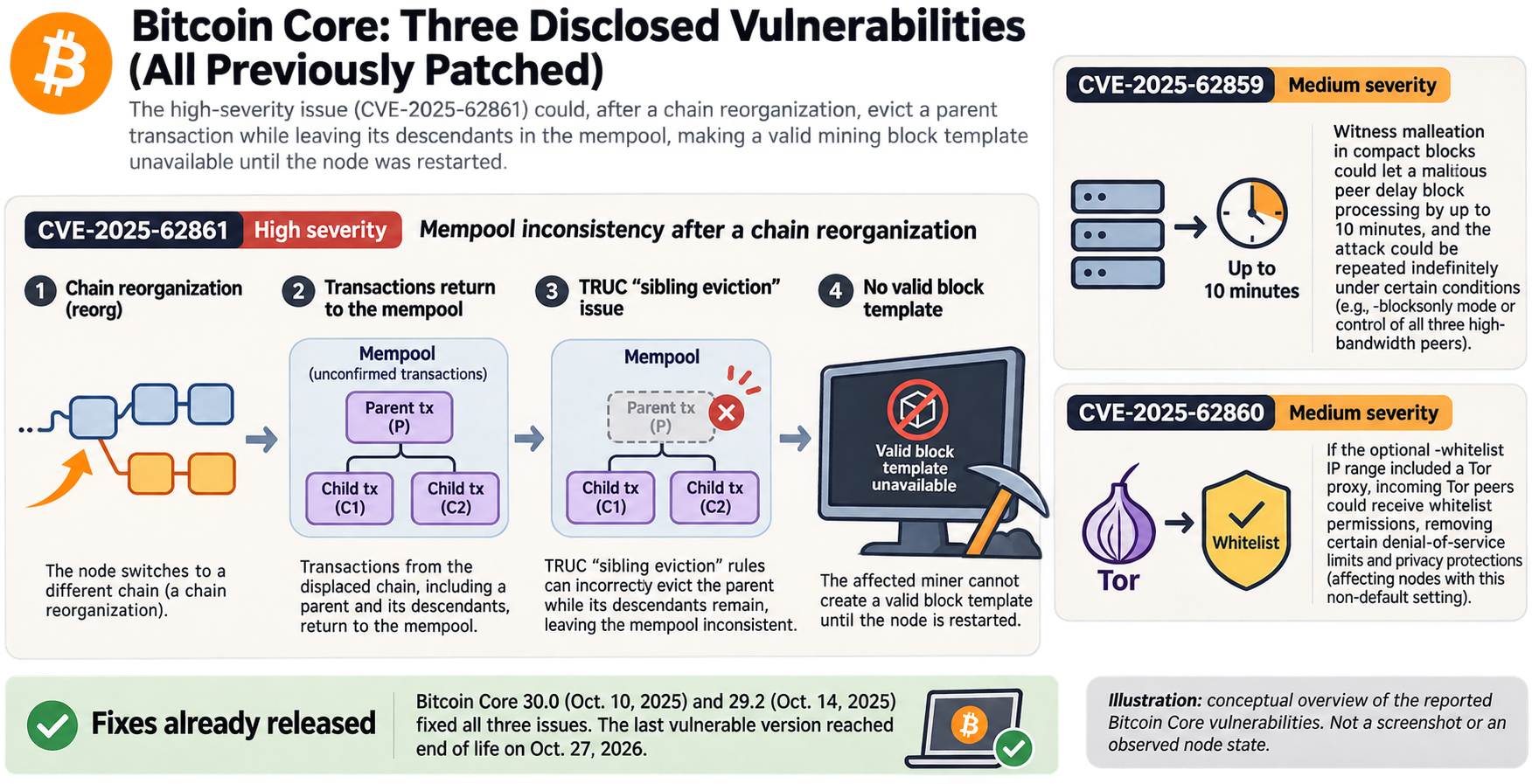
Two medium-severity issues
CVE-2025-62859, reported by Eugene Siegel in April 2025, could let a malicious peer use witness malleation in compact blocks to delay block processing by up to 10 minutes. According to the advisory, the attack could be repeated indefinitely against nodes running in -blocksonly mode or when the attacker controlled all three high-bandwidth peers.
CVE-2025-62860 concerned the optional -whitelist setting. If its configured IP range included a Tor proxy, incoming Tor peers could receive whitelist permissions. Bitcoin Core said “thousands” of reachable mainnet nodes had been whitelisting incoming Tor connections, removing certain denial-of-service limits and privacy protections. Nodes without the non-default whitelist setting were not affected.
Bitcoin Core 30.0 included fixes for all three issues on October 10, 2025; version 29.2 followed on October 14. According to the advisories, the last vulnerable version reached end of life on October 27, 2026.
Source: theblock.co (originally published 2026-11-11 20:49 UTC+8)