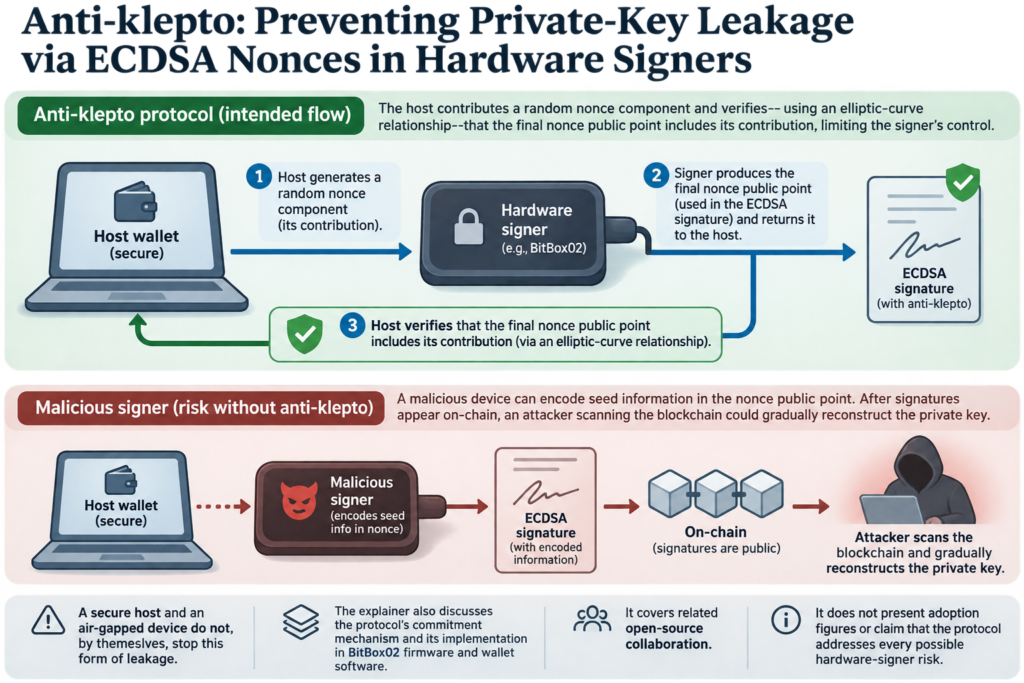
When integrating a hardware signer, a builder needs to consider what a signature might reveal—not just whether the host wallet is secure. An explainer published on November 5, 2026, describes how a malicious device could encode seed information in the public point associated with an ECDSA nonce (a value used when creating a signature). Once signatures appear on-chain, an attacker scanning the blockchain could gradually reconstruct the private key. According to the explainer, a secure host and an air-gapped device would not, by themselves, stop this form of leakage.
The anti-klepto protocol limits the signer’s control over that nonce. The host wallet contributes a random nonce component, then uses an elliptic-curve relationship to check that the final nonce public point includes its contribution. This constrains the device’s ability to choose the nonce freely.
The explainer also discusses the protocol’s commitment mechanism, its implementation in BitBox02 firmware and wallet software, and related open-source collaboration. It does not present adoption figures or claim that the protocol addresses every possible hardware-signer risk.