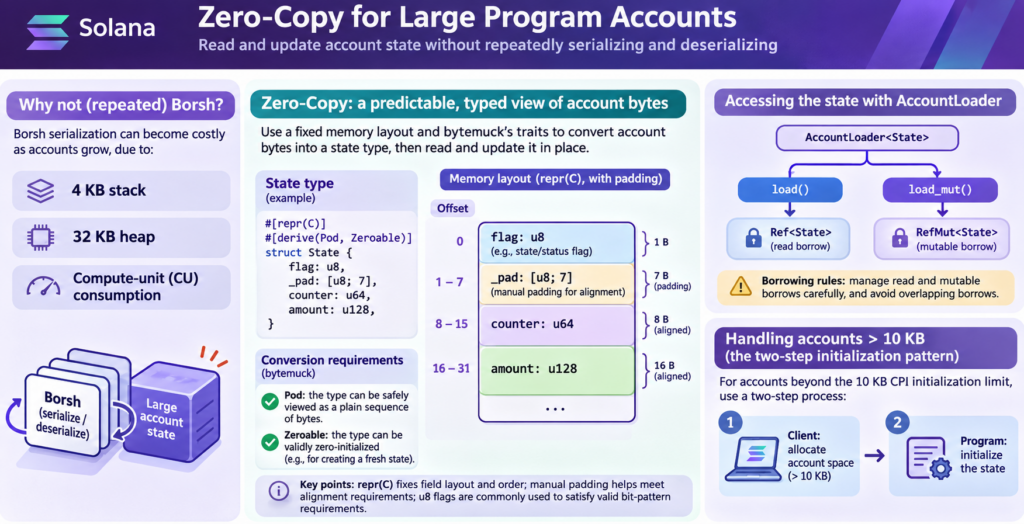
For a Solana builder managing a large program account, the question is how to read and update its state without repeatedly serializing and deserializing it. An article originally published on November 16, 2026, at 12:01 p.m. UTC+8 explains zero-copy as an approach to that task. It identifies a 4 KB stack, a 32 KB heap and compute-unit (CU) consumption as constraints that can make Borsh serialization costly as accounts grow.
The approach depends on a predictable memory layout. repr(C) fixes field layout, while bytemuck’s Pod and Zeroable traits impose requirements for converting account bytes into a state type. The article also describes manual padding for alignment and u8 flags to meet valid bit-pattern requirements.
To access that state, AccountLoader provides load and load_mut. Their Ref and RefMut borrow guards matter: code must manage read and mutable borrows without overlap that violates borrowing rules.
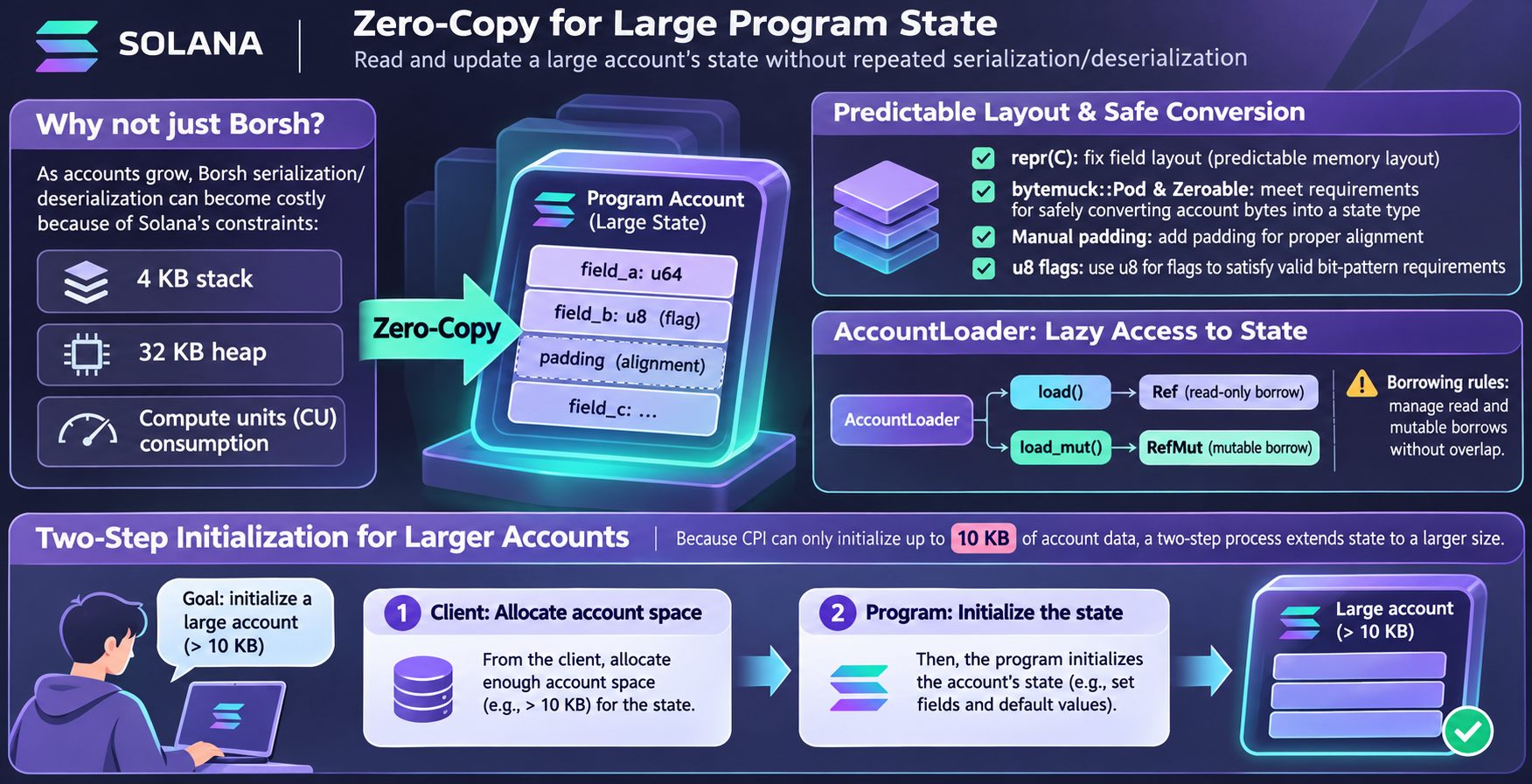
For accounts beyond the cited 10 KB cross-program invocation (CPI) initialization limit, the article describes a two-step process: allocate account space from the client, then initialize the state. This is a development pattern described in the source, not a claim that any particular program has deployed it.
Source: learnblockchain.cn (originally published 2026-11-16 12:01 UTC+8)