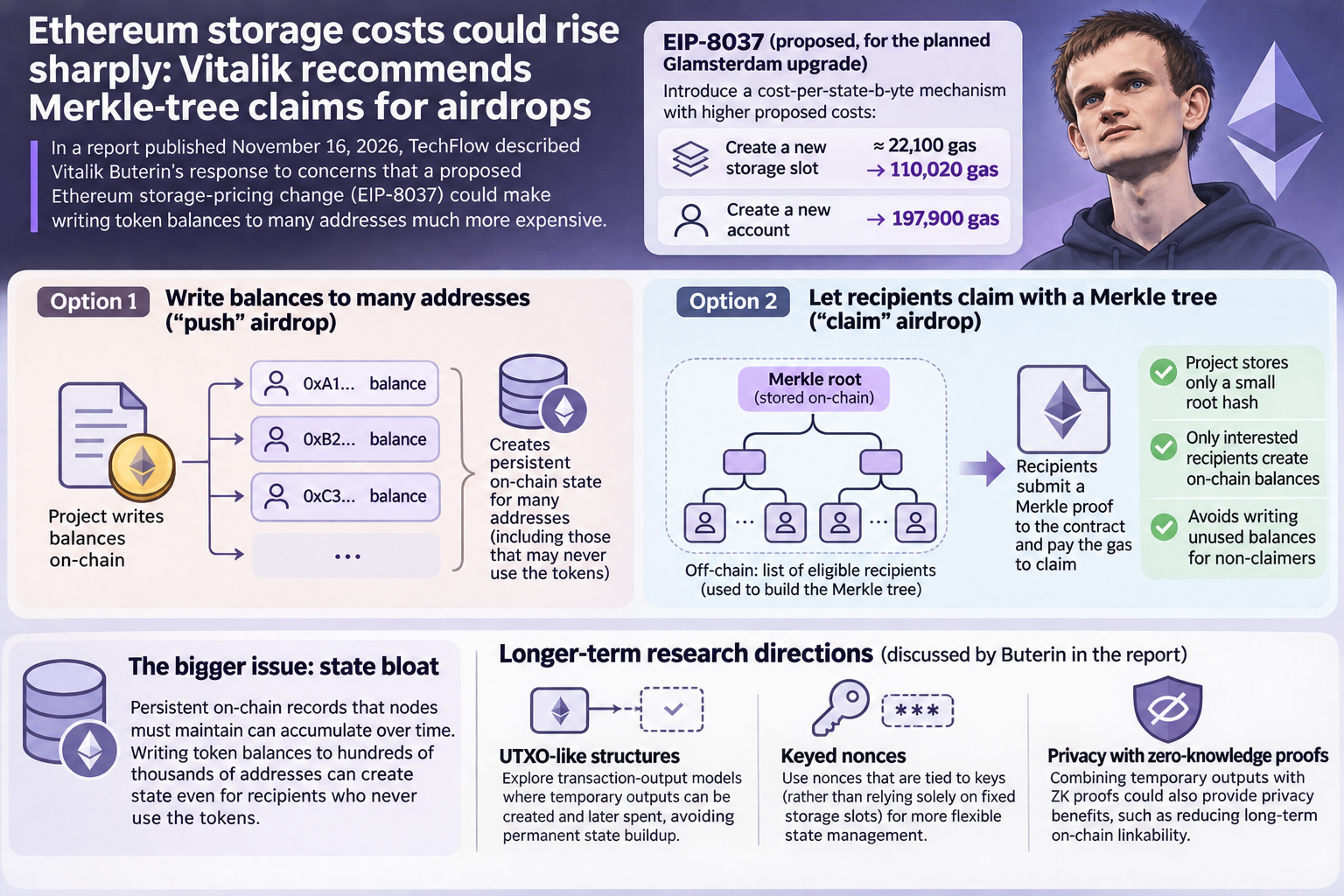
For builders planning a large token distribution, the question is whether to write balances to many addresses in advance or let recipients claim them. In a report published November 16, 2026, TechFlow described Vitalik Buterin’s response to concerns that a proposed Ethereum storage-pricing change could make the first approach substantially more expensive.
What the proposal would change
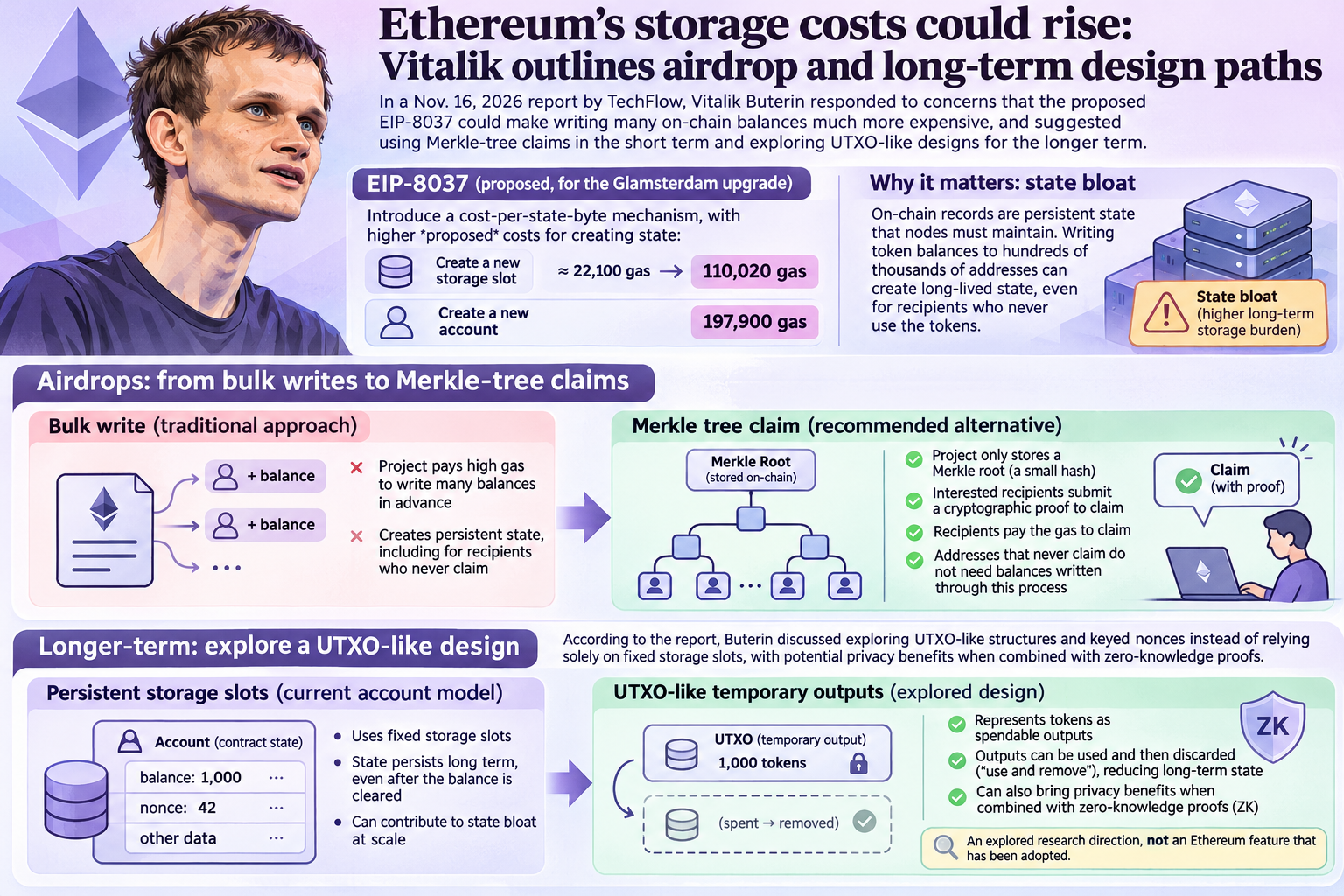
The report says EIP-8037, being advanced for the planned Glamsterdam upgrade, would introduce a cost-per-state-byte mechanism. Under the proposal, creating a new storage slot would rise from about 22,100 gas to 110,020 gas, while creating a new account would cost 197,900 gas. These are proposed costs, not enacted rules.
The concern is state bloat: persistent on-chain records that nodes must maintain. Writing token balances to hundreds of thousands of addresses can create state even for recipients who never use the tokens.
Let recipients claim instead
According to the report, Buterin pointed to a long-recommended alternative for airdrops: a Merkle tree, which lets a contract check a recipient’s cryptographic proof against a stored root hash. Rather than paying to write every balance in advance, a project can let interested recipients submit proofs and pay the gas to claim. Addresses that never claim would not need balances written through that distribution process.
For the longer term, the report says Buterin discussed exploring UTXO-like structures and keyed nonces instead of relying solely on fixed storage slots. It also describes potential privacy benefits when temporary outputs are combined with zero-knowledge proofs. Those are research directions in the report, not changes that Ethereum has already adopted.