For builders reviewing lending contracts, the failure point in Kava’s account of the HARD Lend attack was collateral accounting: a dormant BUSD market still retained valuation logic that an attacker could exploit. In a security update reported on November 16, 2026, Kava said the attacker inflated the recorded value of BUSD collateral, then repeated borrowing and liquidation cycles to drain available liquidity from an older lending pool.
Kava said approximately 53.9 million KAVA, valued at about $1.83 million, was taken. According to the report’s account of on-chain data, about 49.2 million KAVA—91.28% of the stolen tokens—was subsequently moved to BNB Chain through LayerZero and sold.
Kava said it had contained the contract vulnerability and stopped further outflows. As of November 16, some funds connected to the attack had been frozen at centralized exchanges and bridge endpoints, according to the report. Kava contributors were working with security teams, trading platforms and law enforcement to trace funds and pursue recovery.
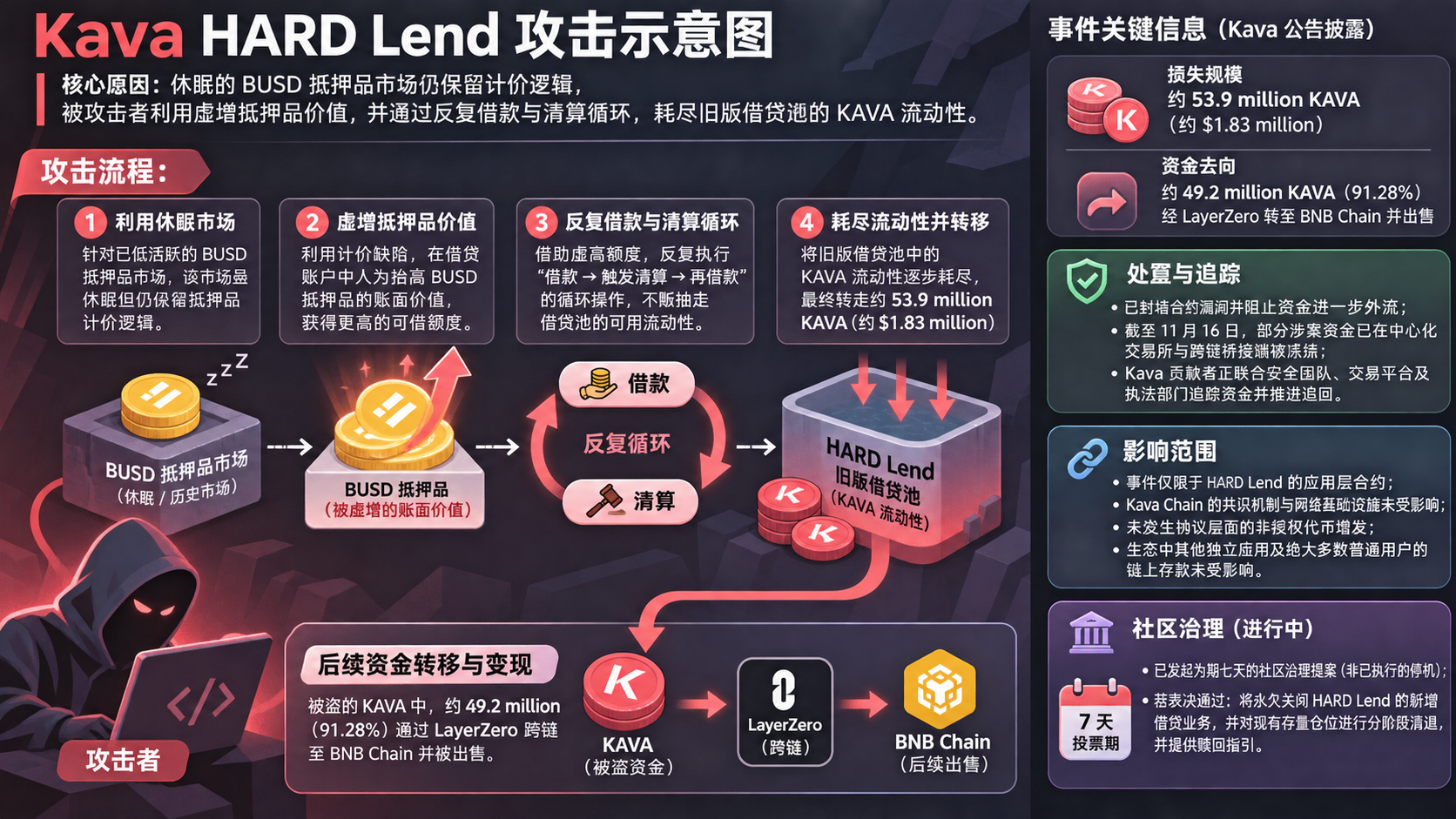
Kava said the incident was confined to HARD Lend’s application-level contracts: its chain’s consensus and network infrastructure were unaffected, and no unauthorized tokens were minted at the protocol level. It also said other independently deployed applications and the vast majority of ordinary users’ on-chain deposits were unaffected.
The team launched a seven-day community governance proposal, not an enacted shutdown. If approved, it would permanently end new HARD Lend borrowing and lending activity and provide a phased process for clearing existing positions and guiding redemptions.