
For wallet developers, the central question in the proposed post-quantum signature scheme SHRINCS is how to prevent a one-time signing key from being used twice. A security analysis published by Blockstream Research Director Jonas Nick, Mikhail Kudinov and collaborators examines that risk alongside the proposal’s larger signature sizes. The proposal remains a draft under review, not a change to Bitcoin’s rules.
As reported on November 20, 2026, SHRINCS uses SHA-256, a hash function already used by Bitcoin. It offers two ways to sign a transaction: a smaller stateful path, which requires the wallet to track whether a one-time key has been used, and a larger stateless path, which avoids that particular tracking risk.
The distinction matters because accidentally reusing a one-time key on the stateful path could let an attacker forge a signature for the address and steal funds. Nick said the specification and wallet implementations would need to enforce a switch to the stateless path whenever a state counter might be compromised. Kudinov has asked engineers, cryptographers and protocol developers to review the draft Bitcoin Improvement Proposal (BIP) and its security analysis.
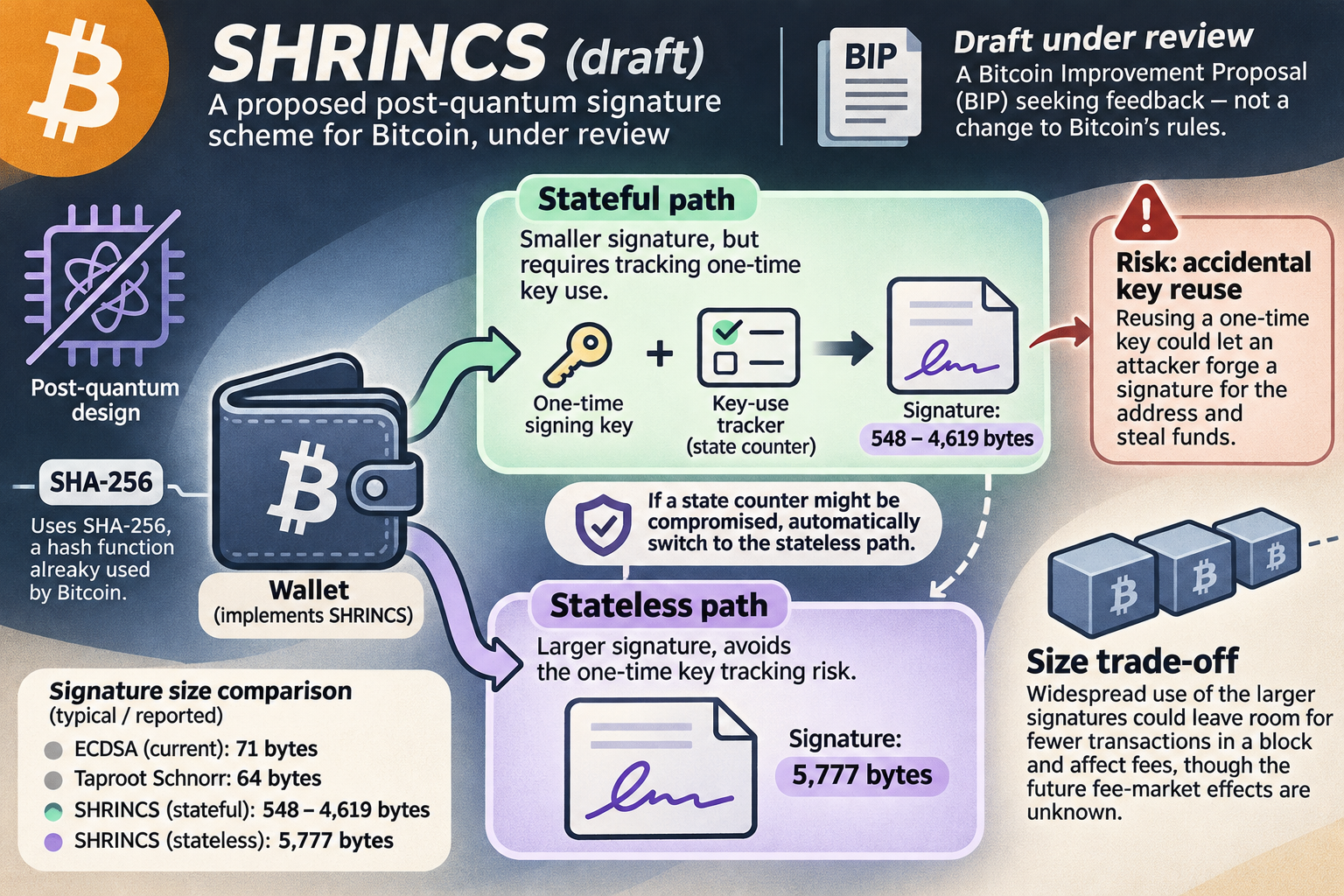
The size trade-off is substantial. Bitcoin’s current ECDSA signatures are typically 71 bytes, while Taproot Schnorr signatures are 64 bytes. The reported SHRINCS ranges are 548 to 4,619 bytes for stateful signatures and 5,777 bytes for stateless signatures. Nick warned that widespread use of the larger signatures could leave room for fewer transactions in a block and affect fees, though he said the future fee-market effects are unknown. He also noted that researchers are continuing to optimize both paths.
The SHRINCS working group, which includes researchers backed by nonprofits including Brink and OpenSats, is refining the specification and seeking feedback. The analysis identifies a wallet-implementation problem builders would have to solve; it does not establish that SHRINCS has been adopted by Bitcoin.