Adding a tokenized stock to a lending market need not mean finding a new group of lenders. Coinbase’s dedicated Aave V4 market on Base uses one pool of USDC to fund loans against eight tokenized stocks, while setting borrowing limits separately for each stock. In a November 25, 2026 analysis, SeaLaunch reported that the market held about $19 million in stock collateral and had lent out a cumulative $8.3 million in USDC.
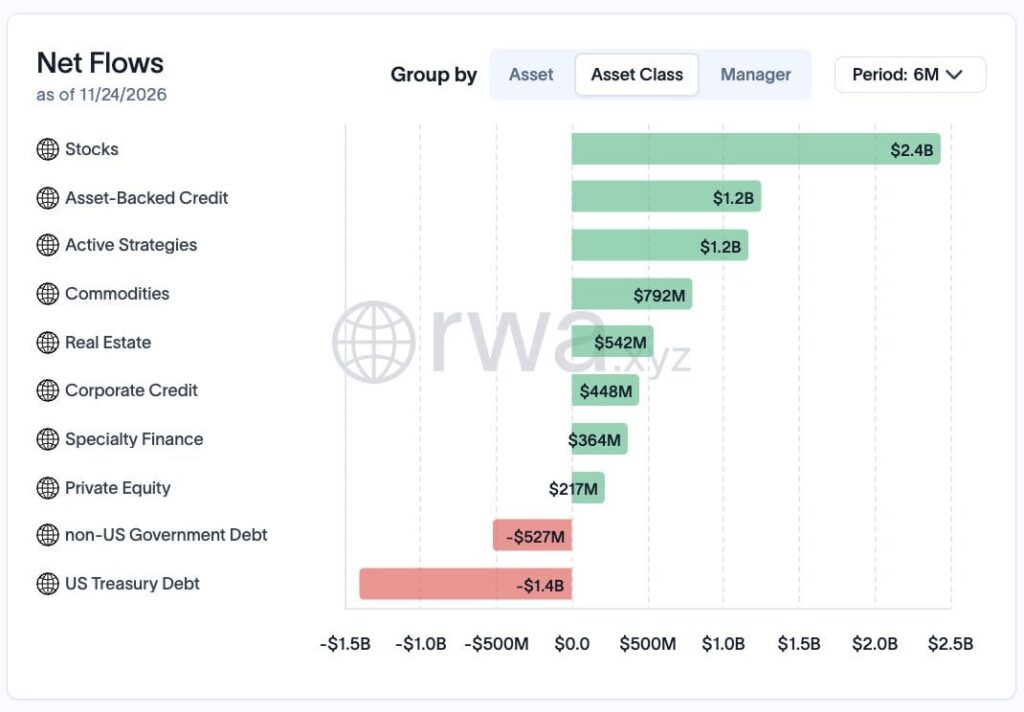
The distinction between issuing a token and putting it to use matters in a growing market. Citing rwa.xyz data, SeaLaunch reported that tokenized stocks attracted $2.4 billion in net inflows over the preceding six months, the most of any real-world asset category. Tokenized US Treasuries recorded $1.4 billion in net outflows over the same period. Those figures cover the broader market, not just Coinbase’s products.
What the stock tokens represent
Coinbase launched its tokenized stock offering in August 2026 on Base, an Ethereum layer-2 network. According to SeaLaunch, each token represents a beneficial claim on an underlying share held one-for-one by a regulated, bankruptcy-remote custodian, separately from Coinbase’s operating assets. Holders can keep the tokens in self-custody wallets and settle transfers around the clock.
Within three months, the offering reached $45 million across nearly 400 US stocks and exchange-traded funds, with more than 97,000 distinct holders. The largest tokens by value were NVDAc (Nvidia) at $10.9 million, GOOGLc (Google) at $10.4 million, METAc (Meta) at $5.4 million and SPCXc, described by SeaLaunch as SpaceX-related, at $4.2 million.
How the hub funds loans and the spokes set limits
Coinbase launched the dedicated lending market in late September. A holder can deposit an eligible stock token as collateral and borrow USDC without selling the stock exposure. The loan has no fixed maturity. The borrower can repay at any time but must keep the loan-to-value ratio—the debt relative to the value of the collateral—within the permitted range.
Aave V4 splits the work between two components:
- The hub holds the USDC. Lenders supply one reserve, and every stock-backed loan draws on it.
- The spokes set the collateral rules. Each stock has its own collateral factor, which determines how much borrowing its value supports; a cap on how much of the stock the market will accept; and a threshold at which a position becomes eligible for liquidation.
To support another stock, the market can set its risk parameters on a spoke rather than open a separate USDC pool and recruit lenders for it. That matters for the less widely held tokens in Coinbase’s catalog: they can draw on existing liquidity without receiving the same borrowing limits as the largest stocks. Only eight stocks were supported as collateral at the time of the analysis, not the full catalog of nearly 400 securities.
SeaLaunch put the $19 million deposited as collateral at roughly 40% of the value of Coinbase’s stock tokens in circulation. GOOGLc accounted for $6 million, NVDAc for $5.1 million and METAc for $3.7 million. NVDAc had used 73% of its deposit cap and GOOGLc 54%; each of the other stocks was below 30%. These percentages measure how much more collateral the market can accept, not how close individual borrowers are to liquidation.
How 22 vaults use the market
SeaLaunch identified managed strategy vaults as the main source of borrowing demand. Three managers oversaw about $10 million across 22 stock-token vaults. Their deposits accounted for nearly one-third of the hub’s stock collateral; the $10 million figure includes assets deployed elsewhere.
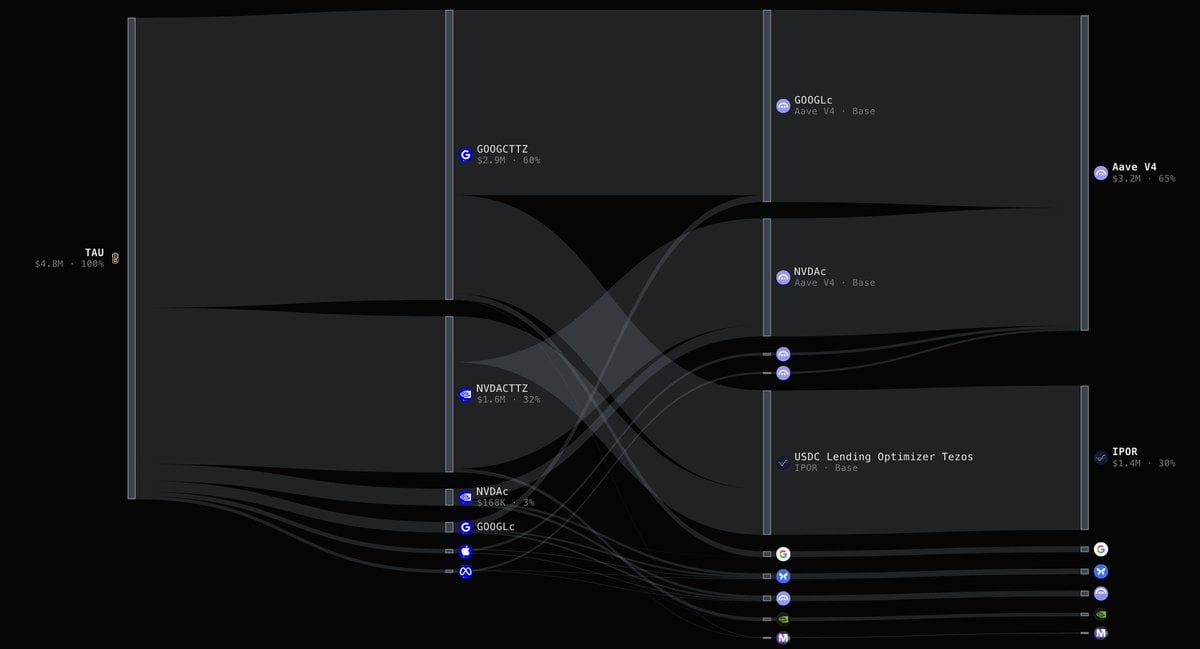
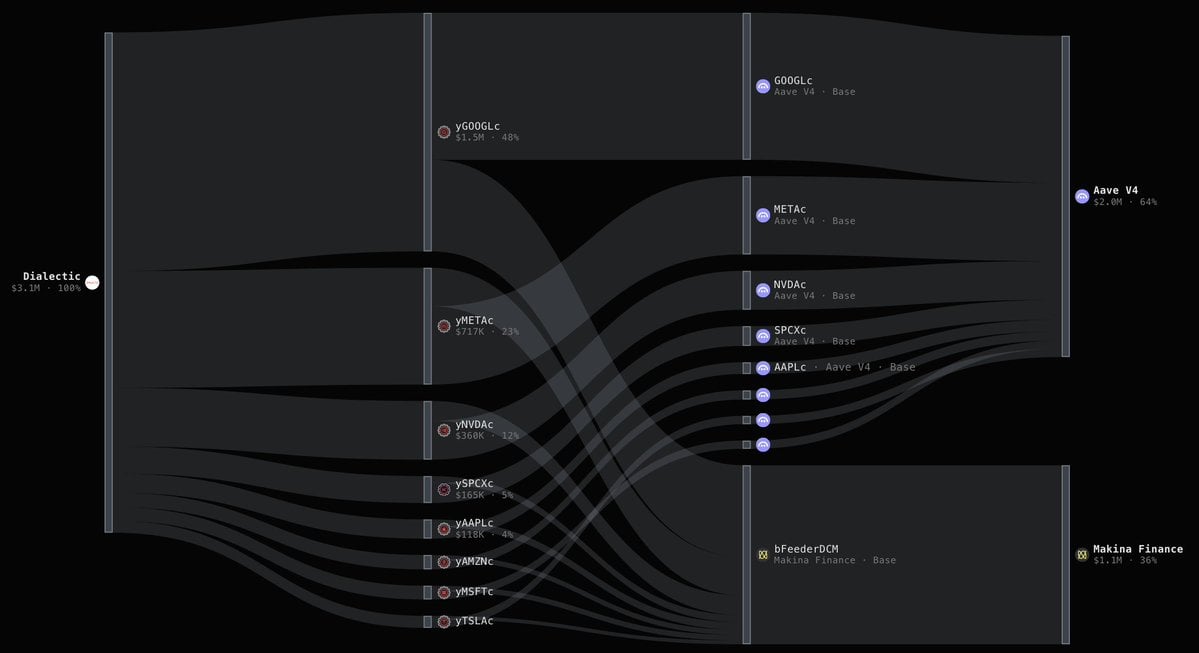
The vaults follow a similar sequence: hold a stock token, deposit it in Aave V4, borrow USDC against it and deploy the USDC in an external strategy. The vault retains exposure to the stock price. The additional return it seeks is the spread between what the external strategy earns and what the vault pays to borrow USDC, not the external yield in full.
| Manager | Assets managed | Reported allocation |
|---|---|---|
| 628 Labs (IPOR) | $4.8 million | Concentrated in Google and Nvidia vaults. It placed 65% in Aave V4 as collateral and 30% in IPOR’s USDC Lending Optimizer. |
| Dialectic Group | $3.1 million | Across eight vaults, the largest was yGOOGLc at $1.5 million. It placed 64% in Aave V4 and 36% in Makina Finance. |
| Superform | $2.2 million | Across eight vaults, superNVDA was the largest at $680,000. It placed 60% in Aave V4 and 28% in the Clearstar USDC vault on Morpho. |
A separate index aims to hedge the stock exposure
SeaLaunch also described an equity-basis index that Keyring was developing with Bitget and its real-world asset platform, Reality. Unlike the vaults above, the proposed index would seek to offset changes in the price of its stock holdings rather than retain that exposure.
The design would pair a leveraged position in Reality-issued stock tokens, financed through a permissioned lending market, with an equally sized short position in perpetual contracts on Hyperliquid. USDC lenders would earn interest on overcollateralized loans. The index would instead seek to collect funding payments from traders holding long contracts, net of financing costs. SeaLaunch described a strategy in development, not an operating index with demonstrated returns.