
Polymarket now lets traders take a position on what an hour of Nvidia GPU time will cost without renting a chip. On November 26, 2026, founder and CEO Shayne Coplan announced markets on on-demand rental rates for the H100, B200 and B300, with contracts extending through December 2028. Coplan likened the resulting series of prices to a yield curve for computing costs.
What the contracts settle on
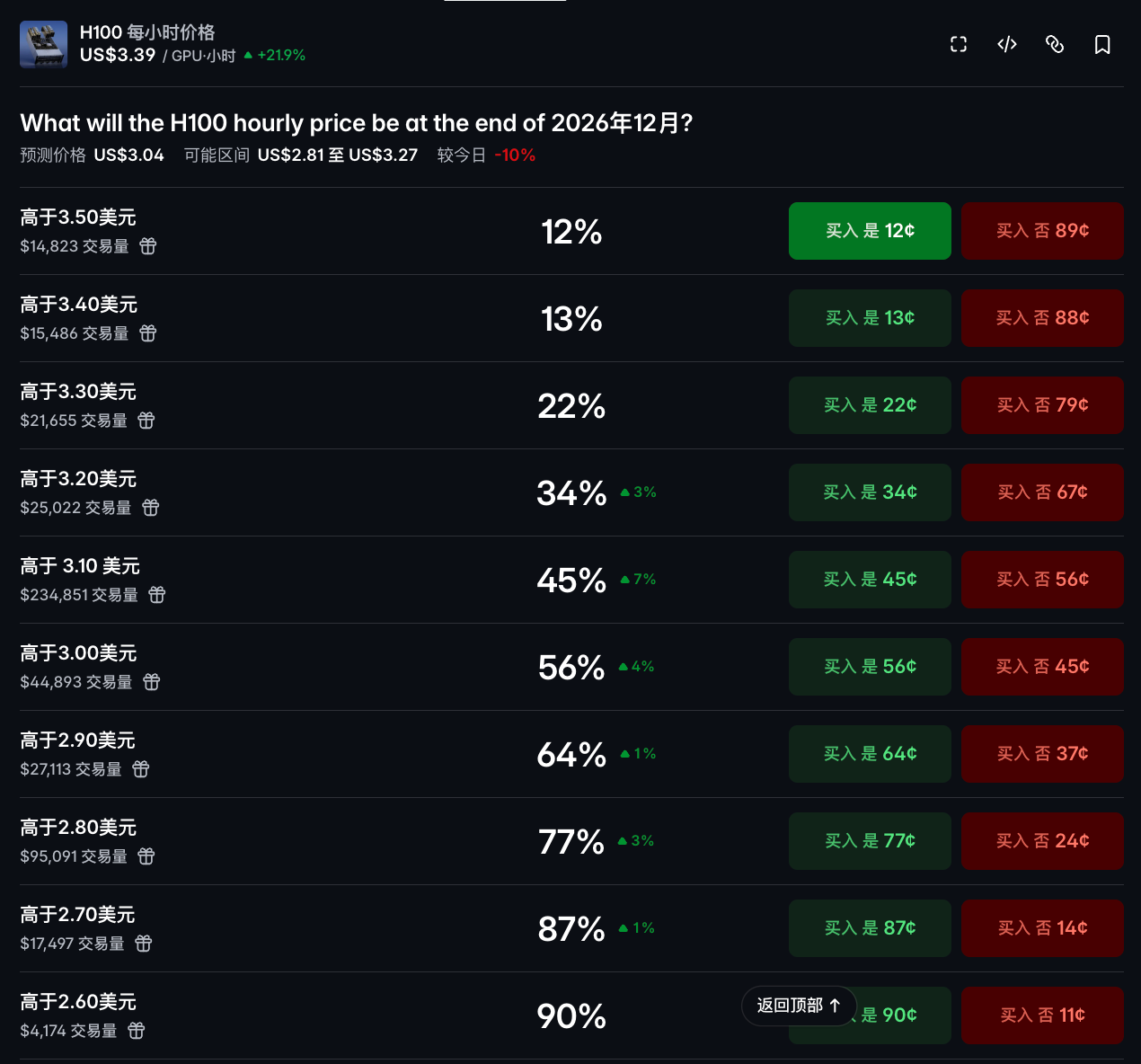
One contract asks whether the average on-demand rental rate for an H100 in December 2026 will exceed $3 per GPU-hour. The answer is either yes or no. Polymarket settles the contract in cash against the OCPI index, which draws on completed on-demand rentals rather than cloud providers’ advertised rates. The index is available on the Bloomberg Terminal. Neither side of the trade receives GPU time.
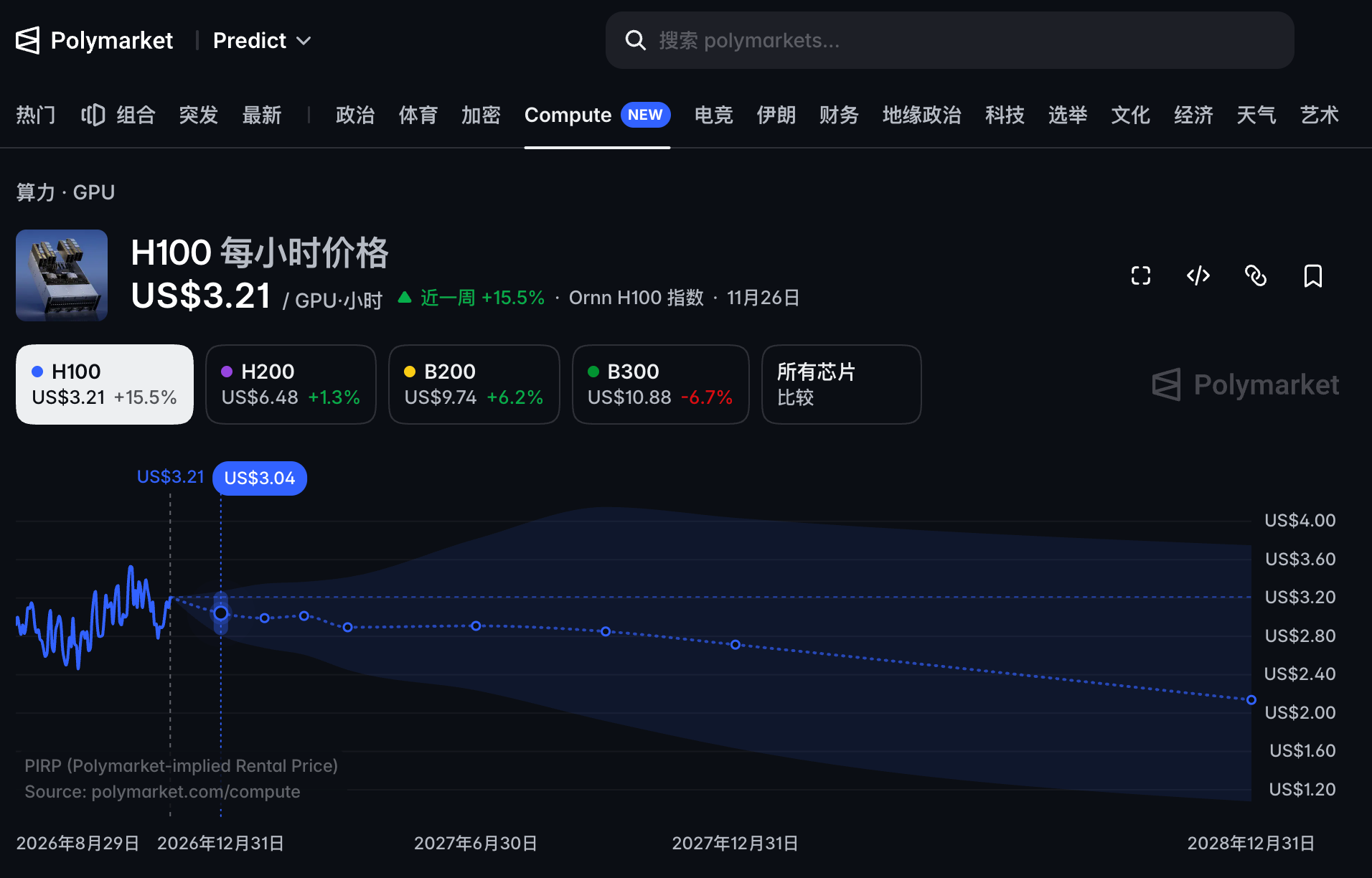
Settlement and forecasting use different prices. The rental index determines the outcome; before settlement, trades at several thresholds indicate how likely participants think each outcome is. Polymarket uses those probabilities to infer a rental rate for each month. The series of monthly estimates is its forward curve. Polymarket also plans related perpetual contracts, but they were not open for trading at the time of the announcement.
What the early prices showed
On November 26, the Ornn index put on-demand rates at approximately $3.21 per GPU-hour for the H100, $6.48 for the H200, $9.74 for the B200 and $10.88 for the B300. By contrast, Polymarket’s early curve implied an H100 rate of about $2.14 per GPU-hour by the end of 2028, more than 30% below the November index reading. That was a price inferred from trades, not a rate a customer could book.
Trading was thin: individual rental-price markets recorded volumes in the tens of thousands of dollars, while H200-related predictions drew only hundreds of dollars. Rates also varied by venue. Bittensor’s GPU rental platform, lium.io, showed actual rental prices below the corresponding OCPI-based figures displayed on Polymarket.
Where the curve helps, and where it falls short
Coplan said buyers and financiers had already committed hundreds of billions of dollars to compute years in advance. A public rental-rate estimate gives a cloud provider financing a GPU purchase, or a lender accepting GPUs as collateral, a reference for assessing how a decline in rental income might affect repayment. Polymarket had already completed a six-figure institutional block trade with FalconX and AneraLabs in June 2026, using the Ornn H100 index to hedge compute-cost risk.
Polymarket is not the first venue to publish such a curve. Kalshi launched GPU rental-price contracts in March 2026 covering the H100, H200, B200, A100 and RTX 5090. Those contracts settle against Ornn indexes, and Kalshi published forward curves derived from them in July. CME Group had planned H100 and B200 futures based on Silicon Data indexes, while ICE was developing contracts tied to Ornn indexes.
For a buyer negotiating a multiyear reservation, the key limitation is what the index measures. Much of the industry’s contracted revenue comes from reserved capacity, but the benchmark tracks on-demand rentals. The two rates need not move together. Polymarket’s curve can inform a negotiation or help offset exposure to a change in the index; it cannot guarantee the buyer’s rental cost or reserve the capacity.