
Borrowers can lock ETH, Wrapped Bitcoin (WBTC) or wrapped staked ETH (wstETH) in a smart contract to mint USDD. Tron founder Justin Sun highlighted those collateral options in a November 27, 2026 post on X, Crypto.news reported. Eight days earlier, Sky had set borrowing limits to zero on five legacy vaults that accept ETH or wstETH. The change stopped borrowers from creating new debt without forcing them to close existing positions.
How a USDD vault works
Unlike a pooled lending market, where borrowers draw assets supplied by other users, a USDD vault creates new stablecoins against deposited collateral. USDD’s August transparency report said it added ETH and WBTC vaults that month. On November 24, USDD advertised annualized borrowing rates starting at 4%, a minimum mint of 5,000 USDD and minimum collateral ratios of 130% to 140% for ETH vaults.
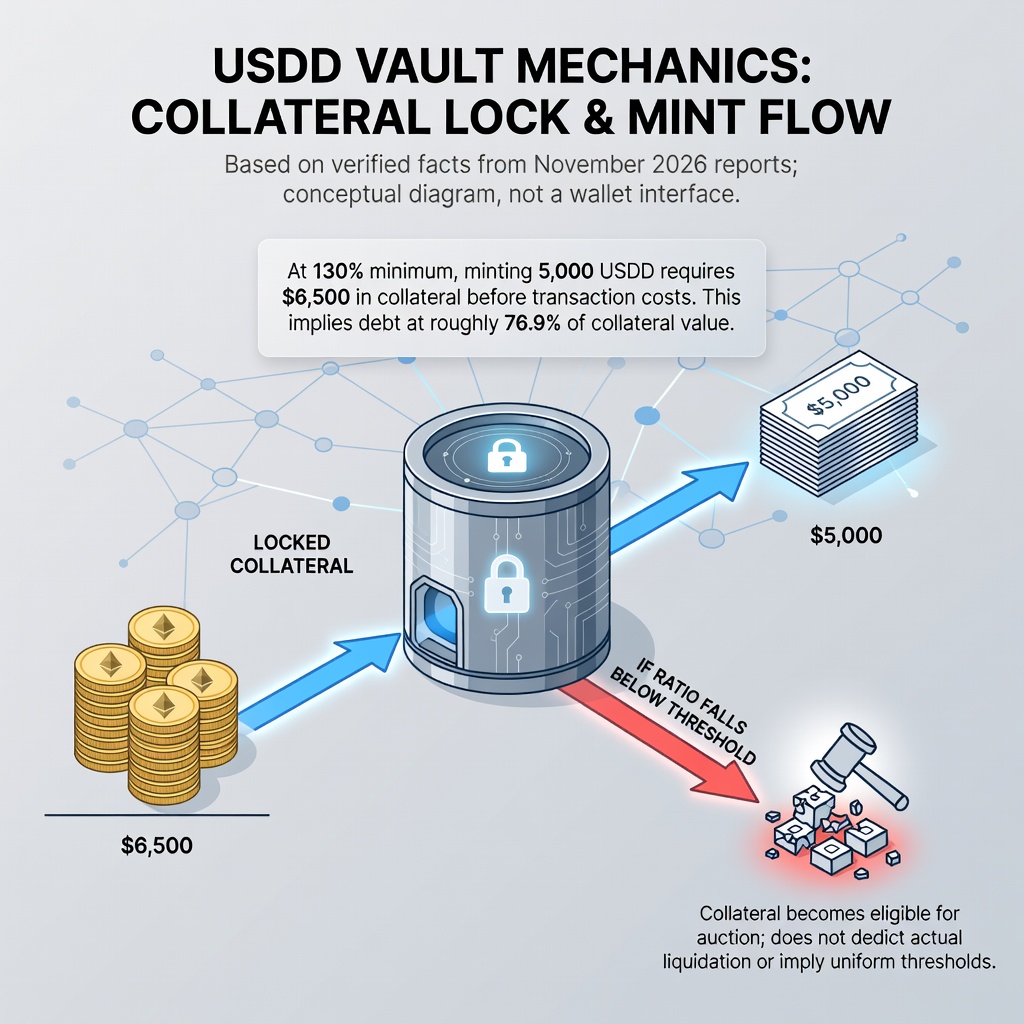
The collateral ratio compares the value of the locked assets with the outstanding debt. At a 130% minimum, minting 5,000 USDD requires $6,500 in collateral before transaction costs. That puts the debt at roughly 76.9% of the collateral’s value. If the ratio falls below the vault’s threshold, the position becomes eligible for liquidation: the collateral can be auctioned to recover the debt.
What Sky’s zero limits changed
Sky’s November 19 governance action set borrowing limits to zero on ETH-A, ETH-B, ETH-C, WSTETH-A and WSTETH-B. Existing borrowers could still manage their positions, repay debt and withdraw collateral within the applicable limits. BA Labs, Sky’s risk adviser, recommended the cuts to reduce exposure to potential security threats, not in response to a specific exploit.
The restrictions did not halt Sky’s Peg Stability Module. On November 20, the Sky Frontier Foundation said the module remained operational after processing more than $2 billion in swaps on November 19.
What backs the USDD supply
A vault’s minimum collateral ratio is distinct from the reserve ratio USDD reports for its overall supply. USDD’s September 2026 report listed $2.24 billion in reserves against $1.52 billion in circulating USDD, a reported ratio of 146.95%. That aggregate figure does not distinguish assets held directly from funds deployed in external lending markets.
DIA’s October 2 assessment found that three TRX vault types held roughly $1.16 billion in collateral against $457 million in USDD debt. A separate vault tied to USDD’s Smart Allocator carried about $990 million in debt at 100% collateralization. Its lending-market positions included roughly $723 million in USDS through Spark, $116 million in USDT through Aave and $46 million in USDT0 through Aave’s Plasma market.
The allocator funds ecosystem incentives and savings products such as sUSDD. On November 26, commentator 0xLoki noted that the gap between borrowing costs of 4% to 5% and advertised savings yields near 7% depends on lending rates and incentives. The commentator also warned that borrowing repeatedly against proceeds from earlier borrowing adds leverage and liquidation risk.
USDD launched in May 2022 with an algorithmic design and fell to $0.967 in December of that year before later shifting to collateral backing. In August 2024, about 12,000 BTC left its reserves without a public governance vote. That history helps explain analysts’ continued scrutiny of the reserve mix.
At 15:18 UTC on November 27, CoinPaprika data put USDD at $1.00 (₹93.17), up 0.3% over 24 hours. ETH traded at $1,661 (₹154,435), down 1.7% over 24 hours and up 0.3% over seven days, with a $203.05 billion market capitalization and $7.02 billion in 24-hour volume.