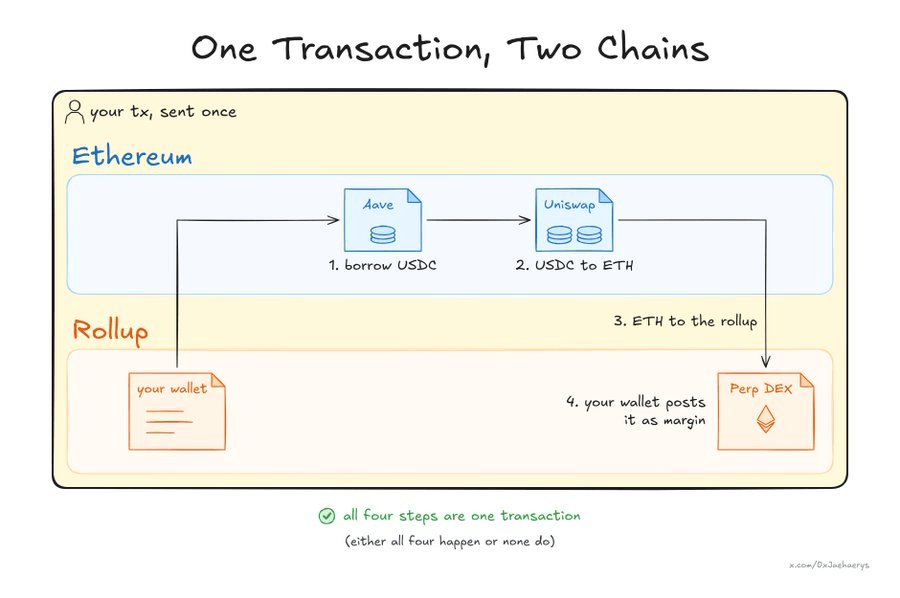
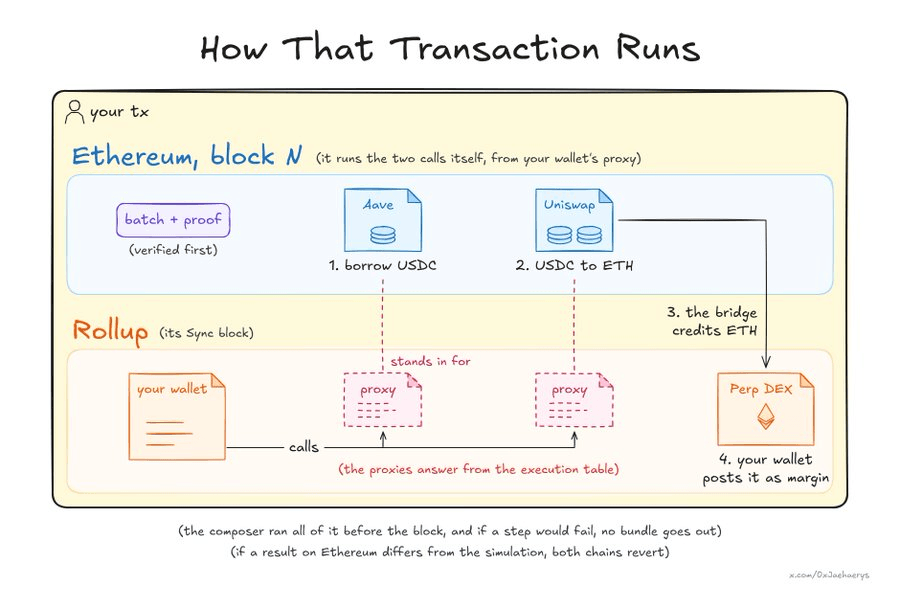
A builder who wants a Rollup transaction to borrow USDC from Aave on Ethereum, swap it for ETH on Uniswap, and deposit the ETH as trading collateral normally has to coordinate actions across chains. The Ethereum Economic Zone (EEZ) proposes making those actions part of one transaction. In an article published on November 14, 2026, at 18:30 UTC+8, 0xJaehaerys describes how the design works, alongside demonstrations and limitations. The article was translated into Chinese by 白话区块链.
What a chain would need to join
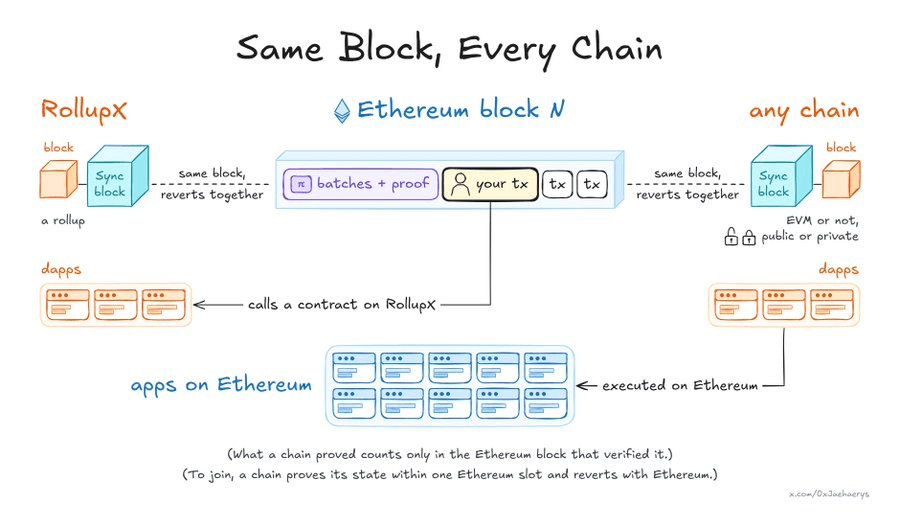
EEZ is described as Ethereum contracts and rules connecting participating chains—not a new chain or a required software stack. A chain could retain its own virtual machine, transaction ordering and access rules. To participate, it would need to prove its new state within one Ethereum slot—a 12-second interval—and roll back with Ethereum if Ethereum reorganizes. The rollback requirement is intended to prevent one side of a cross-chain transaction from remaining after the other disappears.
The design has three principal parts:
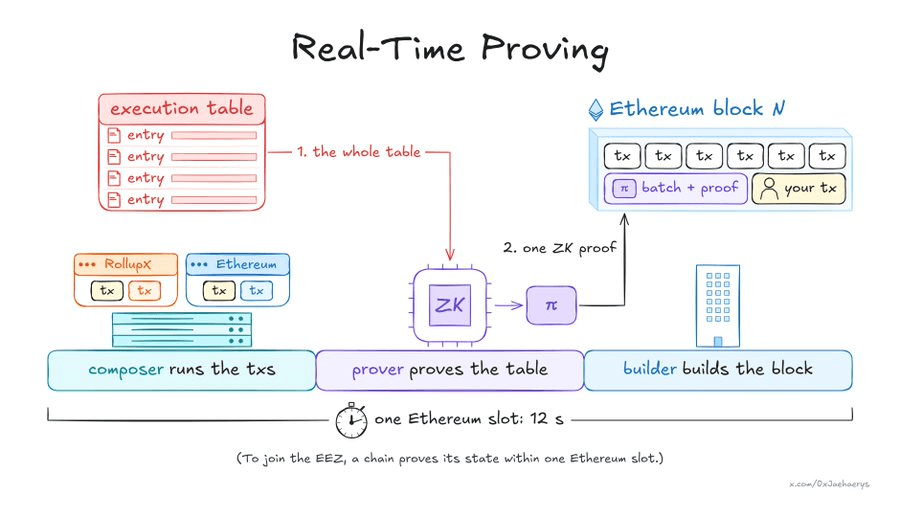
- Real-time proving: A participating chain supplies a proof of its state transition within an Ethereum slot, rather than asking Ethereum to re-execute its transactions. The article says a ZisK proving setup that previously required 24 RTX 5090 GPUs later required four, citing Ethproofs.
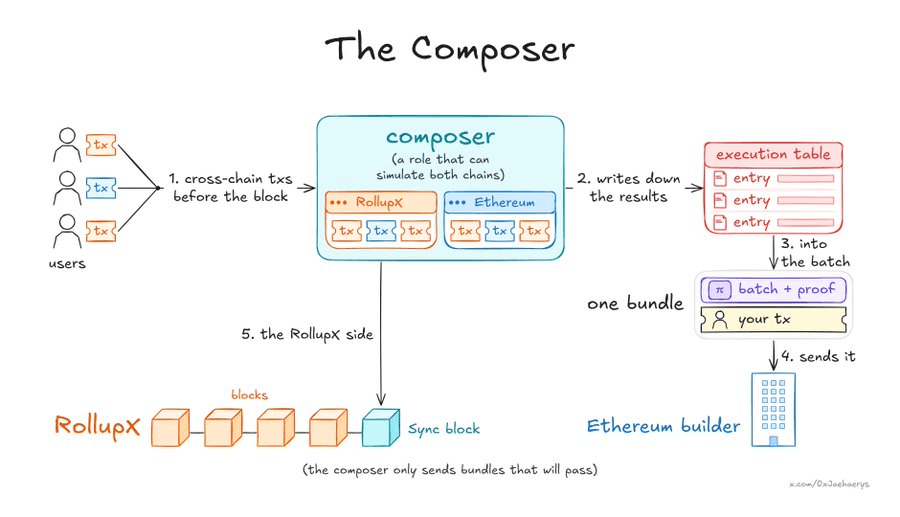
- A composer: Before a block is built, this operator runs the proposed transaction on each involved chain and prepares the expected answers to cross-chain calls.
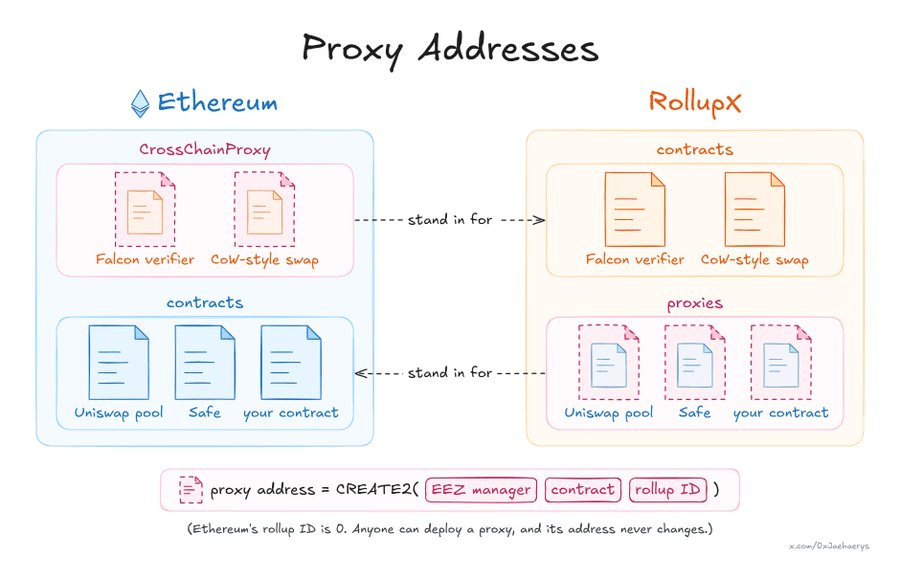
- Proxy contracts: A contract calls a proxy representing a contract on another chain. The article says proxy addresses can be calculated in advance with CREATE2 from the EEZ contract address, the original contract address and a registered chain ID.
From a prepared answer to a contract call
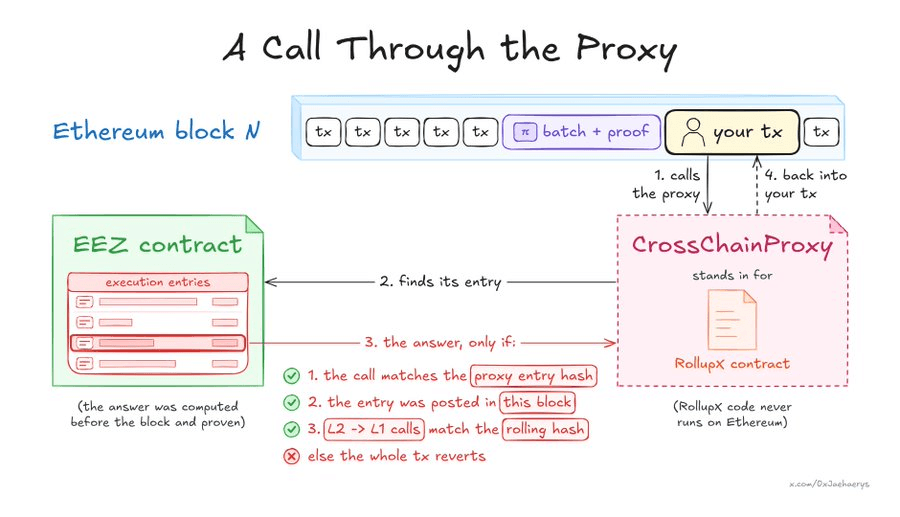
The composer records cross-chain calls in an execution table. Its entries include the expected answers, Rollup state roots before and after a call, callbacks to Ethereum, and a rolling hash of those calls and results. A state root is a hash committing to a chain’s state. The composer sends a bundle to a block builder: a postAndVerifyBatch transaction containing the Rollup batch, table and proof, followed by the user transaction. According to the article, the builder must include the bundle in order or leave it out.
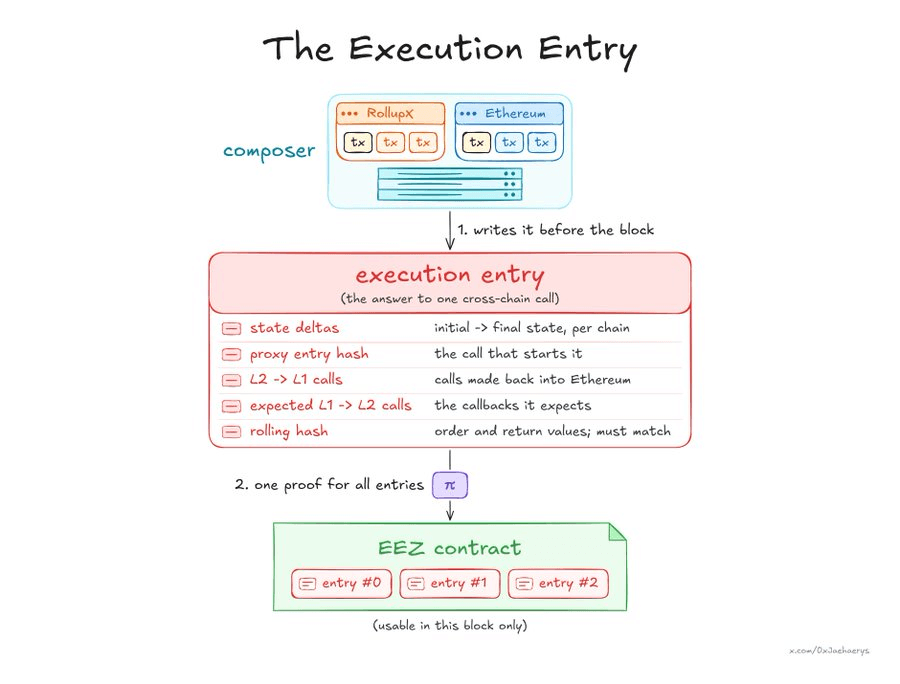
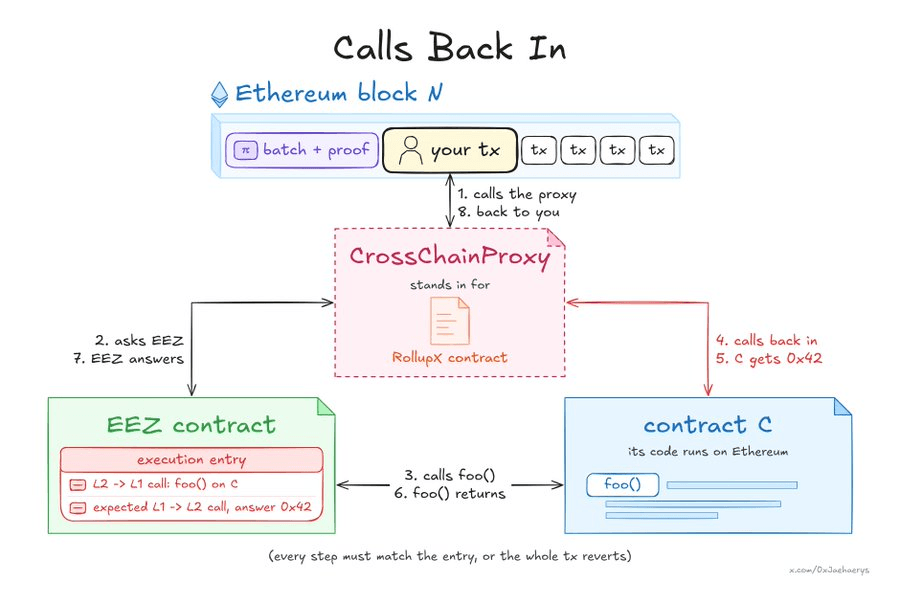
The EEZ contracts verify the batch before the user transaction reaches a proxy. A proxy returns a prepared answer only if the call matches the composer’s simulation, its entry arrived with the batch in the same Ethereum block, and the callback hash matches. Ethereum executes callbacks to its contracts directly; nested calls back to the Rollup can use answers already in the table. The Rollup’s cross-chain work runs in a sync block tied to that Ethereum block, which rolls back if the bundle misses it.
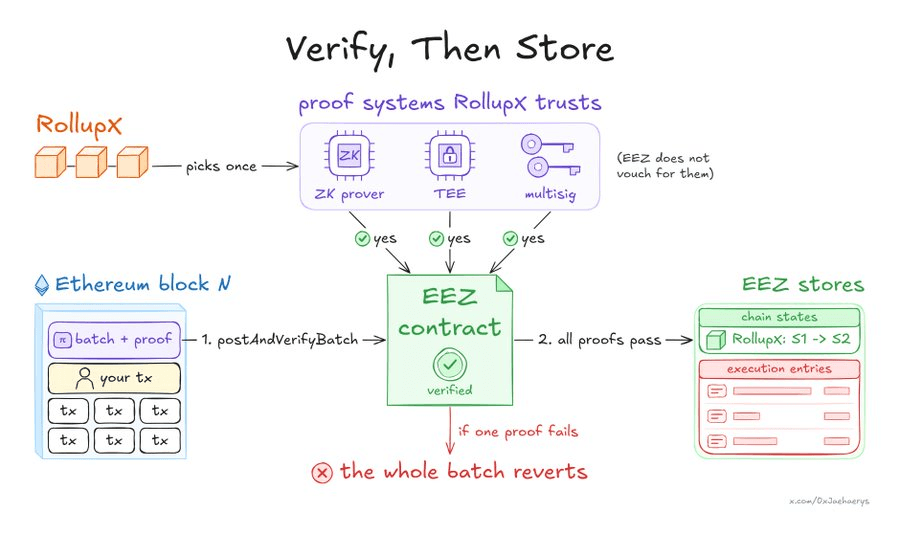
Each Rollup owner chooses which proof systems to trust—including, the article says, zero-knowledge proofs, trusted execution environments or multisignatures—and how many proofs a batch requires. EEZ does not endorse those choices. The mechanism should not be read as a guarantee that every connected chain has the same security assumptions.
For the opening borrowing-and-swap example, the article says collateral would already need to sit at the wallet’s Ethereum proxy address. The composer would prepare the calls; the Aave borrowing and Uniswap swap would execute on Ethereum, while the Rollup transaction would receive the corresponding results, credit bridged ETH and deposit it as collateral. The user would cover the Ethereum gas through a higher tip to the composer. The article says the composer would not submit a bundle if its simulation found a failing step, and a mismatch during execution would revert the operations on both chains.
Examples and constraints reported by the author
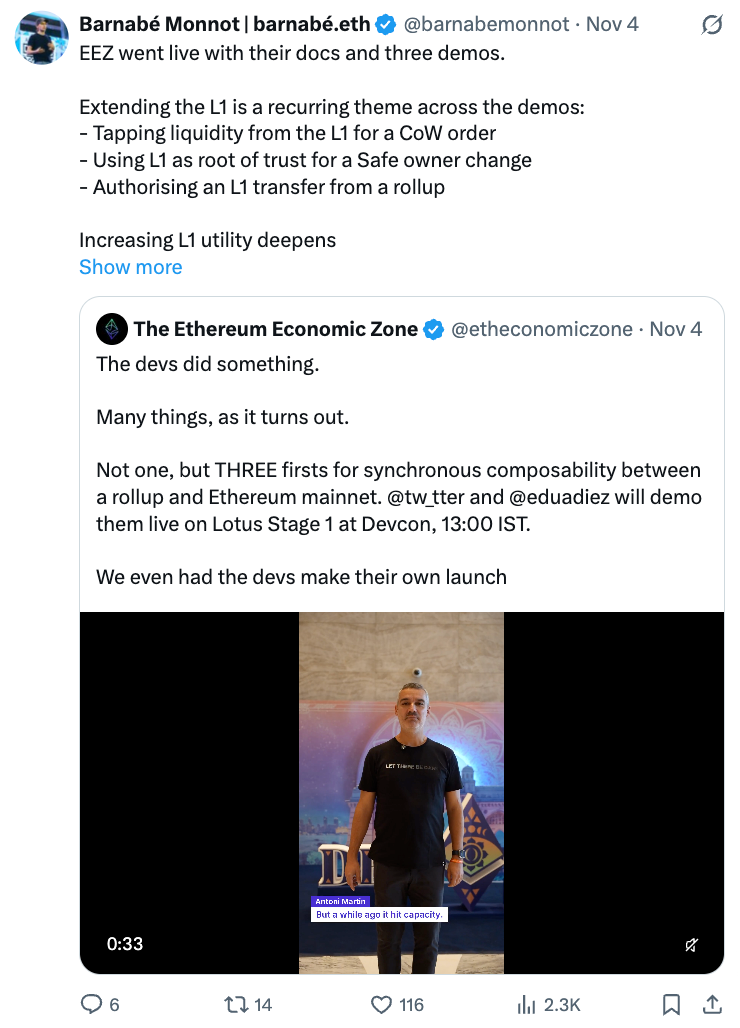
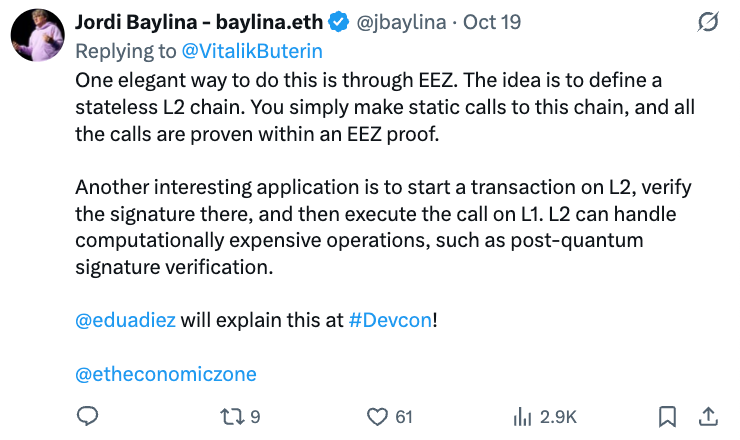
The article reports a RollupX transaction that bought CRV from an Ethereum Uniswap pool and minted wrapped CRV on the Rollup in the same swap, although CRV had not previously existed there. It also describes a RollupX Safe that reads its owner list from a Safe on Ethereum for each transaction, a Bermuda Bay privacy-pool swap using Ethereum’s Uniswap V3, and a demonstration in which a Falcon signature was verified on a Rollup to authorize an Ethereum Safe payment. The author puts the cost of verifying that signature directly on Ethereum at 5.5 million gas. These are reported examples, not evidence that the design has been broadly adopted.
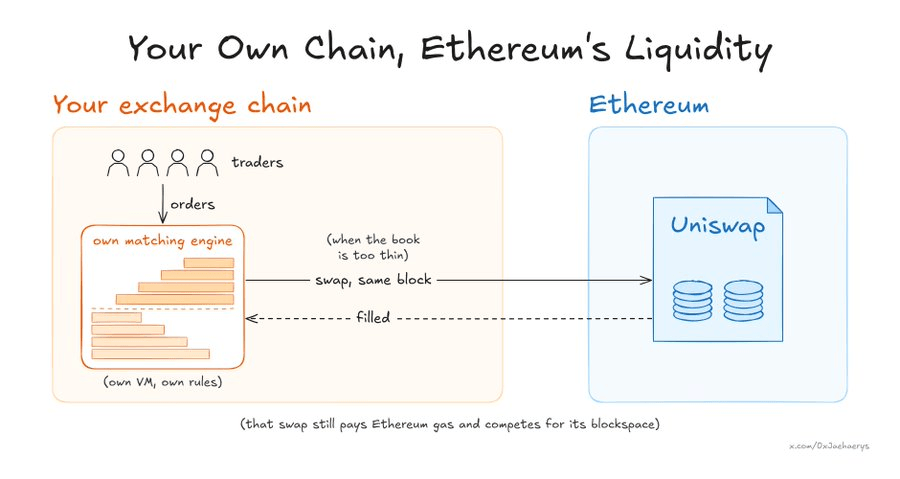
There are trade-offs. The article says a chain cannot simultaneously offer fast blocks, synchronous Ethereum calls and decentralized sequencing; it must choose two. In its example, a chain with 200-millisecond blocks and a centralized sequencer has only one sync block per 60 blocks, so an application can reach Ethereum every 12 seconds. Cross-chain calls also pass through a composer that must see the unencrypted transaction before block production, giving the composer and builder an early view of potential MEV—value obtainable from transaction ordering.
The author further reports that validators built 7% of Ethereum blocks themselves at the time, without an external builder, and says synchronous calls would not occur in those slots. For EEZ’s first month, the article says every batch landed in an external MEV-Boost builder’s block; 56% landed in Titan-built blocks, compared with Titan’s usual 48% share. Those figures describe the period reported in the original article, not current network conditions.
Source: panewslab.com (originally published 2026-11-14 18:30 UTC+8)