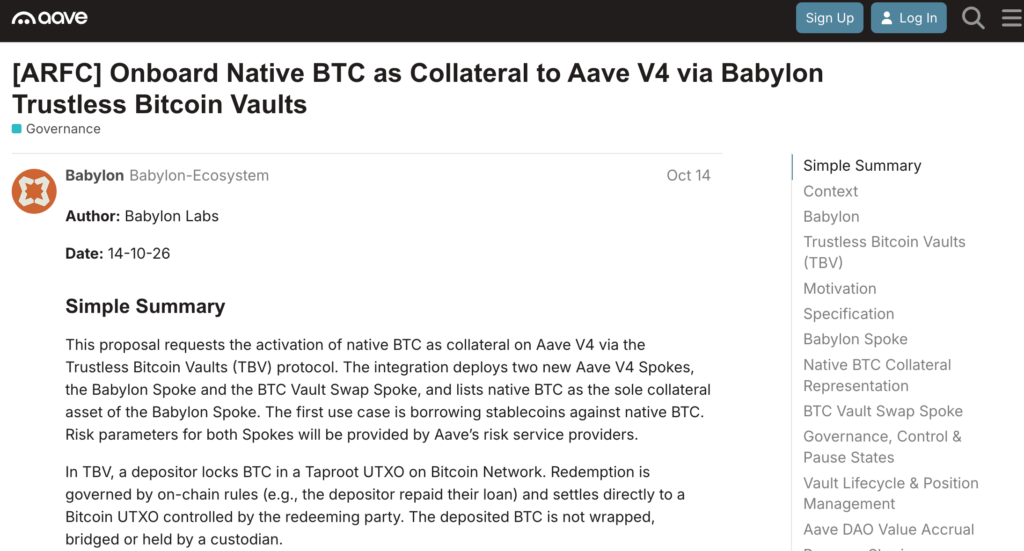
For builders, the proposed Aave–Babylon integration raises a practical question: how can BTC remain on Bitcoin while a lending market on Ethereum recognizes it as collateral? As reported by 深潮 TechFlow on November 10, 2026, Aave DAO had approved an ARFC-stage proposal for that design with 100% of votes in favor. The proposal still needed to advance to an AIP—the final on-chain execution vote. It was not a live lending market.
How the proposed collateral would work
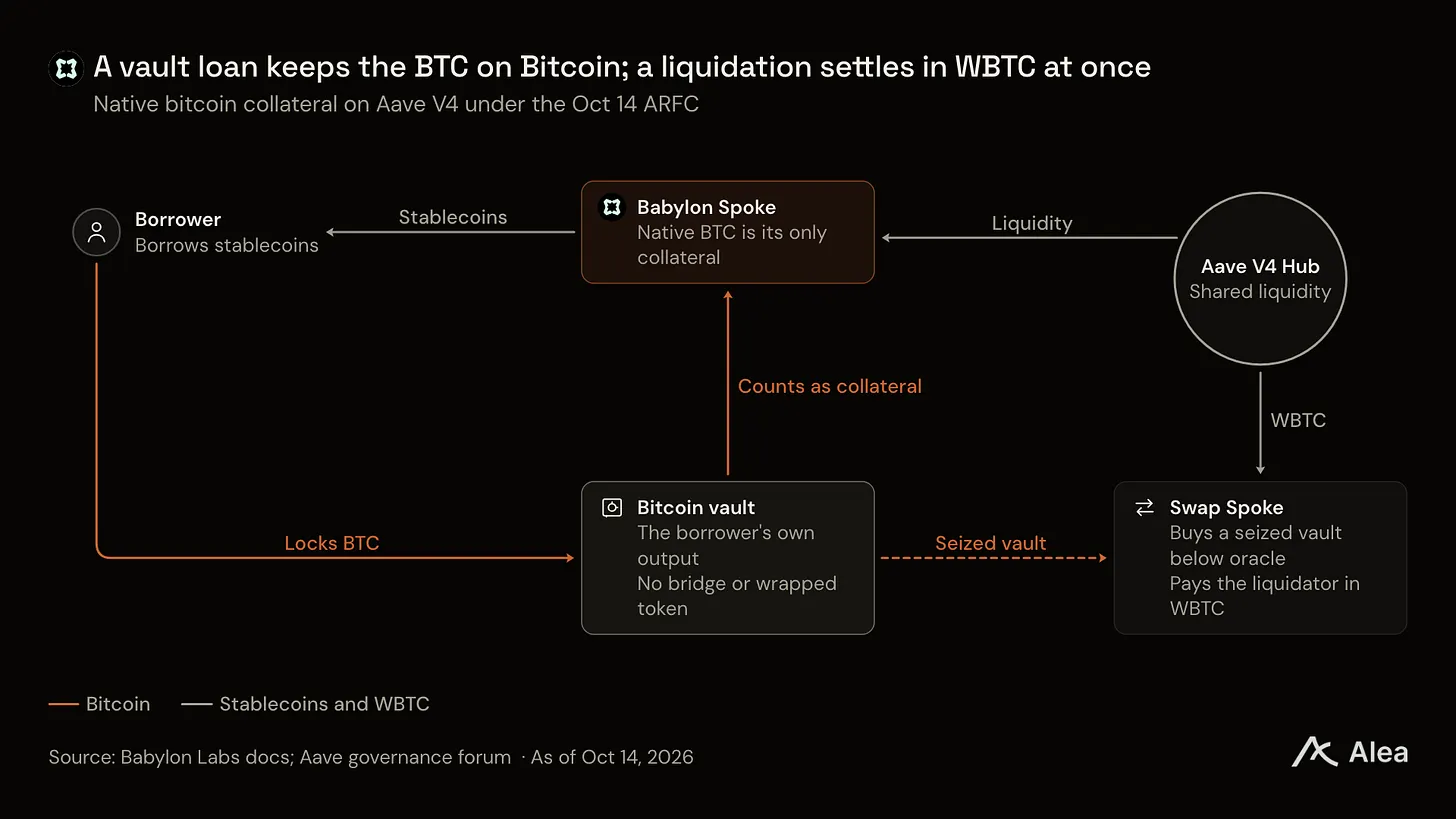
Under the proposal, a borrower would lock native BTC in a Taproot vault on Bitcoin while retaining control of their private keys. A non-transferable accounting token on Ethereum, matching the amount of locked BTC, would represent the collateral in Aave V4. The intended result is borrowing assets such as USDT or USDC without first wrapping the BTC or transferring it to a third-party custodian.
LlamaRisk proposed a 78% collateral factor and a maximum 5.55% liquidation bonus for native BTC. As cited by 深潮 TechFlow, PANews reported that the collateral factor and borrowing rates were comparable to those for WBTC and cbBTC in Aave V4’s core market. Those wrapped assets rely on custodians for their underlying BTC, according to the article’s citation of Cointelegraph.
The proposal was first submitted in May and passed a June community temperature check with 299,743 AAVE voting in favor and none against. Aave founder Stani Kulechov expressed support in the governance forum when the formal proposal appeared on October 14. The stated mainnet target was the end of 2026, with participation and scale initially limited and expanded in stages.
Limits, fees and liquidation
The proposed initial credit lines total about $21 million: $8 million each for USDT and USDC, $2 million each for USDG and RLUSD, and $1 million for GHO. Native-BTC collateral would initially be capped at 300 BTC. Any later increase in the credit lines would require Aave DAO approval.
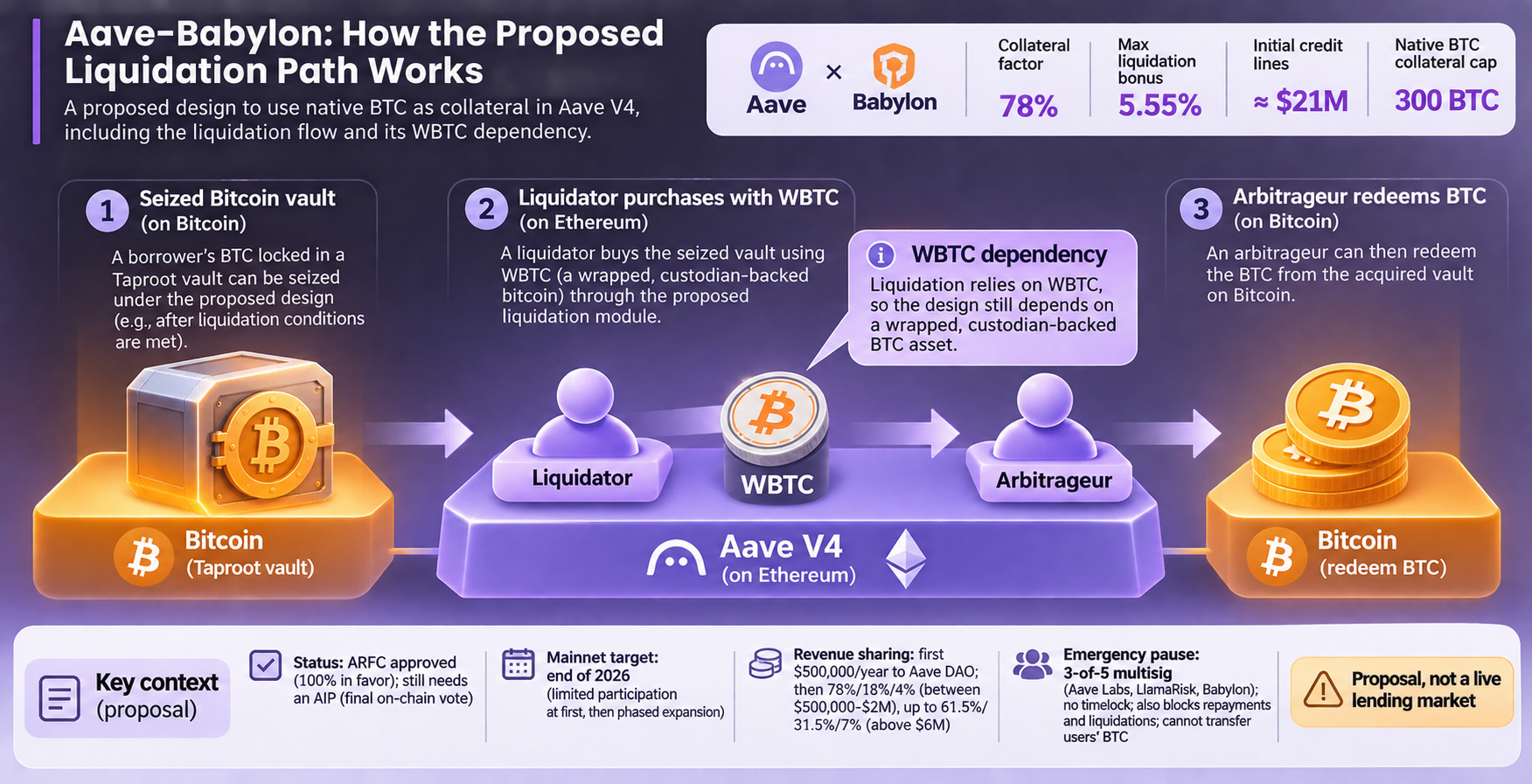
The revenue-sharing plan applies to Aave’s liquidity fees from borrowing on this route and fees generated during liquidation. Aave DAO would receive the first $500,000 annually. For revenue between $500,000 and $2 million, the proposed split is 78% to Aave DAO, 18% to Babylon and 4% to token buybacks. The shares change at higher tiers; above $6 million, the proposed split is 61.5%, 31.5% and 7%, respectively. Buybacks would purchase 85% AAVE and 15% BABY, with the purchased tokens divided equally between Aave DAO and the Babylon Foundation. Alea Research estimated that $10 million in annual revenue, if reached, would yield about $6.92 million for Aave DAO, $2.52 million for Babylon and $560,000 for buybacks. That is a scenario, not reported revenue.
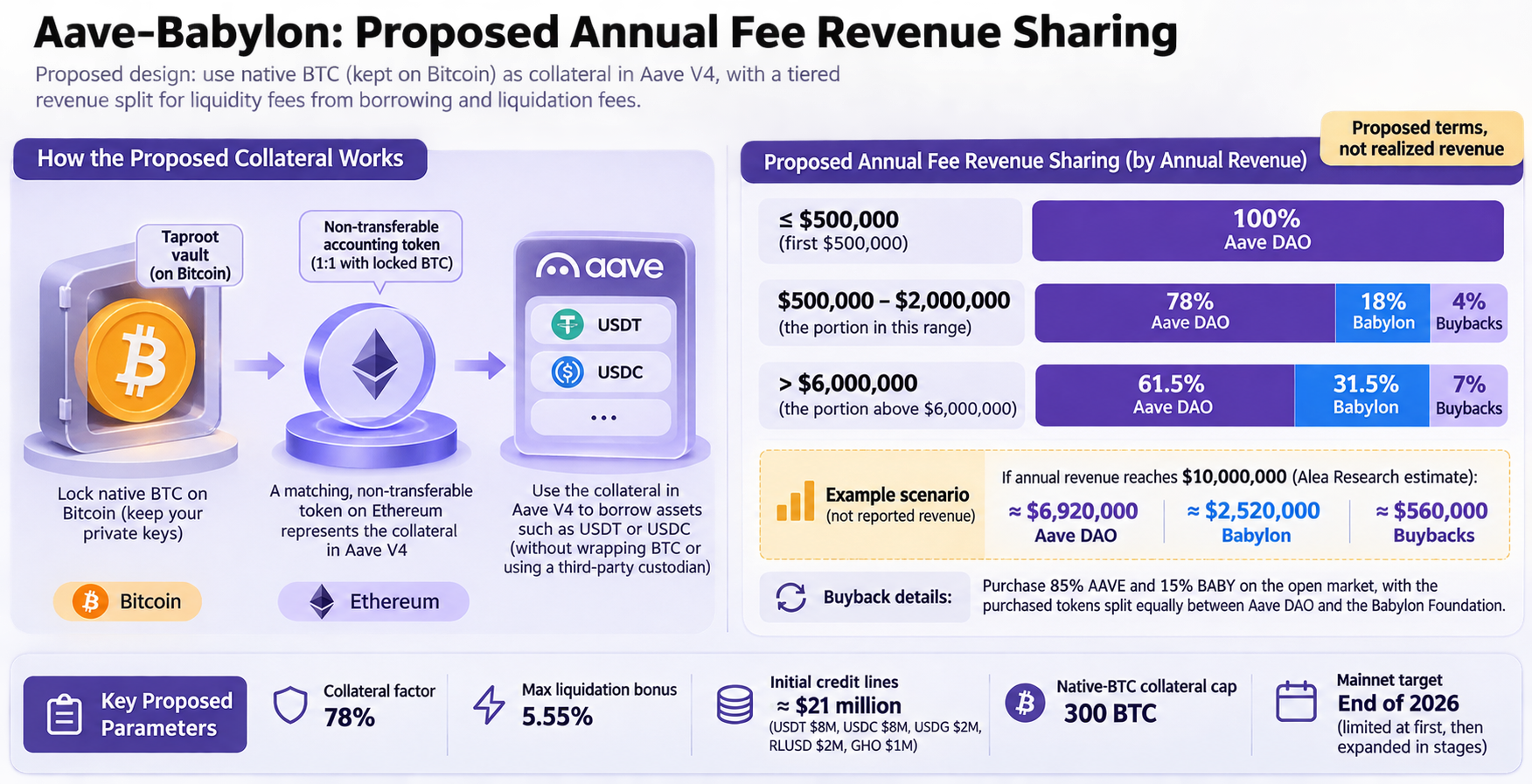
Keeping collateral on Bitcoin does not remove every dependency on wrapped BTC. The proposed liquidation module would let a liquidator buy a seized vault using WBTC, after which an arbitrageur could redeem its BTC on Bitcoin. The proposal also assigns emergency pause authority to a 3-of-5 multisignature group involving Aave Labs, LlamaRisk and Babylon. Pausing or resuming would have no timelock; a pause would also block repayments and liquidations. The group would not have authority to transfer users’ BTC.
Source: techflowpost.com (originally published 2026-11-10 20:53 UTC+8)