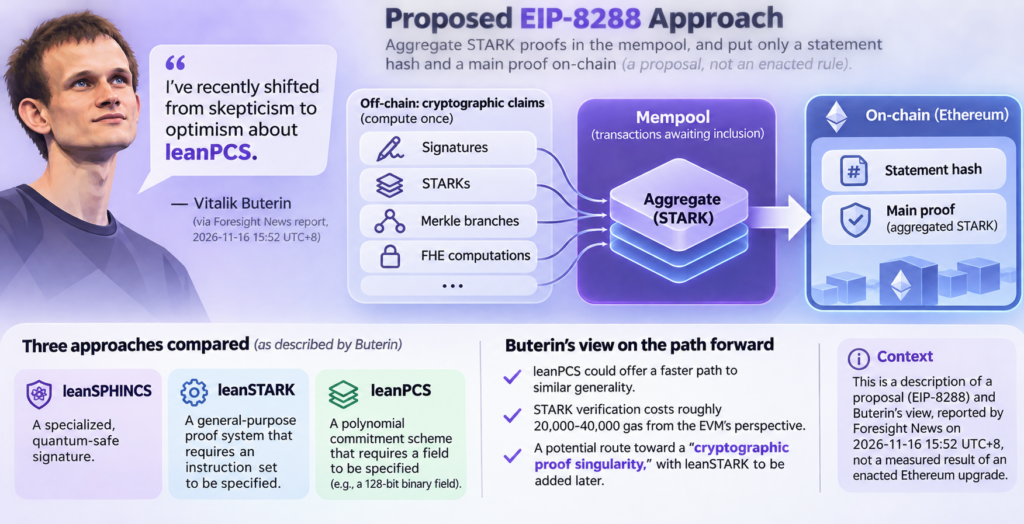
For builders, the question is how a contract could verify cryptographic claims without putting every signature or proof on-chain. In a Foresight News report published November 16, 2026, at 15:52 UTC+8, Vitalik Buterin said he had recently shifted from skepticism to optimism about leanPCS and explained how it relates to the proposed EIP-8288.
As Buterin described it, EIP-8288 would aggregate STARK proofs in the mempool—the pool of transactions awaiting inclusion. For material such as signatures, STARKs, Merkle branches and fully homomorphic encryption (FHE) computations that needs to be computed only once, the aim is to put a statement hash and a main proof on-chain rather than every full signature or proof. This is a description of a proposal, not an enacted Ethereum rule.
Buterin contrasted three approaches: leanSPHINCS, a specialized quantum-safe signature; leanSTARK, a general-purpose proof system that requires an instruction set to be specified; and leanPCS, a polynomial commitment scheme that requires a field to be specified, such as a 128-bit binary field. He argued that leanPCS could offer a faster path to similar generality, with STARK verification costing roughly 20,000–40,000 gas from the EVM’s perspective. He presented that as a potential route toward what he called a “cryptographic proof singularity,” with leanSTARK to be added later—not as a measured result of an enacted upgrade.
Source: foresightnews.pro (originally published 2026-11-16 15:52 UTC+8)