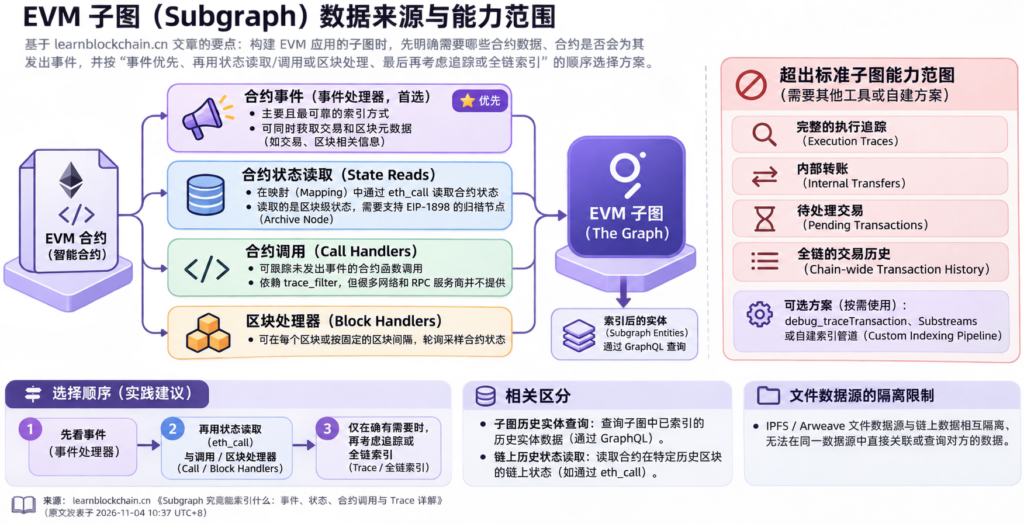
If you’re building a subgraph for an EVM application, start by asking which contract data you need and whether the contract emits events for it. An article published on November 4, 2026, at 10:37 UTC+8 identifies event handlers as the primary, most reliable indexing method; they can also access transaction and block metadata.
When events are insufficient, the article describes three other approaches:
- State reads: A mapping can use
eth_callto read contract state. The result reflects state at the block level and requires an archive node that supports EIP-1898. - Call handlers: These can track calls to contract functions that emit no event, but depend on
trace_filter, which many networks and RPC providers do not offer. - Block handlers: These can sample state at every block or at fixed block intervals.
A standard subgraph does not provide complete execution traces, internal transfers, pending transactions or a chain-wide transaction history. The article points to debug_traceTransaction, Substreams or a custom indexing pipeline for requirements beyond standard subgraph capabilities. It also distinguishes querying historical subgraph entities from reading historical on-chain state, and notes isolation limits for IPFS and Arweave file data sources.
The practical selection order is to check events first, then consider state reads and call or block handlers, and turn to tracing or chain-wide indexing only if the requirement calls for them.
Source: learnblockchain.cn (originally published 2026-11-04 10:37 UTC+8)