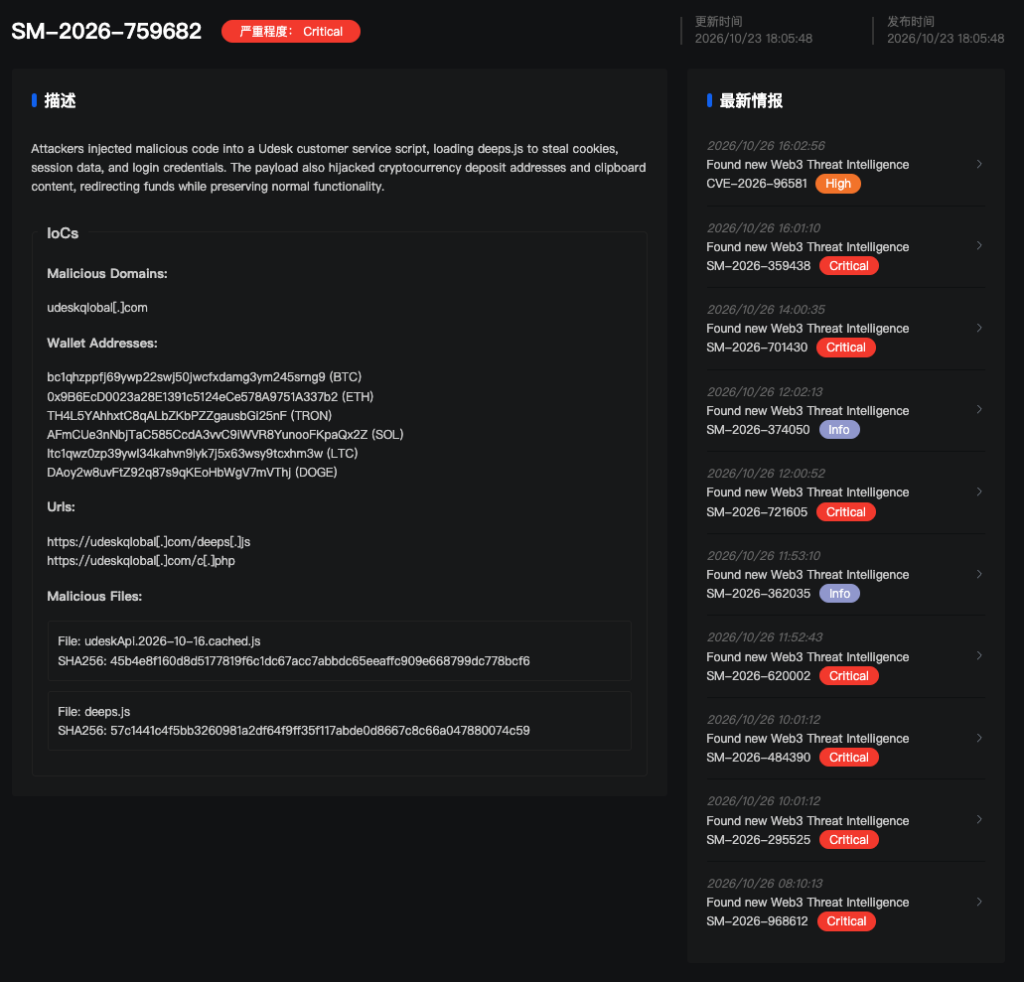
A builder embedding a customer-support script needs to know what else that script loads into the page. In an analysis published on October 27, 2026, SlowMist reported finding a malicious loader in a Udesk-related JavaScript sample. Its analysis of that file and a second-stage payload describes two distinct risks: collection of data accessible to the page, and replacement of deposit addresses on configured sites. The report does not establish how many sites or users were affected.
From support script to remote payload
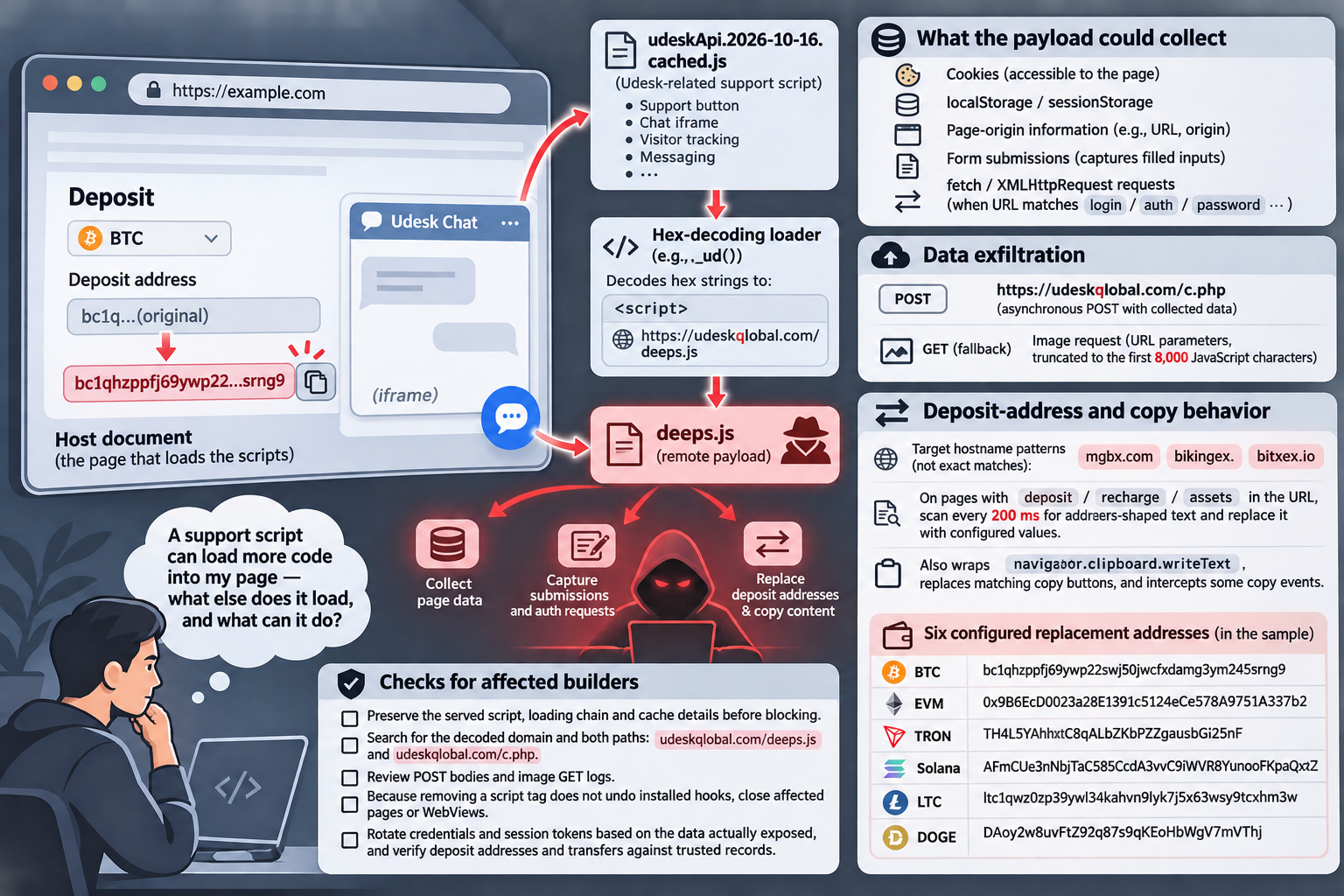
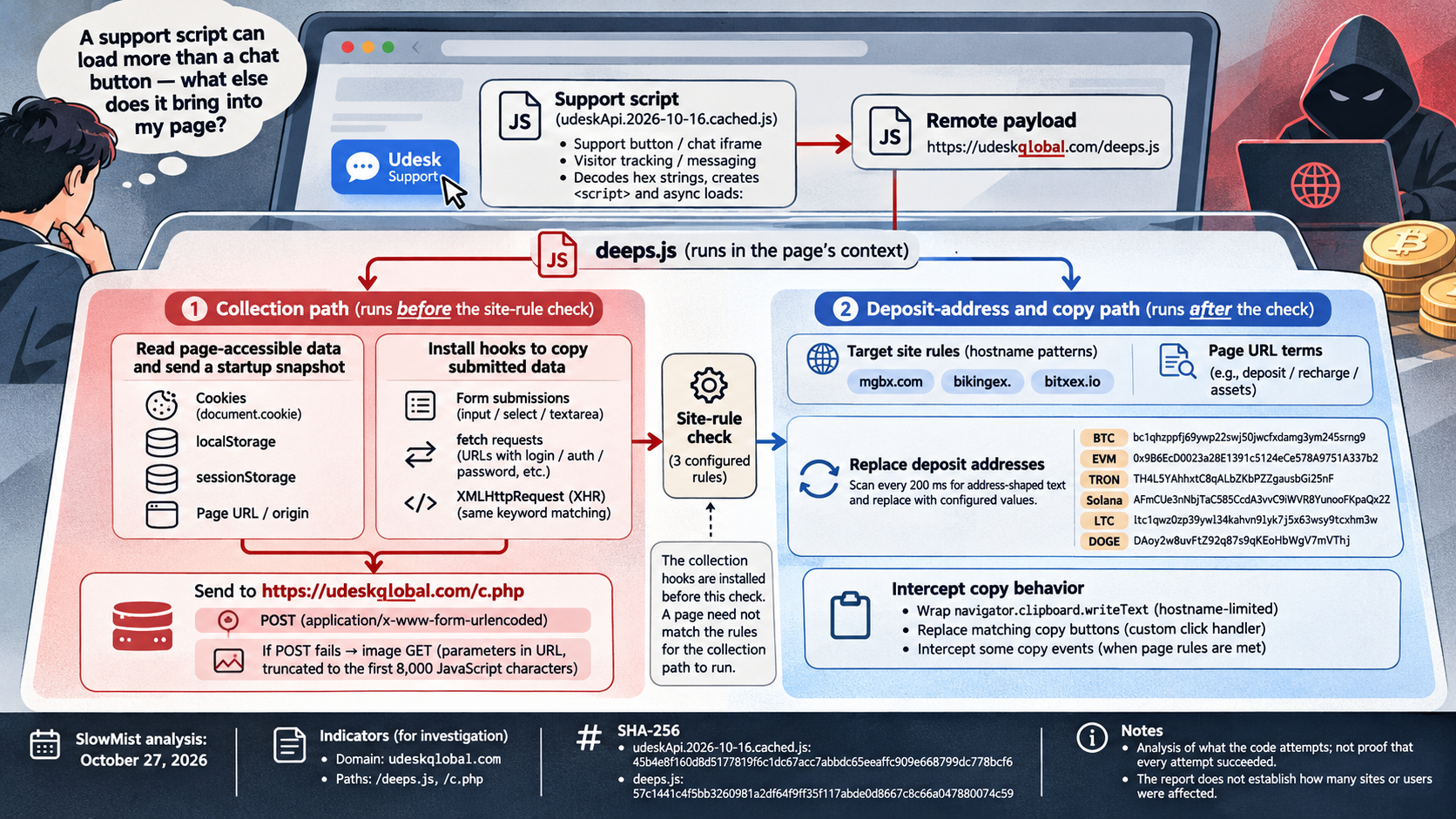
SlowMist examined udeskApi.2026-10-16.cached.js, which contained support-button, chat iframe, visitor-tracking and messaging code. After that code, a separate function decoded hexadecimal strings to create a script element and asynchronously load https://udeskqlobal.com/deeps.js. The domain spells “qlobal” with a q. Searching only for a plain-text URL in the loader could miss it.
The loaded file, deeps.js, runs in the context of the document that loads it, subject to browser and network controls. A chat iframe does not by itself isolate a script loaded into the host page.
What the payload could collect
According to SlowMist’s code analysis, the payload first reads the document’s accessible cookies, localStorage and sessionStorage, along with page-origin information, and sends a startup snapshot to https://udeskqlobal.com/c.php. It also installs hooks for form submissions and for fetch and XMLHttpRequest requests whose URLs match terms such as login, auth or password. Those hooks can copy submitted data while allowing the original submission or request to proceed.
This behavior appears before a check for three configured site rules. A page need not match those rules for the collection hooks to be installed. The exposure still depends on what the affected document can access and what users submit: document.cookie cannot read HttpOnly cookies, and the report does not claim every intercepted request yields complete form fields. If reusable credentials or session tokens were exposed, they could potentially be used to impersonate a user.
SlowMist found that the sending function attempts an asynchronous POST. If that fails, it tries an image GET request carrying parameters in the URL, truncated to the first 8,000 JavaScript characters. An investigation therefore needs to check both POST bodies and image-request parameters; a browser error about reading a cross-origin response does not, on its own, prove the request was never sent.
Deposit-address and copy behavior
After the site-rule check, the payload’s address module targets hostname patterns for mgbx.com, bikingex. and bitxex.io. These are not exact-hostname matches. On matching pages, it also checks the full page URL for terms including deposit, recharge and assets, then scans every 200 milliseconds for address-shaped text to replace with configured values. The code labels six values BTC, EVM, TRON, Solana, LTC and DOGE; its recognition relies on character patterns rather than verifying a selected network or address checksum.
The sample also wraps navigator.clipboard.writeText, replaces matching copy buttons and intercepts some copy events. Their conditions differ: the clipboard API wrapper is limited by the hostname configuration but does not repeat the deposit-page check. SlowMist noted implementation quirks that can affect individual paths, including a failing textContent prototype hook; that failure does not stop the already registered polling and other copy hooks. The analysis establishes what the code attempts, not that every attempted replacement or transfer succeeded.
Checks for affected builders
Teams investigating a possible exposure can preserve the served script response, loading chain and cache details before blocking the affected resource; search for the decoded domain and both paths; and review POST and image GET logs. Because removing a script tag does not undo hooks already installed in a running document, affected pages or WebViews should be closed. Credential and session remediation should follow the data actually exposed, while deposit addresses and transfers should be checked against independent, trusted records. Script-source controls and data-egress policies should be reviewed separately.
Indicators reported by SlowMist (listed for investigation, not as proof of compromise):
- Domain:
udeskqlobal.com; paths:/deeps.jsand/c.php udeskApi.2026-10-16.cached.jsSHA-256:45b4e8f160d8d5177819f6c1dc67acc7abbdc65eeaffc909e668799dc778bcf6deeps.jsSHA-256:57c1441c4f5bb3260981a2df64f9ff35f117abde0d8667c8c66a047880074c59
SlowMist also reported six configured replacement addresses: BTC bc1qhzppfj69ywp22swj50jwcfxdamg3ym245srng9; EVM 0x9B6EcD0023a28E1391c5124eCe578A9751A337b2; TRON TH4L5YAhhxtC8qALbZKbPZZgausbGi25nF; Solana AFmCUe3nNbjTaC585CcdA3vvC9iWVR8YunooFKpaQx2Z; LTC ltc1qwz0zp39ywl34kahvn9lyk7j5x63wsy9tcxhm3w; and DOGE DAoy2w8uvFtZ92q87s9qKEoHbWgV7mVThj.