For anyone maintaining an old Zcash wallet, the key question in the November 2026 report was whether its ZEC remained in Sprout, the network’s original privacy pool. The planned NU7 upgrade would make version-4 transactions—the only format able to move coins out of Sprout—invalid at block 3,543,405.
At the report’s publication on November 6, 2026, at 03:46 UTC+8, the latest available block was 3,543,027. Activation was expected Thursday evening, November 5, in the United States, but the deadline depended on when the network reached the specified block, not on a fixed clock time.
ZecStats data updated that Thursday showed approximately 12,224 ZEC still in Sprout, worth roughly $15 million to $16 million at the market prices cited in the report. ZecStats described the effect of NU7 as leaving any remaining Sprout funds “frozen, not burned.” The blockchain does not identify the owners, so it was unknown how much belonged to people who could still access their wallets and how much was already inaccessible because keys had been lost.
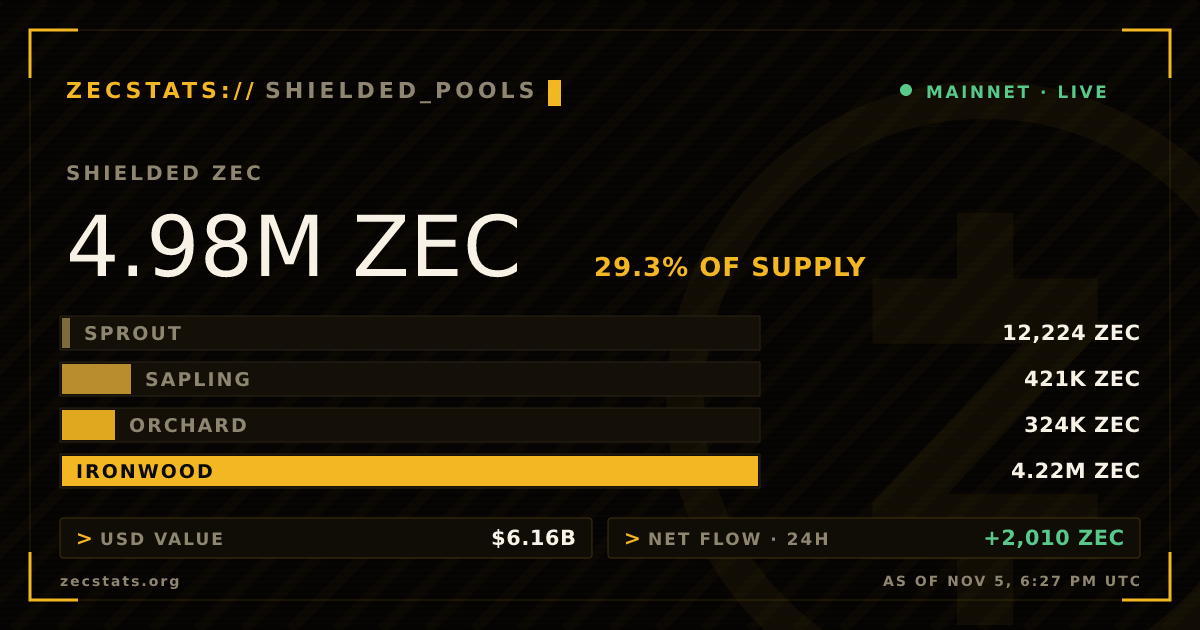
Sprout introduced Zcash’s privacy technology when the network launched in 2016. Zcash uses zero-knowledge proofs to validate transactions without disclosing details such as amounts and addresses. Later privacy systems included Sapling, Orchard and Ironwood. Sprout had been closed to new deposits for years, but holders could still withdraw before the planned rule change.
Under the reported NU7 rules, a holder with ZEC still in Sprout needed to use a compatible withdrawal mechanism before block 3,543,405 to avoid losing access indefinitely. Sprout addresses begin with zc, which may help identify old wallet records. The coins would still count toward Zcash’s circulating issuance; a future upgrade could theoretically restore access, but the technical specification warned that spending might never be re-enabled. Holders using modern supported wallets did not need to move coins out of Sprout.
NU7 was also set to reduce Zcash’s target block interval from 75 seconds to 25 seconds. According to the Zcash Foundation, that meant transactions should receive their first confirmation approximately three times faster.