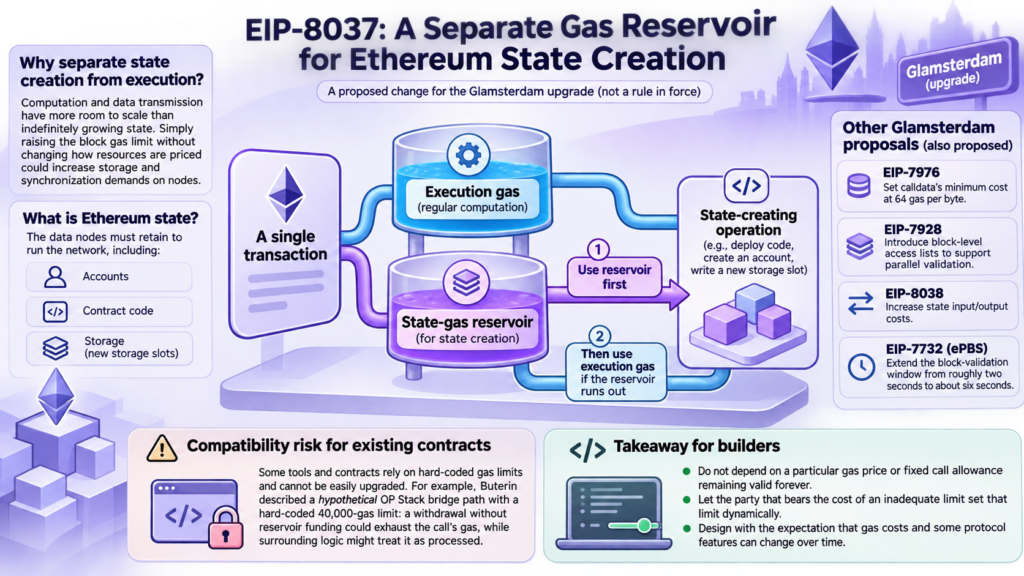
When building a contract that creates accounts, writes new storage slots or deploys code, it is tempting to treat today’s gas costs as fixed. In an article published on November 16, 2026, Vitalik Buterin argued that EIP-8037 would challenge that assumption: the proposal would raise the cost of creating Ethereum state while giving transactions a separate way to fund that cost. It was a proposal discussed in connection with the Glamsterdam upgrade, not a rule already in force.
Why separate state creation from execution?
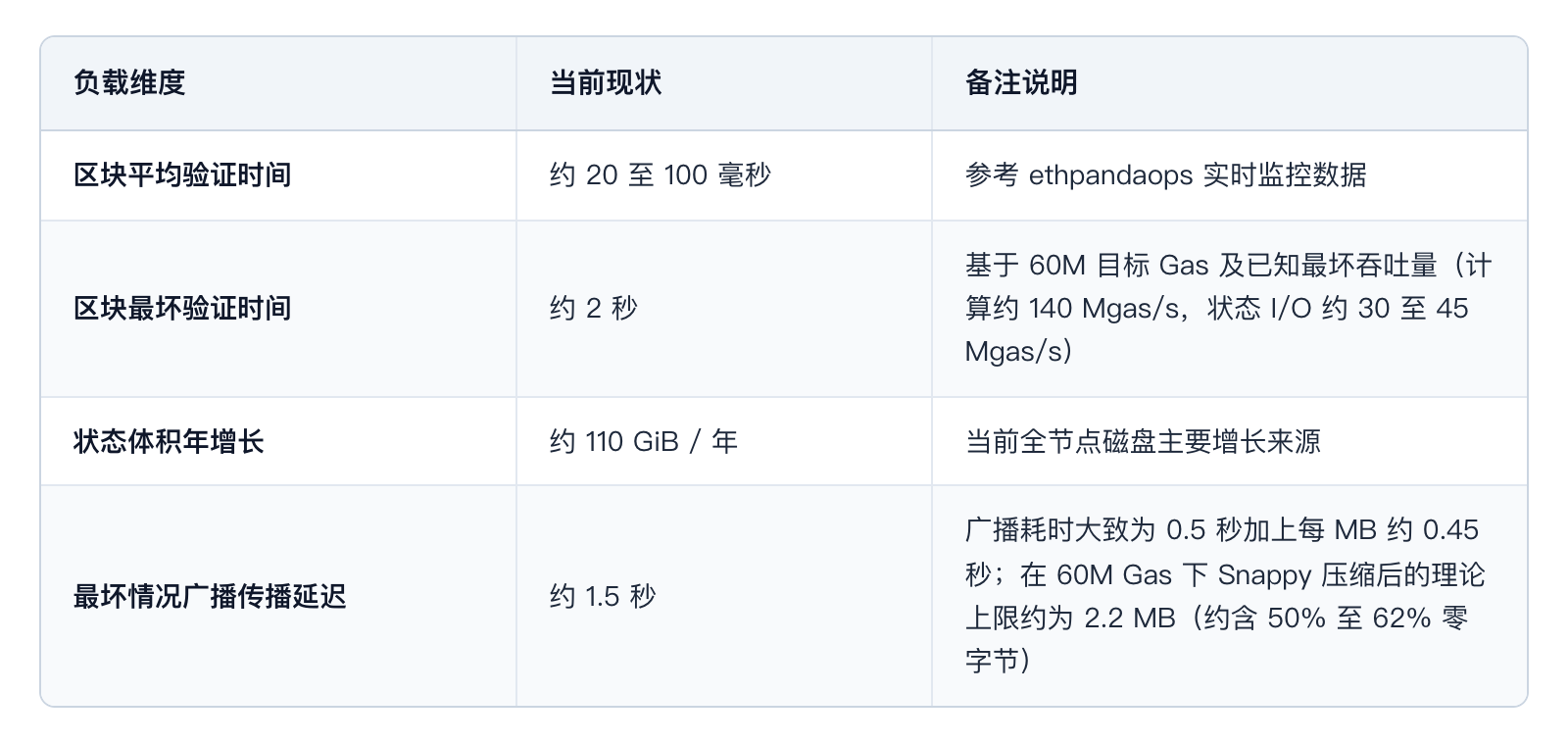
Ethereum’s state is the data nodes must retain to run the network, including accounts, contract code and storage. Buterin’s argument is that computation and data transmission have more room to scale than indefinitely growing state. Raising the block gas limit without changing how resources are priced could therefore increase storage and synchronization demands on nodes.
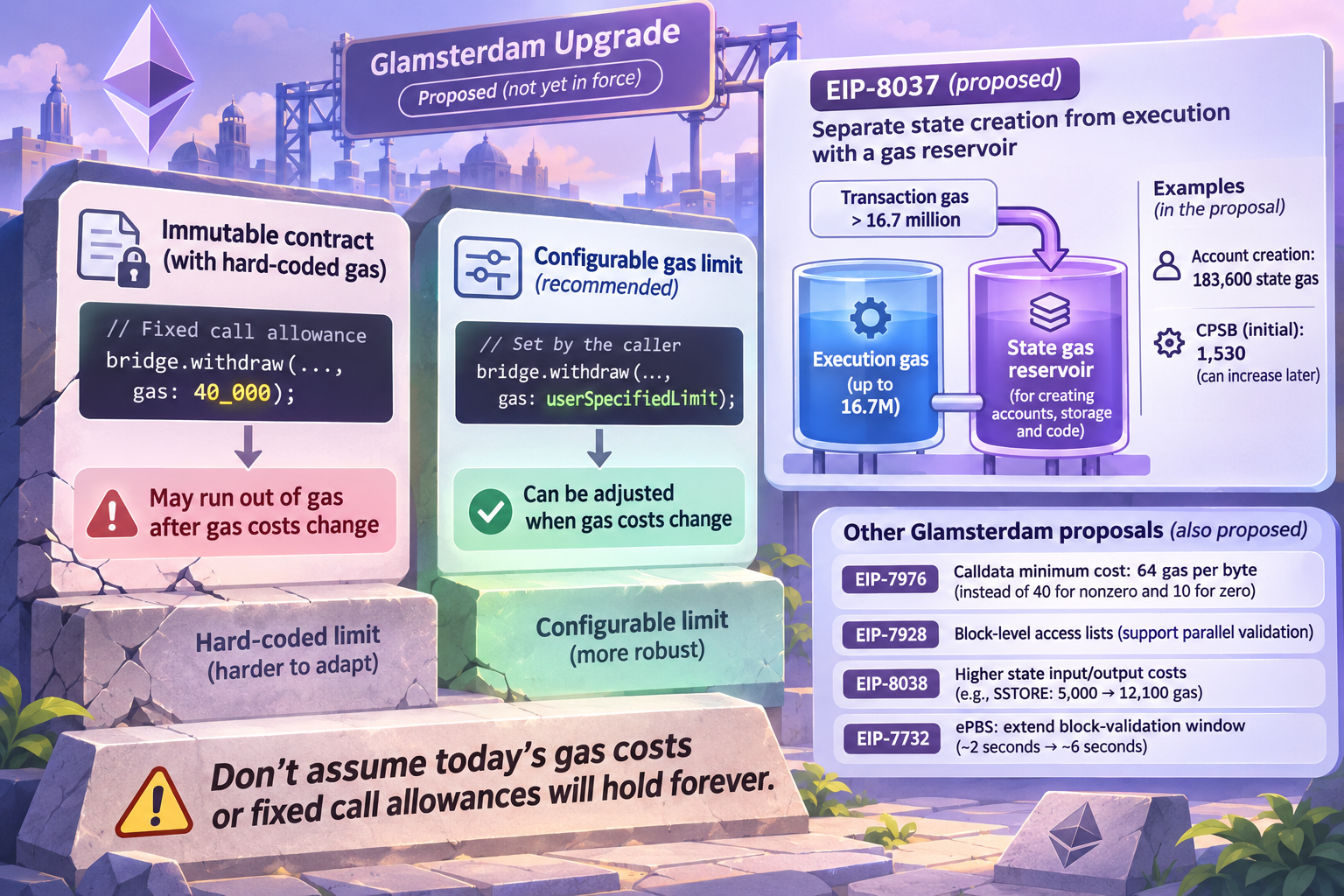
He placed EIP-8037 alongside other Glamsterdam proposals addressing different constraints. EIP-7976 would set calldata’s minimum cost at 64 gas per byte, rather than the cited costs of 40 for a nonzero byte and 10 for a zero byte. EIP-7928 would introduce block-level access lists to support parallel validation; EIP-8038 would increase state input/output costs; and EIP-7732, or ePBS, would extend the block-validation window from roughly two seconds to about six seconds, according to the article. These are proposed changes, and Buterin’s assessment of how much scaling they could enable is a projection, not an observed result.
What the proposed gas reservoir would do
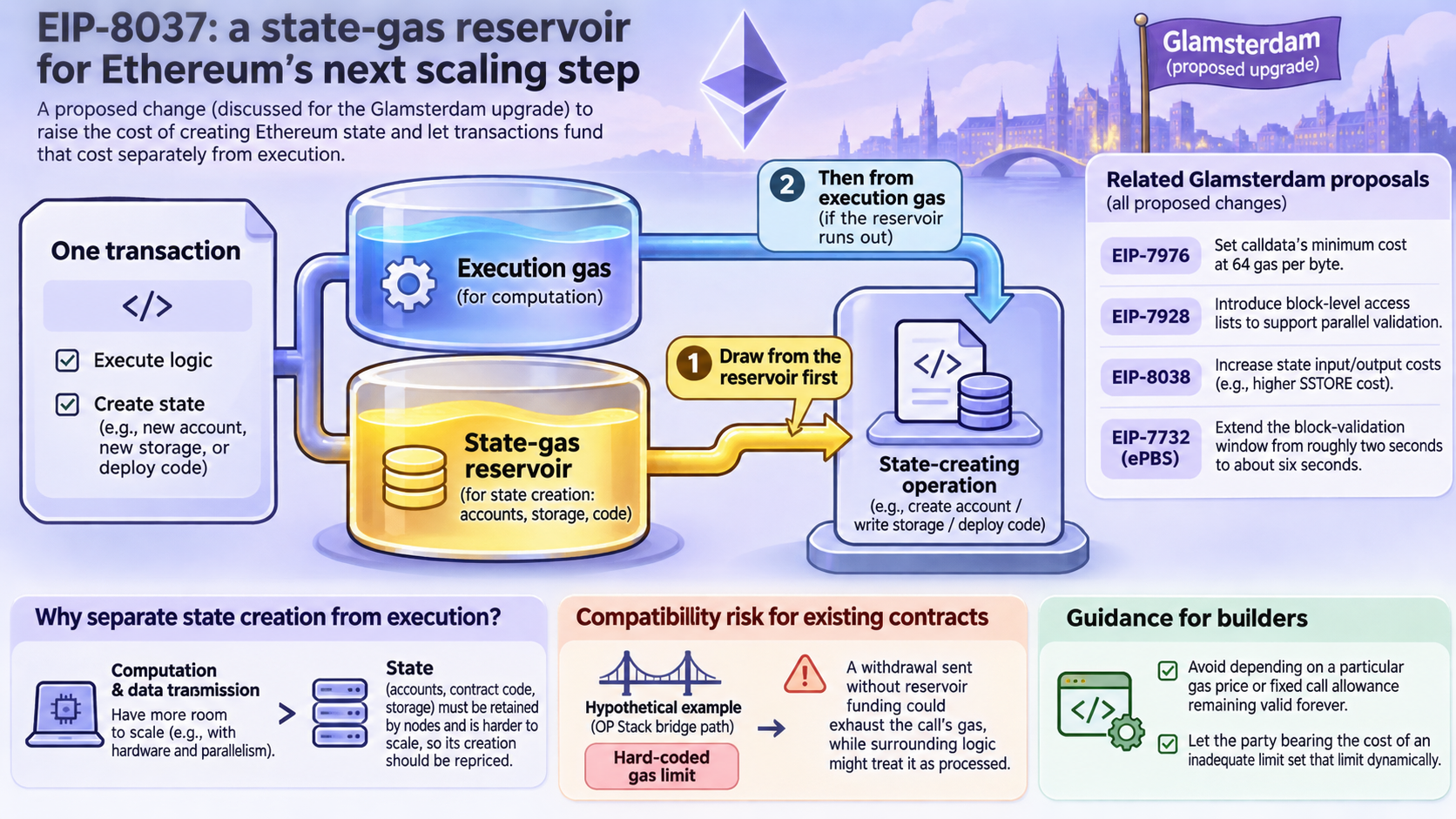
EIP-8037 would substantially reprice new storage slots, contract code and accounts. Buterin gave one proposed account-creation charge as 183,600 state gas, regardless of the route used to create the account. He also described a starting value of 1,530 for the parameter CPSB, which could rise as the gas limit rises.
The proposal’s reservoir would hold gas for state creation separately from ordinary execution gas. A state-creating operation would draw from the reservoir first, then from execution gas if the reservoir ran out. Under the arrangement Buterin described, gas above a transaction’s 16.7 million execution-gas limit would fund the reservoir; a future EIP-8141 transaction format could make the two limits explicit. That separation is intended to let a transaction pay to deploy a large contract without requiring its execution to exceed the execution-gas limit. A child call could also access the reservoir even when its parent limited the execution gas passed to it.
The compatibility risk for existing contracts
The reservoir would not fix every hard-coded gas assumption. Buterin identified transaction-building tools that cannot be readily upgraded, as well as contracts that expect a call to fit within a fixed allowance. He described a hypothetical risk involving an OP Stack bridge path with a hard-coded 40,000-gas limit: a withdrawal sent without reservoir funding could exhaust the call’s gas, while surrounding logic might treat it as processed. The article did not establish that such a withdrawal had occurred.
Other concerns he raised include an immediate-refund design that could make the GAS opcode report an unexpectedly increased amount of gas remaining, difficulty accounting for reservoir use in ERC-4337 workflows, and EIP-8038’s proposed increase of SSTORE from 5,000 to 12,100 gas without reservoir protection. He discussed possible protocol-level remedies but warned that late changes could introduce further risks. According to the article, the Glamsterdam launch window had already been delayed, while work to identify and help affected applications was underway.
For builders—especially those deploying immutable contracts that cannot be upgraded—the practical lesson is to avoid depending on a particular gas price or fixed call allowance remaining valid forever. Buterin recommended that the party bearing the cost of an inadequate limit be able to set that limit dynamically. His broader list of features that might change, from transaction formats to consensus rules, was explicitly a preliminary personal assessment, not a schedule of enacted upgrades. He distinguished those possibilities from EVM bytecode behavior, which he expected to remain compatible even if opcode gas charges change.