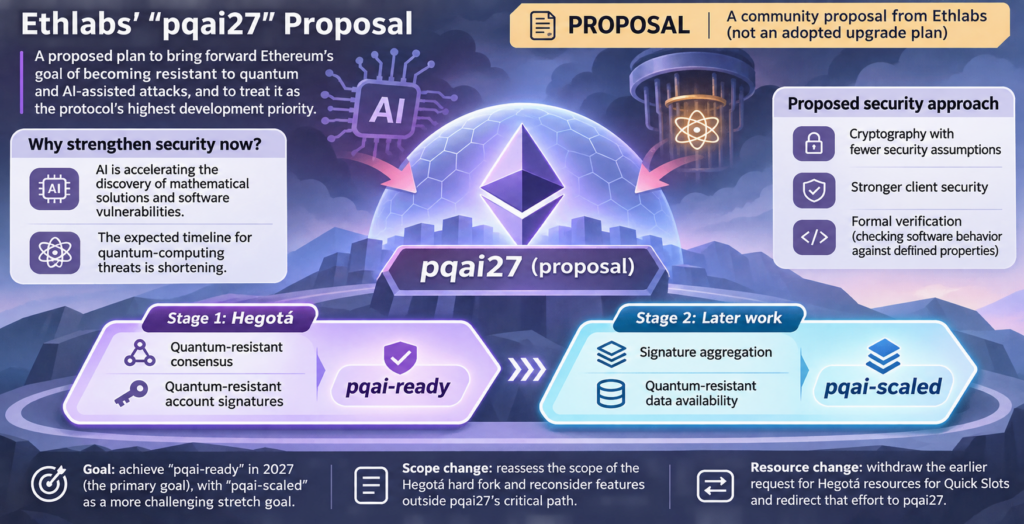
For Ethereum builders, the proposed change would affect both how the network reaches consensus and how accounts sign transactions. As reported on November 12, 2026, Ethlabs posted a proposal on the Ethereum community forum to bring forward a goal of making Ethereum resistant to quantum and AI-assisted attacks by 2027. It calls the effort “pqai27” and wants it treated as the protocol’s highest development priority. This is a proposal, not an adopted upgrade plan.
Ethlabs argued that AI is accelerating the discovery of mathematical solutions and software vulnerabilities, while the expected timeline for quantum-computing threats is shortening. It proposed cryptography with fewer security assumptions, stronger client security and formal verification—methods for checking software behavior against defined properties.
The team suggested reassessing the scope of the planned Hegotá hard fork, reconsidering features outside pqai27’s critical path. It also said it was withdrawing its earlier request for Hegotá resources for Quick Slots and redirecting that effort to pqai27.
Under the preliminary roadmap, Hegotá would introduce quantum-resistant consensus and account signatures, enabling what Ethlabs calls “pqai-ready” operation. Later work on signature aggregation and quantum-resistant data availability would aim for full-capacity “pqai-scaled” operation. Ethlabs described readiness in 2027 as the primary goal and full-capacity operation as a more challenging stretch goal.