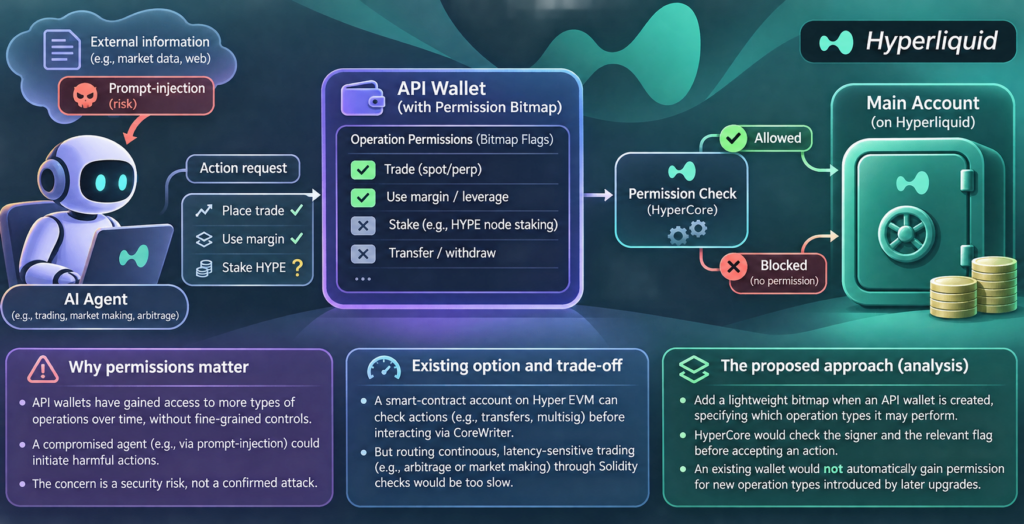
An AI agent that trades through a Hyperliquid API wallet needs permission to act—but a builder also needs a way to limit what that wallet can do. In an analysis published on November 17, 2026, Deven Matthews argued that API wallets had gained access to more types of operations as Hyperliquid evolved, without corresponding fine-grained controls. The concern is a security risk, not a report that an agent has carried out the attack described.
Where the permission boundary matters
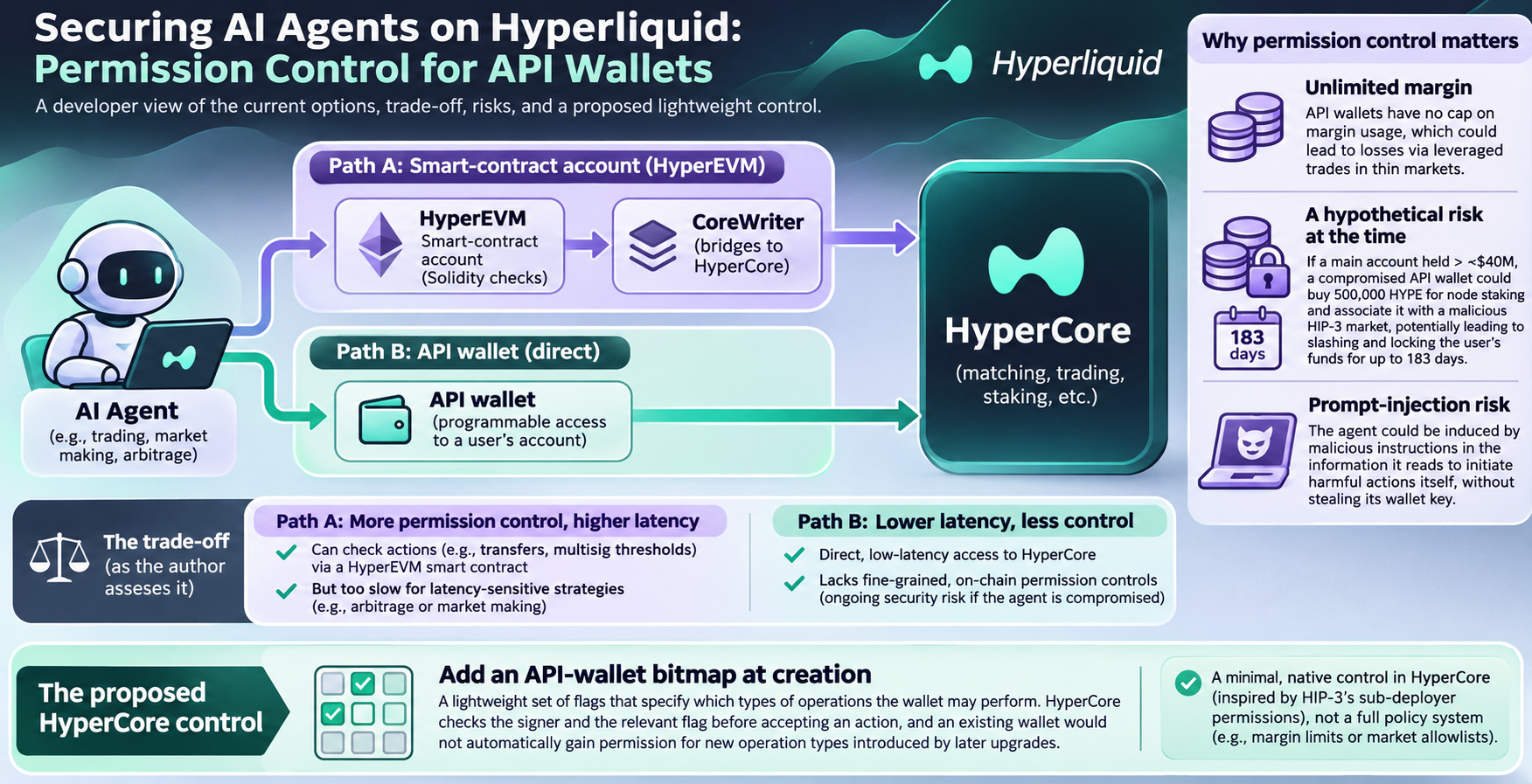
An API wallet lets software act on a user’s Hyperliquid account. Matthews wrote that these wallets were originally restricted from withdrawing directly from the main account or transferring to external addresses. They still had no cap on how much margin they could use, he said, leaving a potential route for losses through leveraged trades in thin markets.
His analysis described a further hypothetical risk under the network conditions at the time: if a main account held more than approximately $40 million, a compromised API wallet could buy 500,000 HYPE for node staking. An attacker could then associate the stake with a malicious HIP-3 market, potentially exposing it to slashing and locking the user’s main-account funds for up to 183 days. These are the author’s claimed possible outcomes, not confirmed events.
For an agent, compromise need not mean that someone steals its wallet key. Matthews also warned that malicious instructions placed in information the agent reads—a prompt-injection attack—could cause it to initiate harmful actions itself.
Why a contract-based check may not be enough
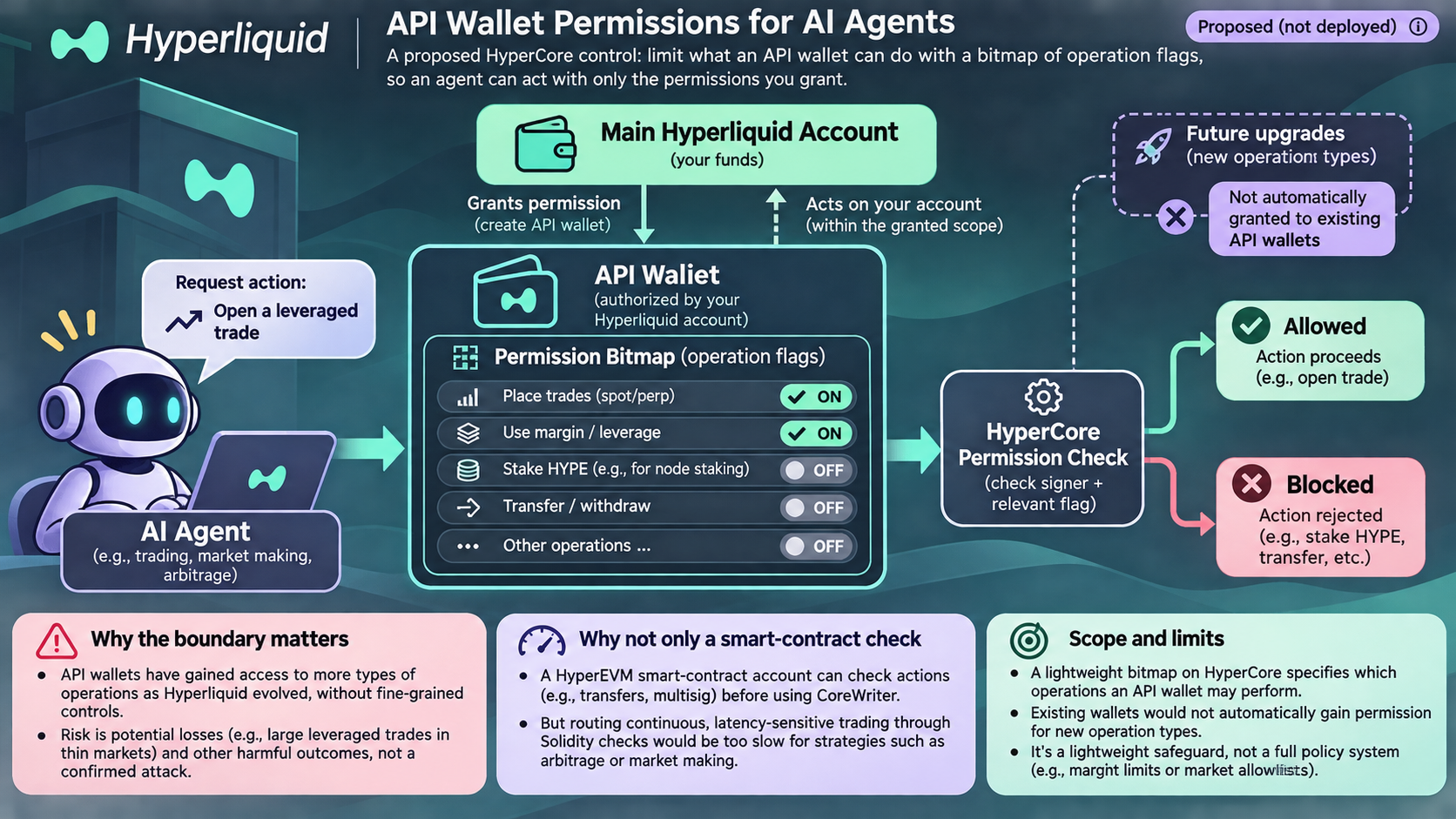
Matthews identified a smart-contract account on HyperEVM as an existing way to check actions such as transfers and multisignature thresholds before interacting with HyperCore through CoreWriter. He argued that routing continuous, latency-sensitive trading through Solidity checks on HyperEVM would be too slow for strategies such as arbitrage or market making. A locally enforced signing policy, he added, instead places trust in the service enforcing it.
The proposed HyperCore control
Matthews proposed adding a lightweight bitmap when an API wallet is created: a set of flags specifying which types of operations that wallet may perform. HyperCore would check the signer and the relevant flag before accepting an action. The intended safeguard is that an existing wallet would not automatically gain permission for new operation types introduced by later upgrades.
He pointed to HIP-3’s sub-deployer permissions as a precedent for granting limited capabilities. The proposed API-wallet bitmap is not described as an enacted rule, nor would it by itself provide every restriction an agent might need: the analysis distinguishes this lightweight approach from a fuller policy system with margin limits and market allowlists.