Developers building on Solana can now use Helius’s default Privacy Ring to create applications with encrypted token balances. In its November 11, 2026 announcement, Helius said the permissionless system was live on mainnet and offered APIs for deposits, confidential transfers and withdrawals. A separate, configurable version for institutions, called Custom Rings, was still undergoing a security audit.
What the default Ring hides
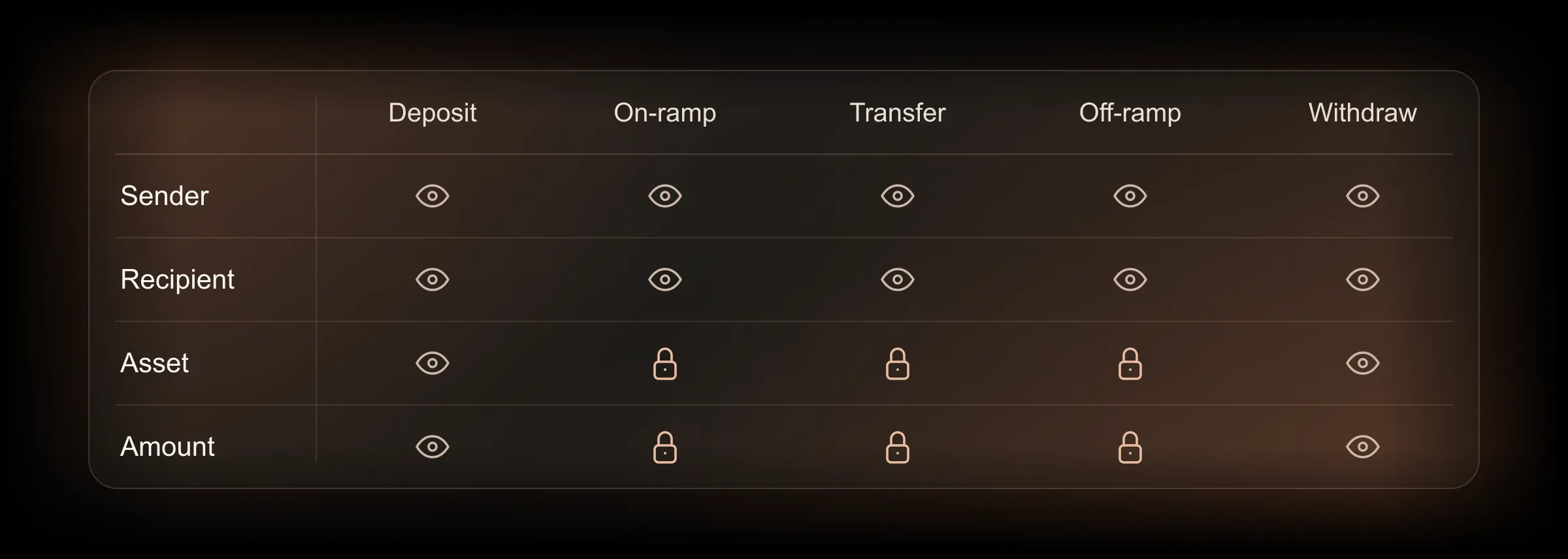
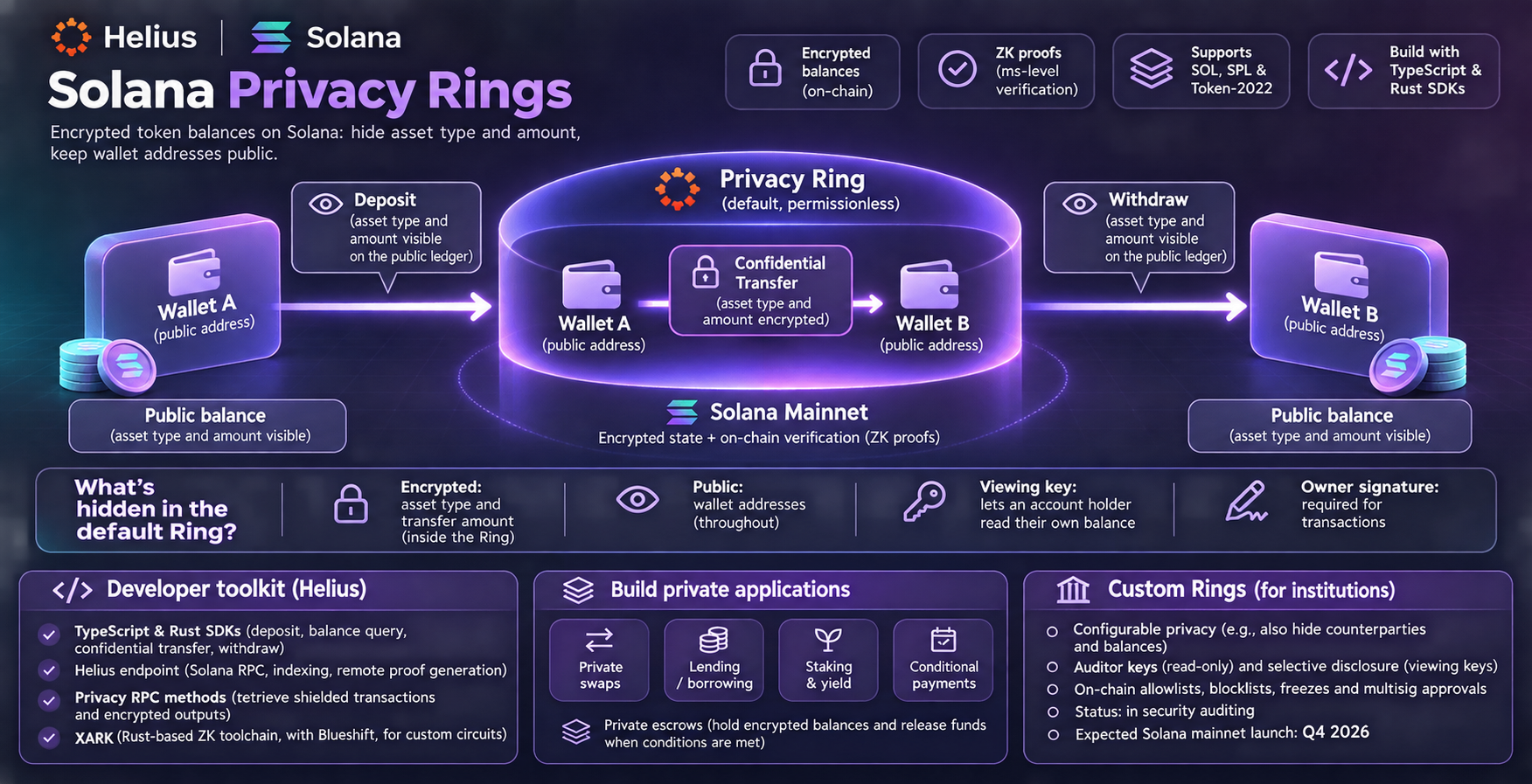
A Privacy Ring is a shielded pool: it records encrypted balances on Solana while allowing transactions to be verified and settled on the chain. Helius says the default Ring encrypts the asset type and transfer amount, but leaves wallet addresses public. An account holder can read their balance using a viewing key.
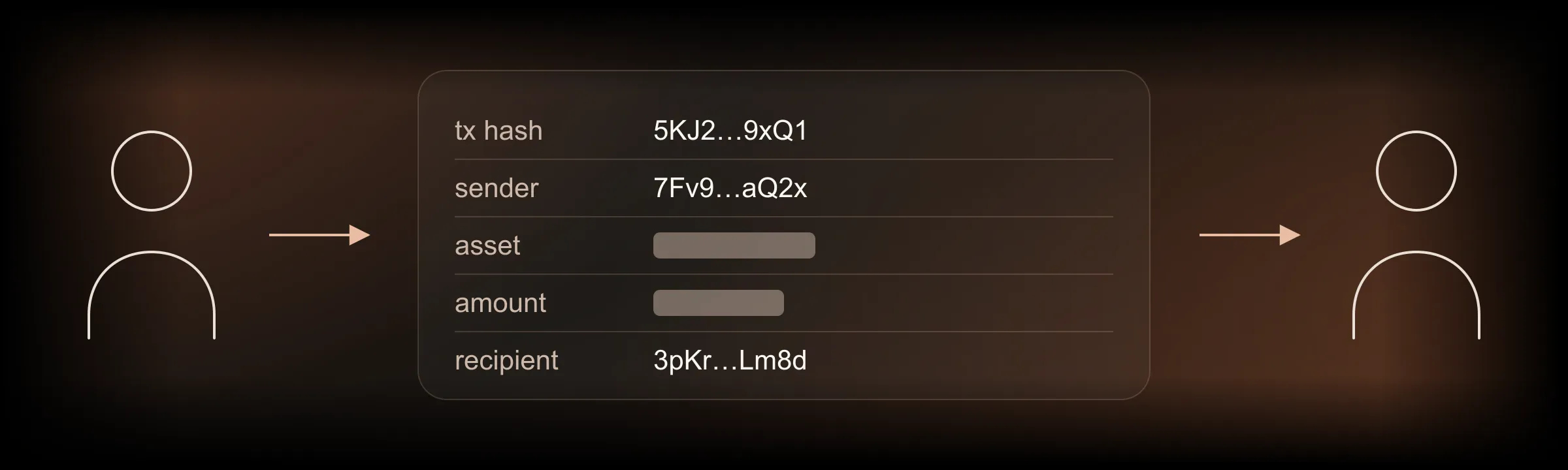
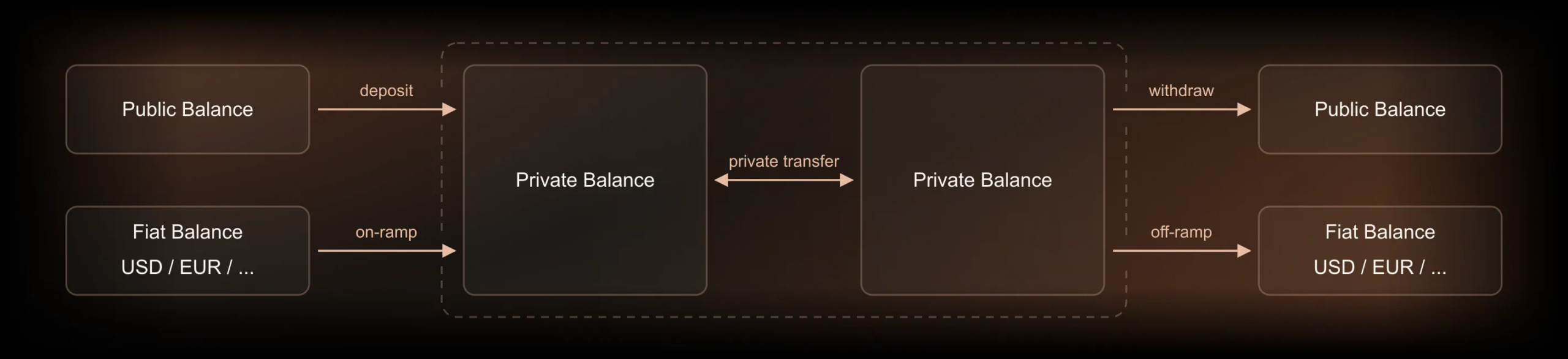
That distinction matters when designing a user flow. Depositing from a public balance into the Ring, or withdrawing back to one, exposes the asset and amount at the public-ledger boundary. Helius says transfers within the Ring conceal those details. It describes private fiat on- and off-ramps separately; some providers were developing those services, not offering them as a universal feature of the launch.
According to Helius, transactions require the asset owner’s signature. The system supports SOL, standard SPL tokens and Token-2022 tokens, stores encrypted state on Solana, and uses succinct zero-knowledge proofs to check transaction validity. Helius claims on-chain proof verification takes a few milliseconds.
Building with encrypted balances
Helius says developers can use TypeScript and Rust SDKs for deposits, balance queries, confidential transfers and withdrawals. Its developer offering also includes a Helius endpoint for Solana RPC, indexing and remote proof generation; privacy-specific RPC methods for retrieving shielded transactions and encrypted outputs; and XARK, a Rust-based toolchain developed with Blueshift for custom zero-knowledge circuits.
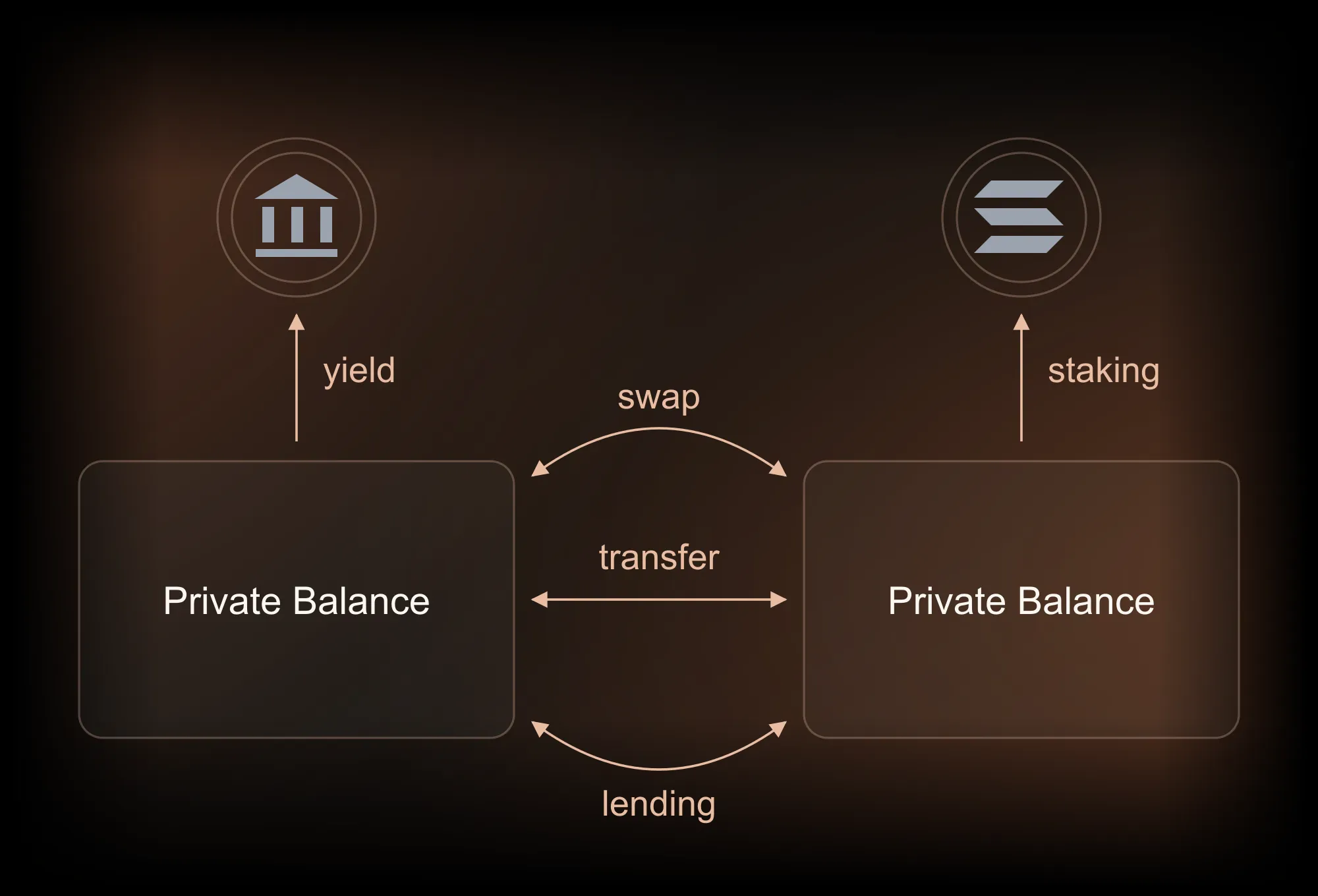
The company describes private escrows—contracts that hold encrypted balances and release funds when specified conditions are met—as a building block for swaps, lending, staking and conditional payments. It says private operations can be combined with other Solana programs in a single atomic transaction. These are described capabilities and application designs, not evidence that every proposed use case was already deployed.
Helius named Decrypt, Ore and Aurora Intents as products using the default Ring on mainnet. It said Range, Chainalysis and Elliptic Labs supported risk-screening workflows, while Crossmint, Moonpay and Paybis were developing private on- and off-ramps. Backpack, DFlow, Jupiter, Squads and Titan were working on integrations, according to Helius.
Custom Rings remain on the roadmap
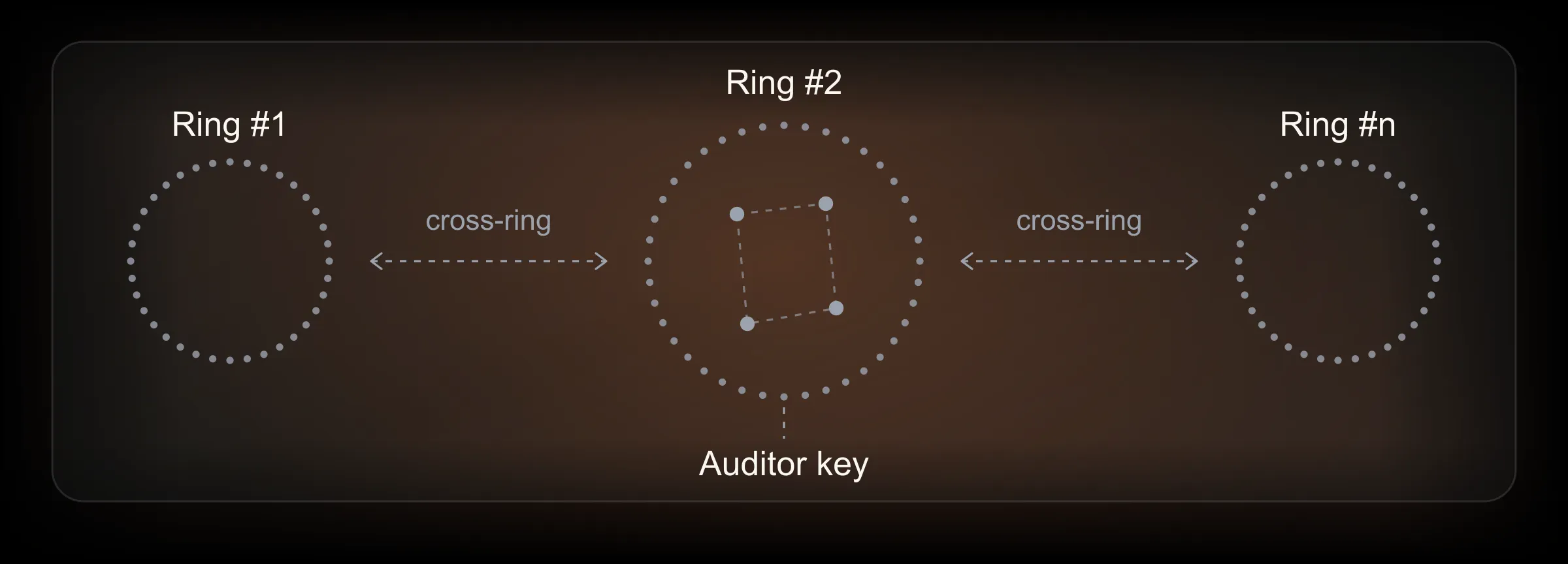
Helius described Custom Rings as separate Solana programs that institutions could configure with different privacy and compliance rules. Its proposed options include a mode that hides amounts and assets, a mode that also hides counterparties and balances, read-only auditor keys, selective disclosure through viewing keys, and on-chain allowlists, blocklists, freezes and additional multisignature approvals. Those options should not be confused with the live default Ring, whose wallet addresses remain public.
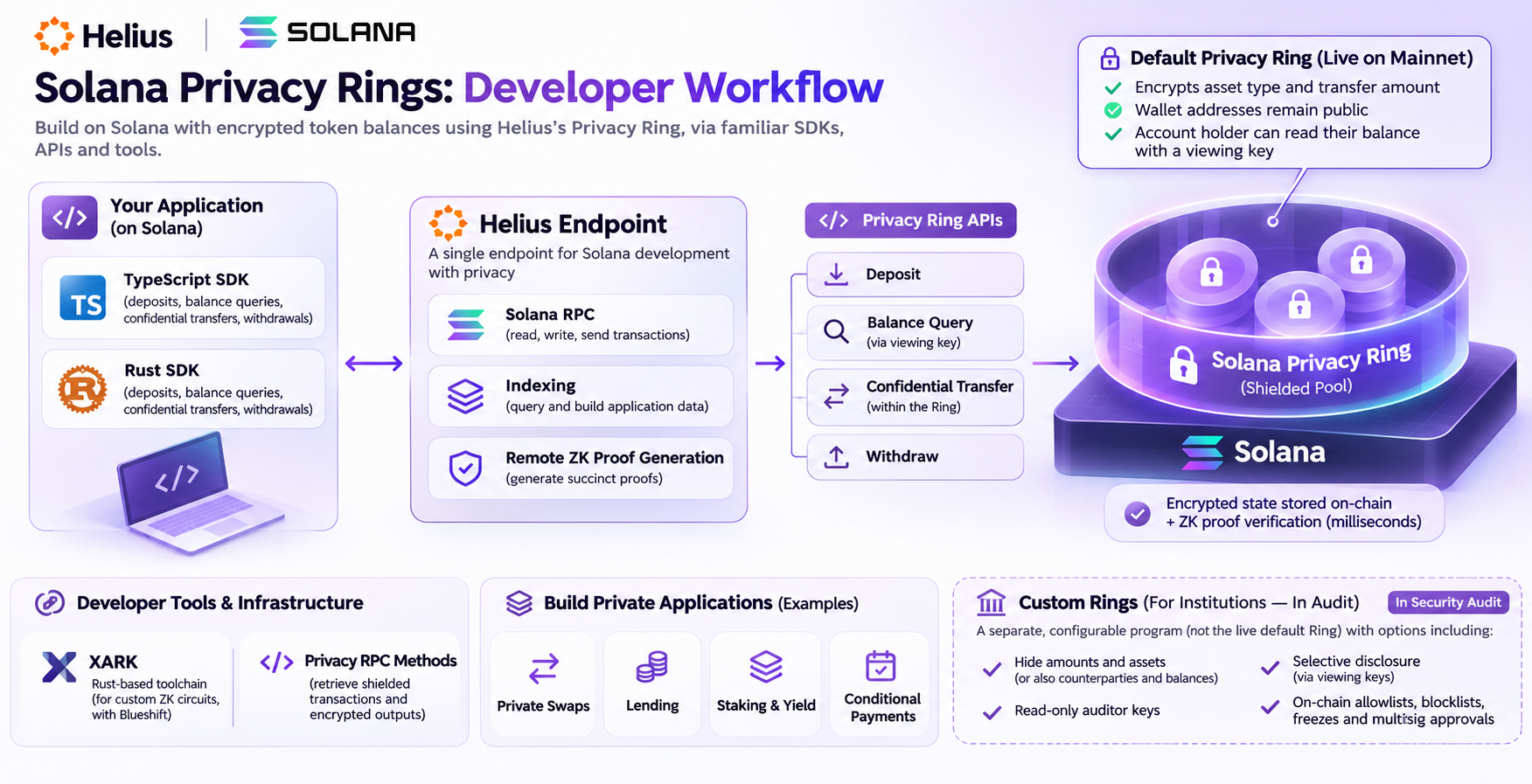
As of the November 11 announcement, Helius said Custom Rings were in security auditing and expected a Solana mainnet launch in the fourth quarter of 2026. Helius also said Certora, ZK Security and OtterSec had audited the deployed core program and zero-knowledge circuits. Formal verification of the mainnet programs and circuits was still in progress, with completion expected by the end of 2026.