
For builders, the engineering question in the Peraire-Bueno case is precise: what must a relay verify before it releases a proposed block’s transactions to a validator? As reported on November 19, 2026, a U.S. federal judge had acquitted Anton and James Peraire-Bueno on November 16 in a case arising from an April 2023 Ethereum block proposal. The ruling addressed the prosecution’s fraud allegations; it did not declare every MEV strategy lawful.
How the relay exposed the transactions
MEV, or maximal extractable value, is value obtained by controlling which transactions enter a block and in what order. In one strategy, a “sandwich” bot buys before a target trade and sells afterward, potentially leaving the target trader with a worse execution price. The three traders described as victims in this case operated bots seeking such opportunities.
According to the court record, the brothers studied those bots, established 16 validators and, on April 2, 2023, placed eight bait transactions in the public pending-transaction queue when one of their validators was due to propose a block. The bots submitted transaction bundles intended to buy before the bait trades and sell afterward.
The relay was supposed to withhold a builder’s full transaction list until the proposing validator signed a block header. The brothers signed a header whose parent-block and state-root fields had been set to zero. The signature was genuine, but the header described an invalid block. The Ultrasound relay software checked that the signer was the scheduled validator and that the fields existed; it did not check those fields’ values before returning the transaction list. Ethereum nodes rejected the invalid block, but the brothers had already seen the bots’ planned trades. They then proposed a valid block that kept the bots’ buys while replacing the expected sequence with their own sales, leaving the bots unable to complete their planned exits.
Prosecutors initially described the operation as taking roughly $25 million in about 12 seconds. That figure and characterization were the prosecution’s, not a separate civil accounting of each loss by the judge.
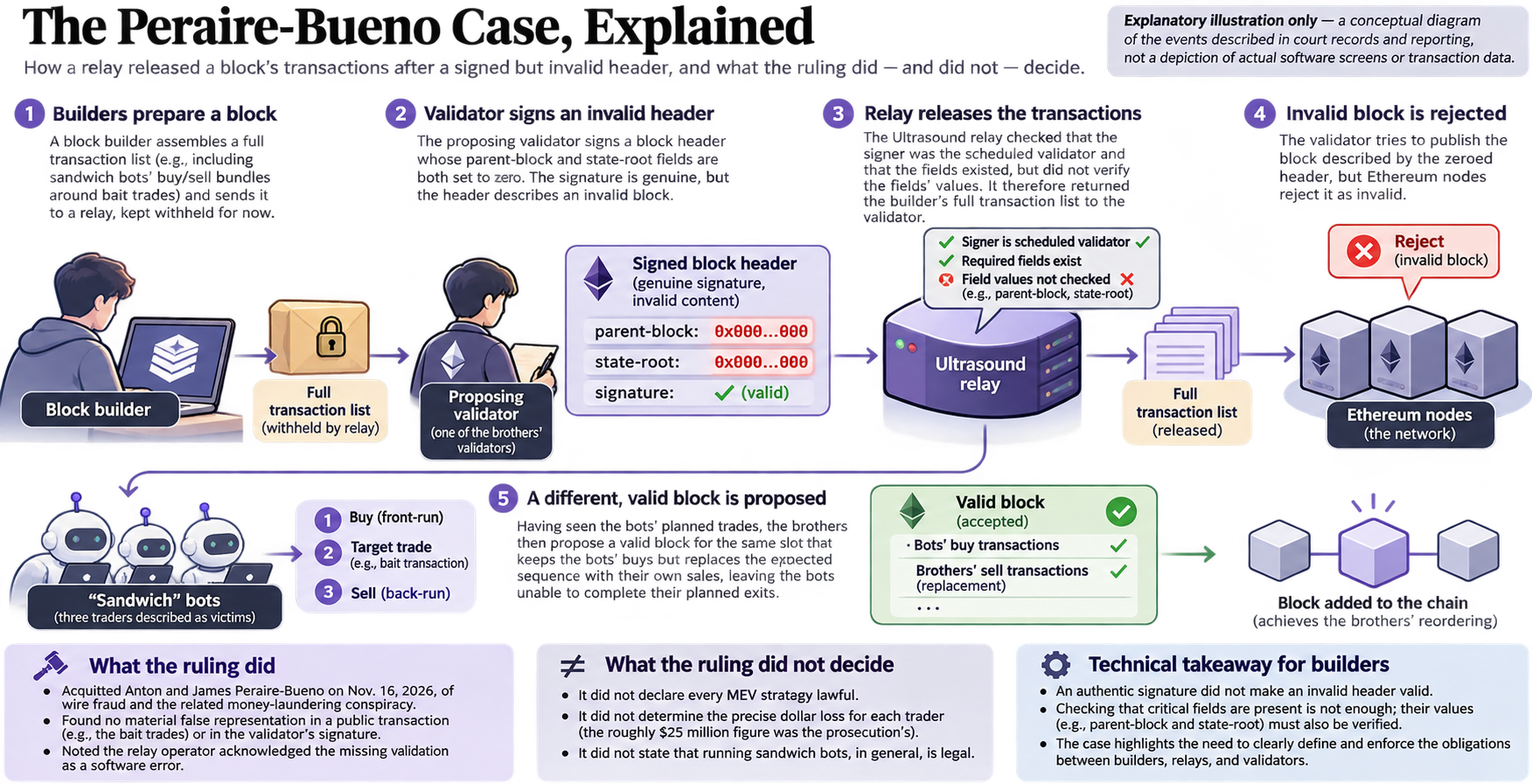
What the ruling did—and did not—decide
Prosecutors argued that the bait transactions and signed header made deceptive promises about how the trades or block would be executed. The judge found no such promise in a transaction appearing in the public queue or in the validator’s signature. The ruling also noted that the relay operator acknowledged the missing validation as a software error. Without the material false representation required for the wire-fraud charges, the related money-laundering-conspiracy charge also failed in this case. A 2025 jury trial had ended without a unanimous verdict before the 2026 acquittal following a trial without a jury.
The case has a separate institutional connection: BlackRock’s March 2026 prospectus for its iShares Staked Ethereum Trust ETF disclosed that staking providers may receive MEV-related revenue and that a finding that MEV violates applicable law could disrupt the fund’s staking program. That disclosure does not say the fund ran sandwich bots or participated in this relay exploit.
For protocol designers, the concrete lesson is narrower than a verdict on MEV as a whole: authentic signatures did not make an invalid header valid, and checking that critical fields were present did not verify their values. The ruling likewise distinguished technical expectations and economic penalties from a legally established promise.