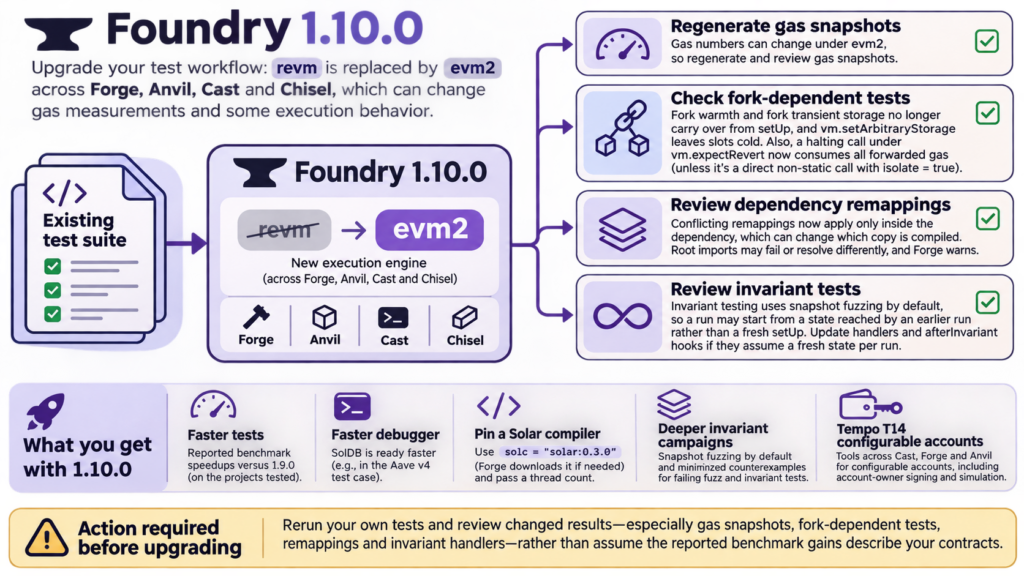
Before running an existing test suite on Foundry 1.10.0, builders should plan to regenerate gas snapshots and check tests that depend on fork state or invariant-test setup. As reported on November 20, 2026, the release replaces the revm execution engine with evm2 across Forge, Anvil, Cast and Chisel. That change can affect gas measurements and some execution behavior.
Check existing tests first
Fork warmth and fork transient storage no longer carry over from setUp, and vm.setArbitraryStorage leaves slots cold. A halting call covered by vm.expectRevert now consumes all forwarded gas, as it does on-chain, except for a directly made non-static call with isolate = true. Tests that run out of gas afterward may need to forward a fixed amount to that call.
Forge also changes how it handles conflicting dependency remappings, potentially changing which dependency copy is compiled. Test discovery now runs suites under src, test and script; forge test warns about project suites it skips. Invariant testing—a campaign that checks properties across sequences of calls—uses snapshot fuzzing by default, so a run may begin from a state reached by an earlier run rather than a fresh setUp state.
Changes to the development workflow
The release notes report that, on the projects tested, forge test ran 4.5 times faster on Morpho Blue, 3.5 times faster on Spark PSM and 2.1 times faster on Aave v4 than version 1.9.0. These are the release’s benchmark results, not a speed guarantee for every project. For a 1.46-million-step Aave v4 test, the SolDB debugger was ready in 1.40 seconds rather than 1.96 seconds.
Forge can pin a Solar compiler release with solc = "solar:0.3.0", downloading it if needed, and can pass its thread count to Solar. Failing fuzz and invariant tests now report minimized counterexamples. The release also adds tools for Tempo T14 configurable accounts across Cast, Forge and Anvil, including account-owner signing workflows and simulation.
For teams upgrading, the immediate task is to rerun their own tests and review changed results—especially gas snapshots, fork-dependent tests, remappings and invariant handlers—rather than assume the reported benchmark gains describe their contracts.