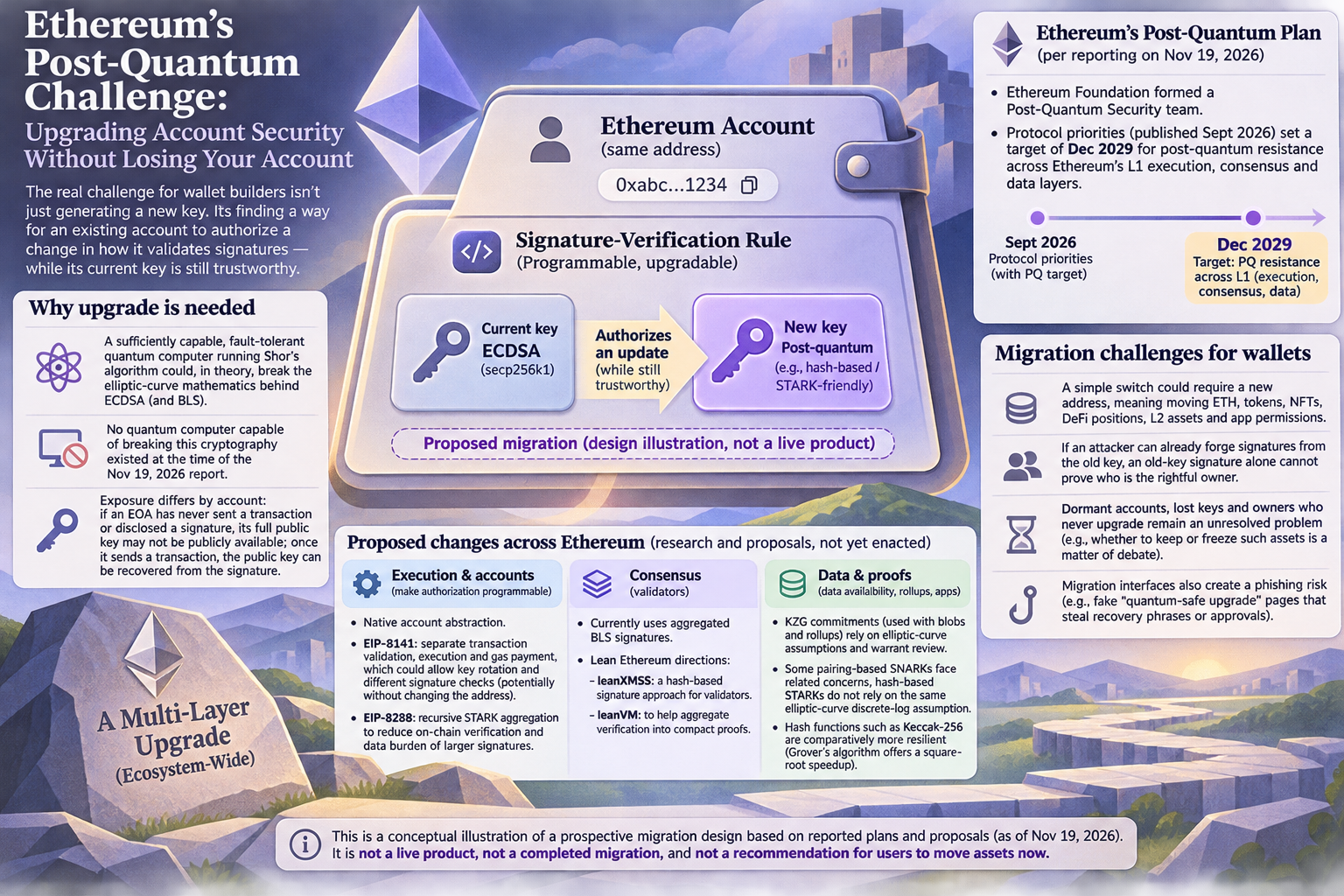
For a wallet builder, the post-quantum challenge is not simply generating a new key. It is finding a way for an existing account to authorize a change in how it validates signatures—while its current key is still trustworthy.
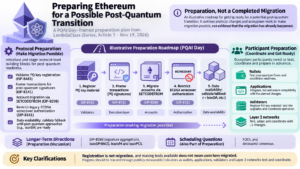
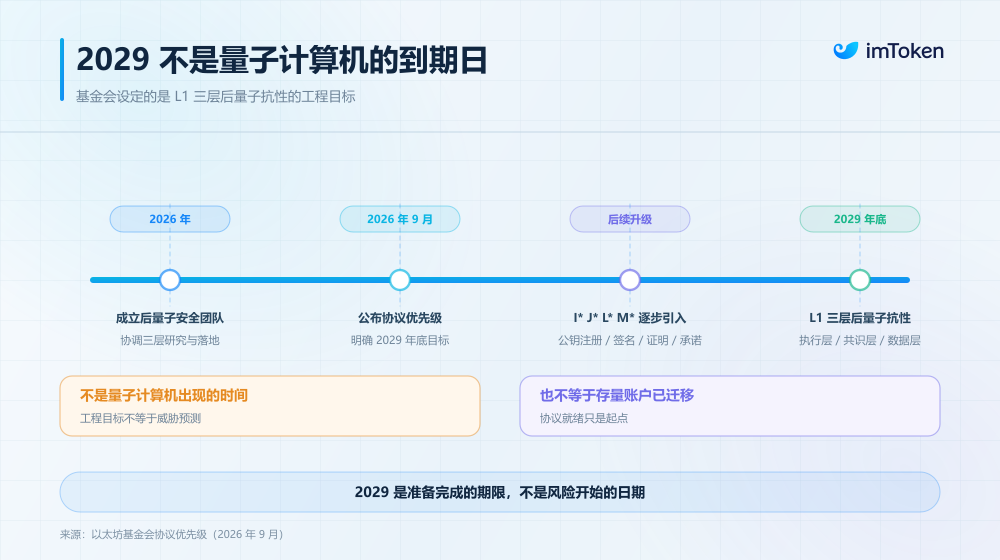
As reported on November 19, 2026, Ethereum’s post-quantum work was an engineering plan, not a completed migration. The Ethereum Foundation had formed a Post-Quantum Security team, and protocol priorities published that September set a target of December 2029 for post-quantum resistance across Ethereum’s L1 execution, consensus and data layers. That target does not mean the changes were already in effect.
Why an account upgrade is difficult
An ordinary Ethereum externally owned account (EOA) uses an ECDSA signature from a secp256k1 private key to authorize transactions. A sufficiently capable, fault-tolerant quantum computer running Shor’s algorithm could, in theory, undermine the elliptic-curve mathematics behind ECDSA. The source reports that no quantum computer capable of breaking this cryptography existed at the time of publication.
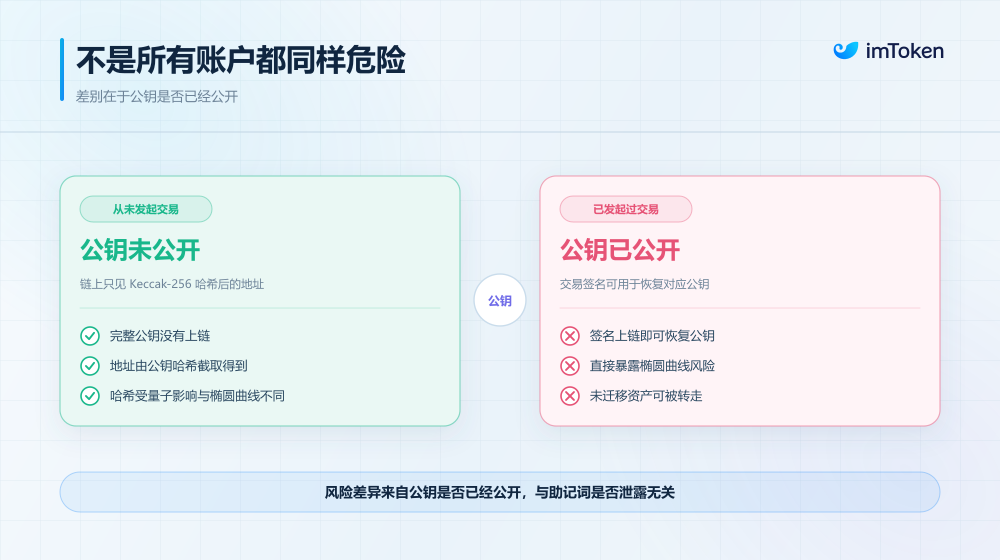
Exposure also differs between accounts. An EOA address is derived from a hash of its public key. If an account has never sent a transaction or disclosed a signature elsewhere, its full public key may not be publicly available. Once it sends a transaction, the public key can be recovered from the public transaction signature. That distinction matters to a future attack based on deriving a private key from an exposed public key; it is not a reason to assume that any account is permanently safe.
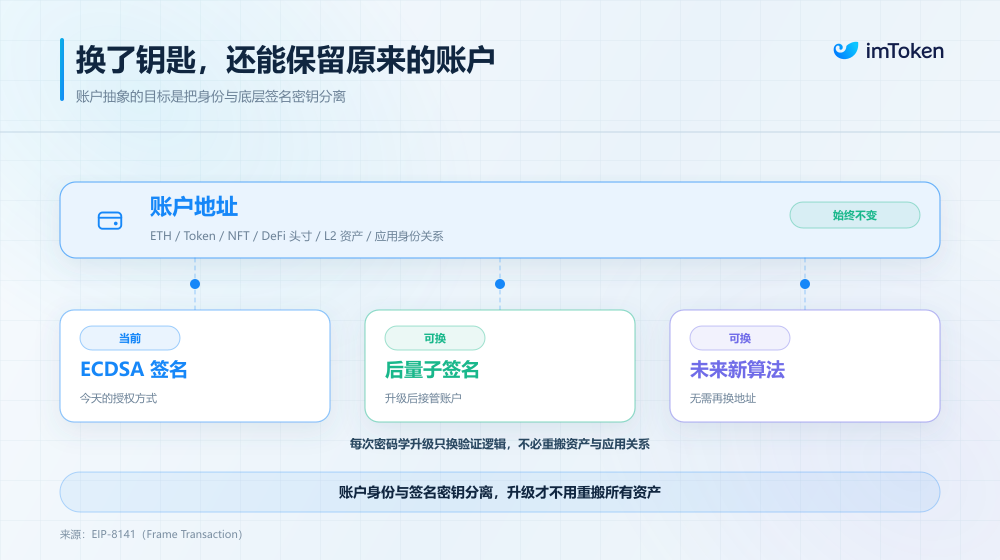
Simply switching to a new signature scheme could require a new address. For a user, that may mean moving not only ETH and tokens but also dealing with NFTs, DeFi positions, L2 assets and application permissions associated with the old address.
Proposed changes across Ethereum
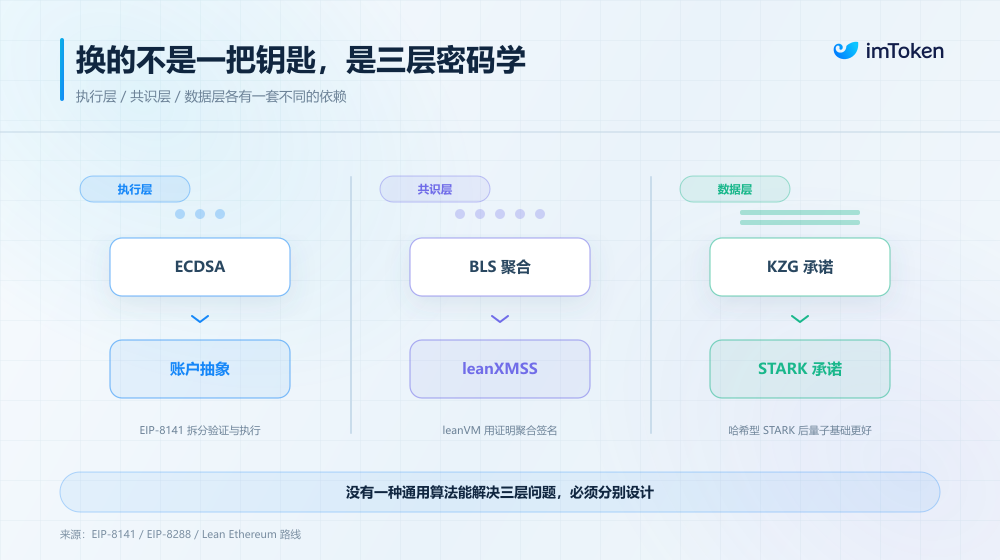
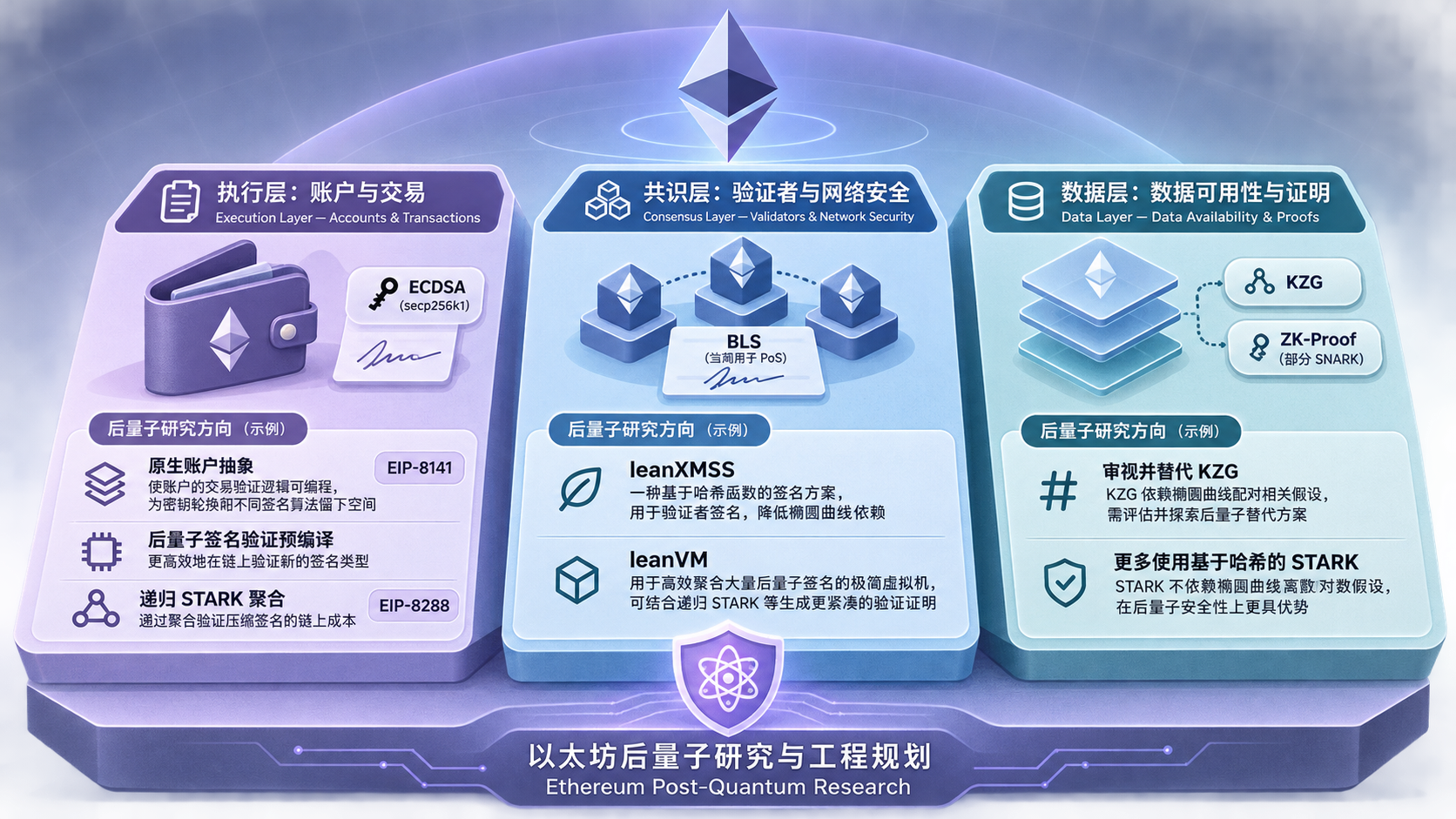
Execution and accounts. Native account abstraction would make transaction authorization programmable rather than permanently tying it to one ECDSA key. EIP-8141 is presented as a proposal to separate transaction validation, execution and gas payment into distinct steps. That could leave room for key rotation and different signature checks, potentially without changing an account’s address. Work on precompiled verification for post-quantum signatures is also described; EIP-8288 proposes recursive STARK aggregation to reduce the on-chain verification and data burden of larger signatures. These are proposed or researched approaches, not capabilities that every existing wallet can use today.
Consensus. Ethereum’s proof-of-stake validators currently benefit from aggregating BLS signatures. Replacing them with larger post-quantum signatures creates network, storage and verification costs. The Lean Ethereum directions described in the source include leanXMSS, a hash-based signature approach for validators, and leanVM, intended to help aggregate verification into compact proofs. Neither is described as an enacted replacement for BLS.
Data and proofs. KZG commitments used with blobs and rollup data availability rely on elliptic-curve assumptions that also warrant review. Some pairing-based SNARKs face related concerns; hash-based STARKs do not rely on the same elliptic-curve discrete-logarithm assumption. The migration question therefore extends beyond wallet signatures to data infrastructure, rollups and applications. Hash functions such as Keccak-256 are comparatively more resilient to the quantum attacks discussed: Grover’s algorithm offers a square-root speedup, unlike Shor’s attack on the relevant public-key mathematics.
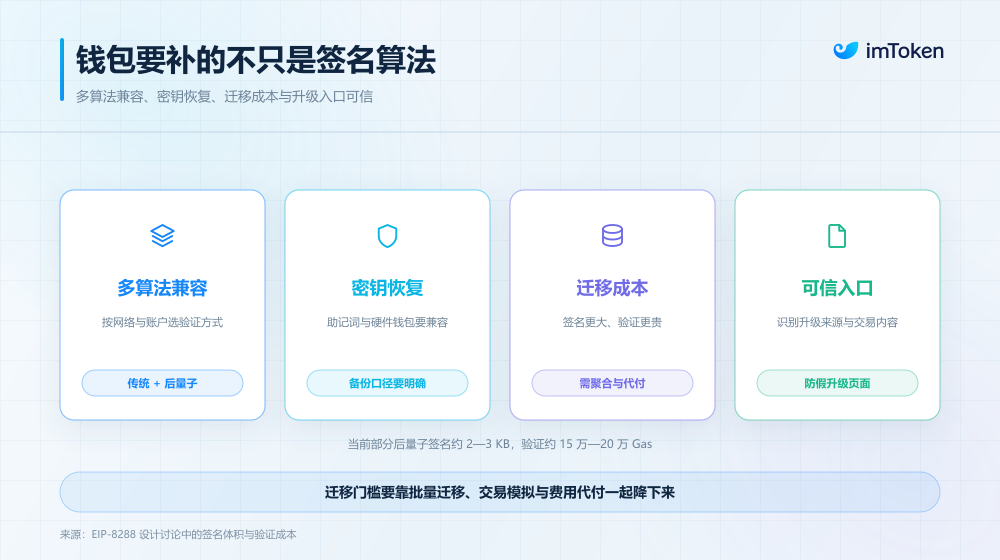
The migration problem wallets must solve
A prospective migration would authorize a new post-quantum key before the old signature scheme becomes vulnerable. In principle, a wallet could generate the new key and use a valid signature from the existing account to approve a change to its validation rules. That is an illustrative design, not an available migration procedure or a tested wallet instruction.
If an attacker can already forge signatures from the old key, an old-key signature alone cannot establish which party is the rightful owner. Dormant accounts, lost keys and owners who never upgrade pose a separate unresolved problem. Whether such assets should remain where they are or face measures such as a freeze is described as a matter of debate, not an adopted rule.
Migration interfaces also create a phishing risk: a page claiming to offer a “quantum-safe upgrade” could instead solicit a recovery phrase or a malicious authorization. At the November 2026 reporting date, the source did not describe an immediate need for users to move assets because of quantum computing. For builders, its practical lesson is to design for verifiable authorization and future changes to account validation—not to treat a proposed cryptographic upgrade as already deployed.