If you are building a credential for a game character or another NFT, the first design question is what the credential should follow. A badge assigned to a wallet identifies that wallet; an ERC-5114 badge identifies a particular NFT, even if that NFT changes hands.
This explanation reflects the original article published November 22, 2026, at 15:25:38 UTC+08:00. It describes proposed uses and interface behavior, not a newly announced deployment.
Four approaches to non-transferable credentials
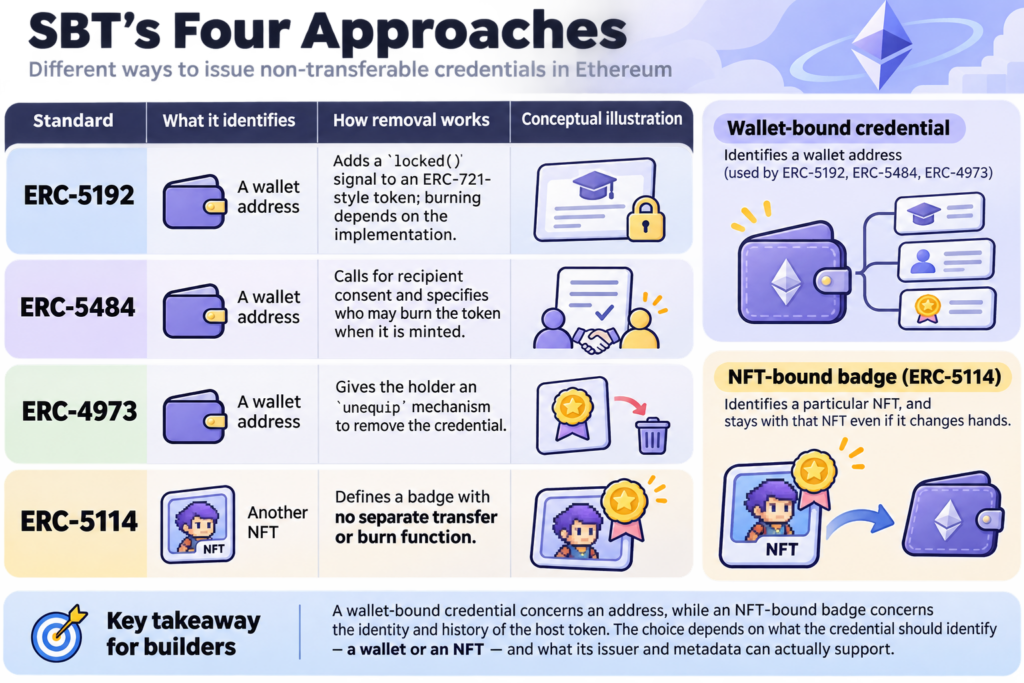
A soulbound token (SBT) is a broad term for a token designed not to be transferred separately. It is not one Solidity standard. The article compares four approaches:
| Standard | What it identifies | How removal works |
|---|---|---|
| ERC-5192 | A wallet address | Adds a locked() signal to an ERC-721-style token; burning depends on the implementation. |
| ERC-5484 | A wallet address | Calls for recipient consent and specifies who may burn the token when it is minted. |
| ERC-4973 | A wallet address | Gives the holder an unequip mechanism to remove the credential. |
| ERC-5114 | Another NFT | Defines a badge without a separate transfer or burn function. |
The distinction matters for a builder: a wallet-bound credential concerns an address, while an NFT-bound badge concerns the identity and history of the host token. The article suggests achievements for game characters and maintenance records for tokenized vehicles as possible ERC-5114 uses, not as evidence that those applications have been deployed.
Reading the ERC-5114 interface
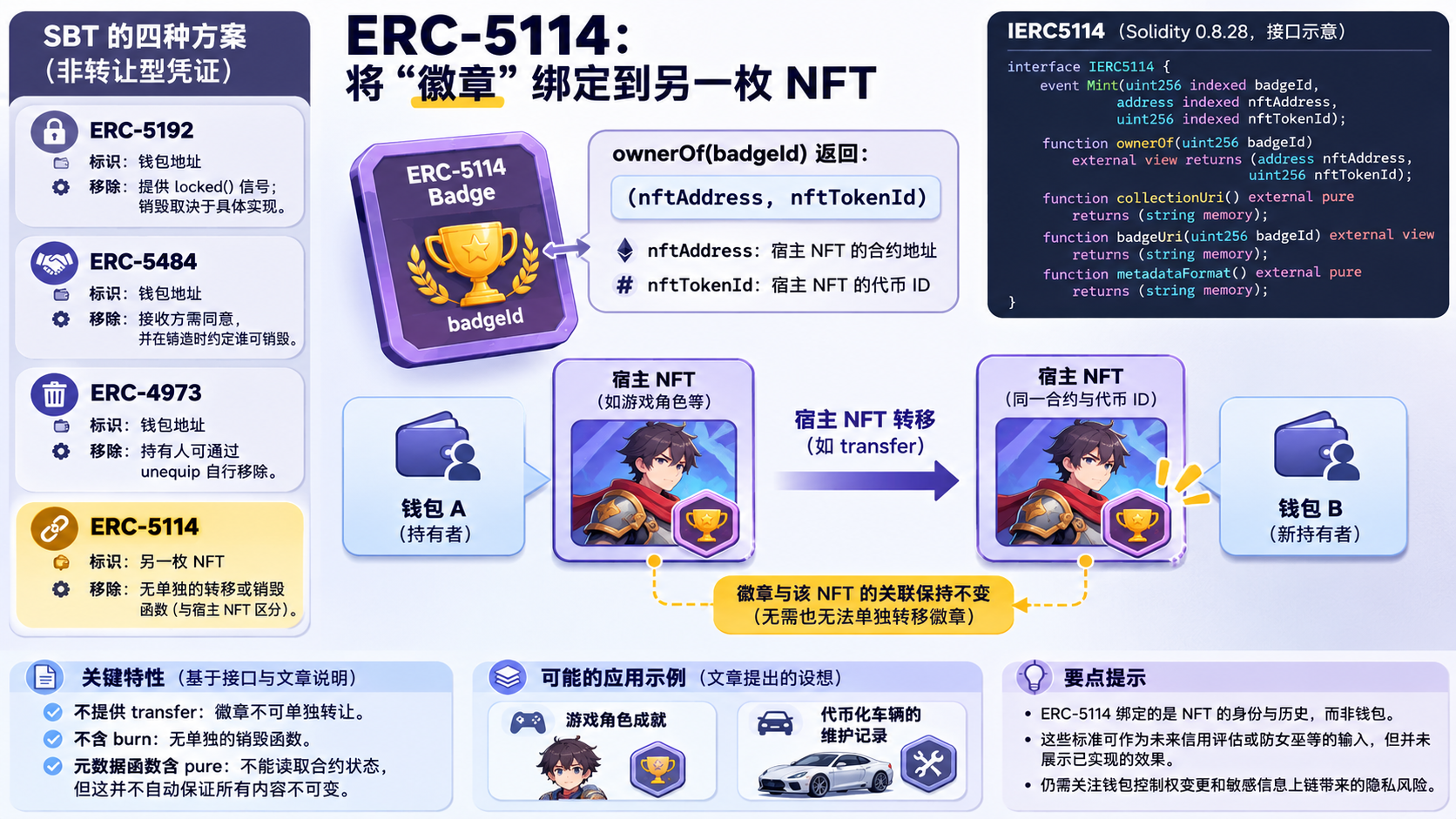
The article presents this illustrative interface using Solidity 0.8.28 syntax; it does not report testing or deployment:
interface IERC5114 {
    event Mint(uint256 indexed badgeId, address indexed nftAddress, uint256 indexed nftTokenId);

    function ownerOf(uint256 badgeId) external view returns (address nftAddress, uint256 nftTokenId);
    function collectionUri() external pure returns (string memory);
    function badgeUri(uint256 badgeId) external view returns (string memory);
    function metadataFormat() external pure returns (string memory);
}
Here, ownerOf(badgeId) returns the host NFT’s contract address and token ID, rather than the wallet address returned by an ERC-721 token’s ownerOf. That pair identifies which NFT carries the badge. If the host NFT is transferred, the badge remains associated with that NFT; it does not need a separate badge-transfer call.
The interface also lists metadata functions. pure means a function cannot read contract state, but that keyword alone does not prove all referenced content is immutable. The article describes content-addressed metadata as a way to reduce the risk of changing a badge’s referenced material after issuance. Likewise, a badge with no burn function is distinct from its host NFT: burning the host would not, by itself, call a burn function on the badge.
What non-transferability does not solve
The article frames credentials as a possible input to future reputation checks, including credit assessment or resistance to Sybil attacks—where one actor uses many accounts. Those are proposed applications, not demonstrated outcomes of these standards.
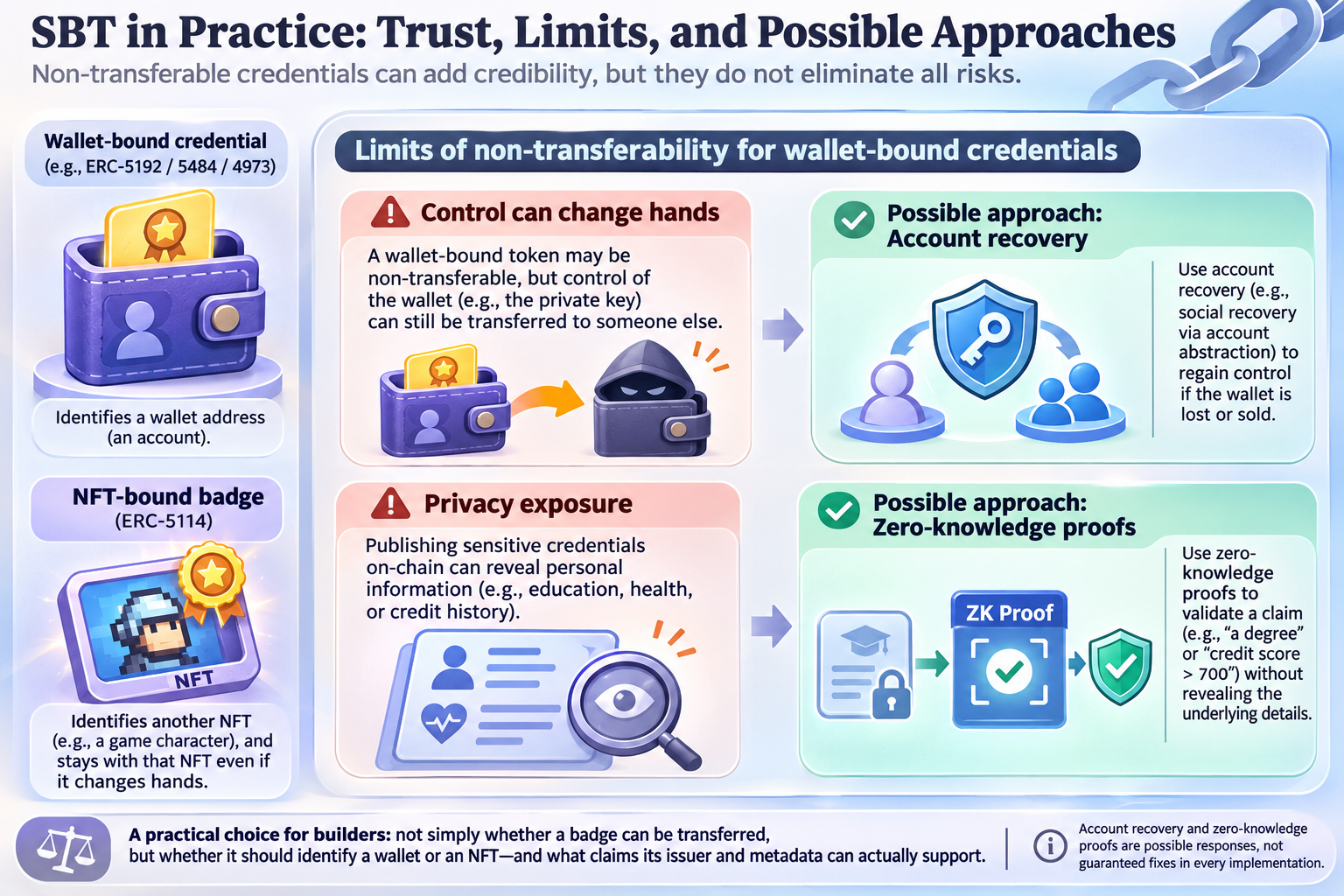
It also identifies two limits. A wallet-bound token may be non-transferable while control of its wallet can still change hands. And publishing sensitive credentials on-chain creates privacy concerns. The article discusses account recovery and zero-knowledge proofs as possible responses, without establishing that either removes those risks in every implementation. For builders, the practical choice is therefore not simply whether a badge can be transferred, but whether it should identify a wallet or an NFT—and what claims its issuer and metadata can actually support.