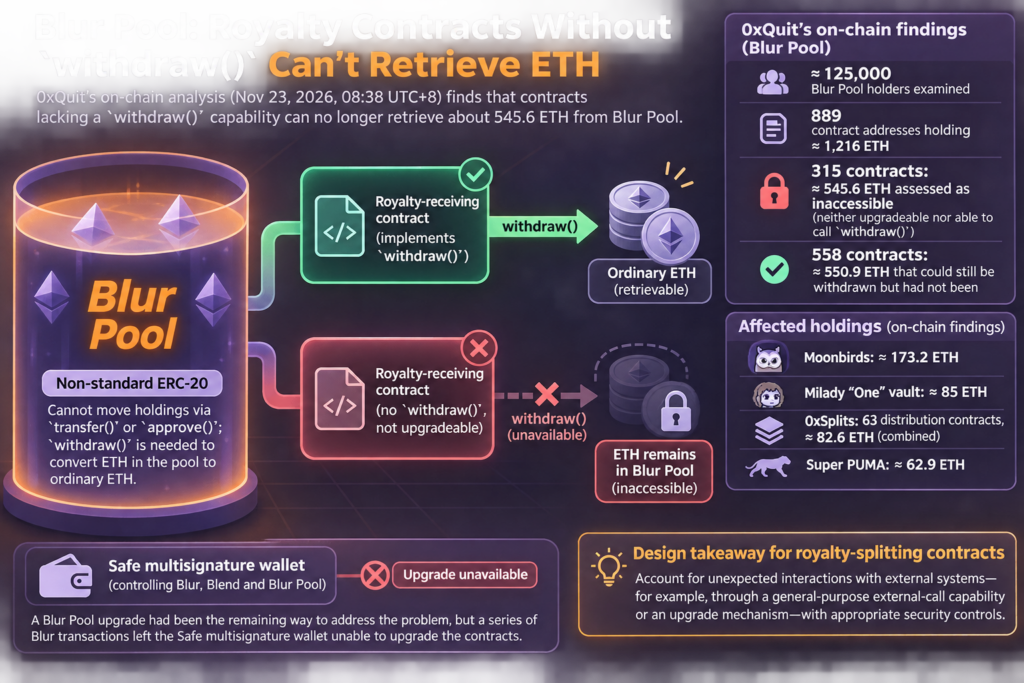
For builders of royalty-receiving contracts, the Blur Pool case turns on a specific capability: can the receiving contract call withdraw()? In an analysis reported on November 23, 2026, at 08:38 (UTC+8), 0xQuit said contracts without that capability could no longer retrieve approximately 545.6 ETH held in the pool.
Blur Pool uses a non-standard ERC-20 mechanism, according to 0xQuit. Its holdings cannot be moved through the usual transfer() or approve() functions; withdraw() is needed to convert ETH held in the pool into ordinary ETH. Some royalty-receiving contracts do not implement that function. 0xQuit said a Blur Pool upgrade had been the remaining way to address the problem, but that a series of Blur transactions left the Safe multisignature wallet controlling Blur, Blend and Blur Pool unable to upgrade the contracts.
After examining roughly 125,000 Blur Pool holders, 0xQuit found 889 contract addresses holding about 1,216 ETH. Of those, 315 contracts held approximately 545.6 ETH that 0xQuit assessed as inaccessible because the contracts were neither upgradeable nor able to call withdraw(). Another 558 contracts held about 550.9 ETH that could still be withdrawn but had not been.
Holdings identified as affected included about 173.2 ETH associated with Moonbirds, about 85 ETH in the Milady “One” vault, a combined 82.6 ETH across 63 0xSplits distribution contracts, and about 62.9 ETH associated with Super PUMA. These figures and the assessment of which contracts are affected are 0xQuit’s on-chain findings.
0xQuit’s design takeaway for royalty-splitting contracts is to account for unexpected interactions with external systems—for example, through a general-purpose external-call capability or an upgrade mechanism—with appropriate security controls.