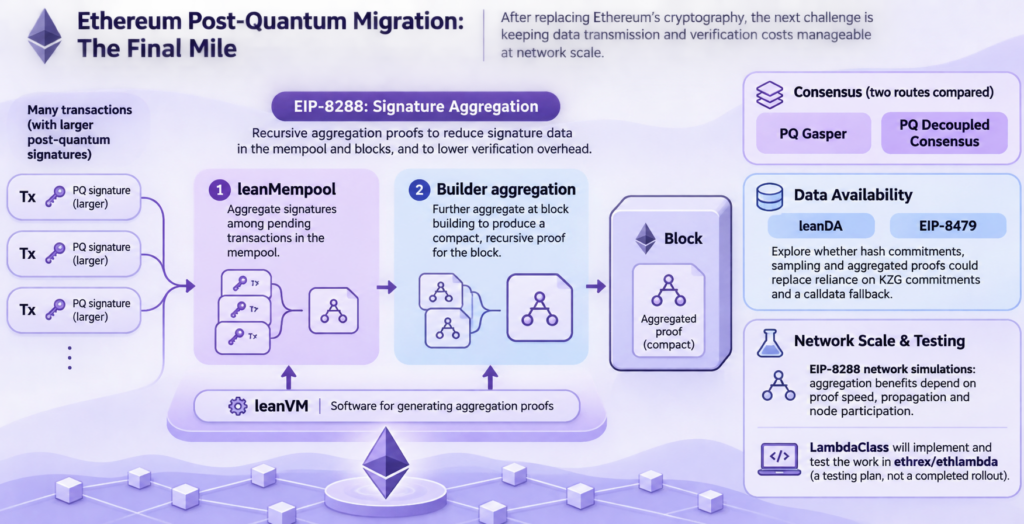
For builders, replacing Ethereum’s cryptography is only part of a post-quantum migration. A network using larger post-quantum signatures would also need to keep data transmission and verification costs manageable. The concluding article in this series, published on November 22, 2026, examines proposals and software work aimed at that problem—not changes already deployed across Ethereum.
Signature aggregation is the main focus. EIP-8288 proposes recursive aggregation proofs to reduce signature data in blocks and the mempool—the pool of transactions awaiting inclusion—and to lower verification overhead. The article identifies leanVM as software for generating proofs and distinguishes two stages: “builder aggregation” and “leanMempool.” It also compares two potential consensus routes, PQ Gasper and PQ Decoupled Consensus.
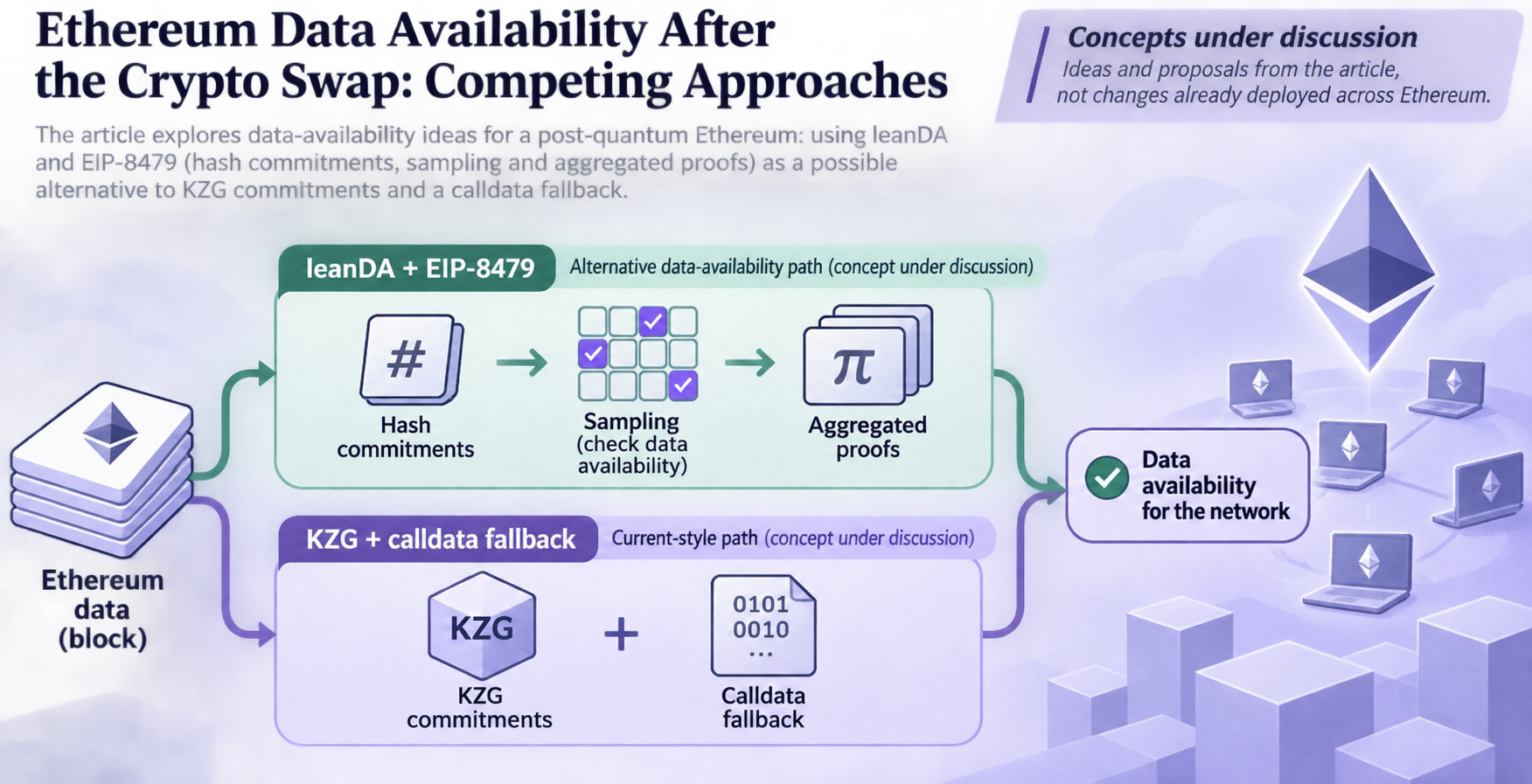
For data availability, the article discusses leanDA and EIP-8479. It explores whether hash commitments, sampling and aggregated proofs could replace reliance on KZG commitments and a calldata fallback.
The practical question is whether those approaches work at network scale. The article’s discussion of EIP-8288 network simulations says aggregation benefits depend on proof speed, propagation and node participation. It says LambdaClass will implement and test the work in ethrex/ethlambda; that is a testing plan, not evidence of a completed rollout.