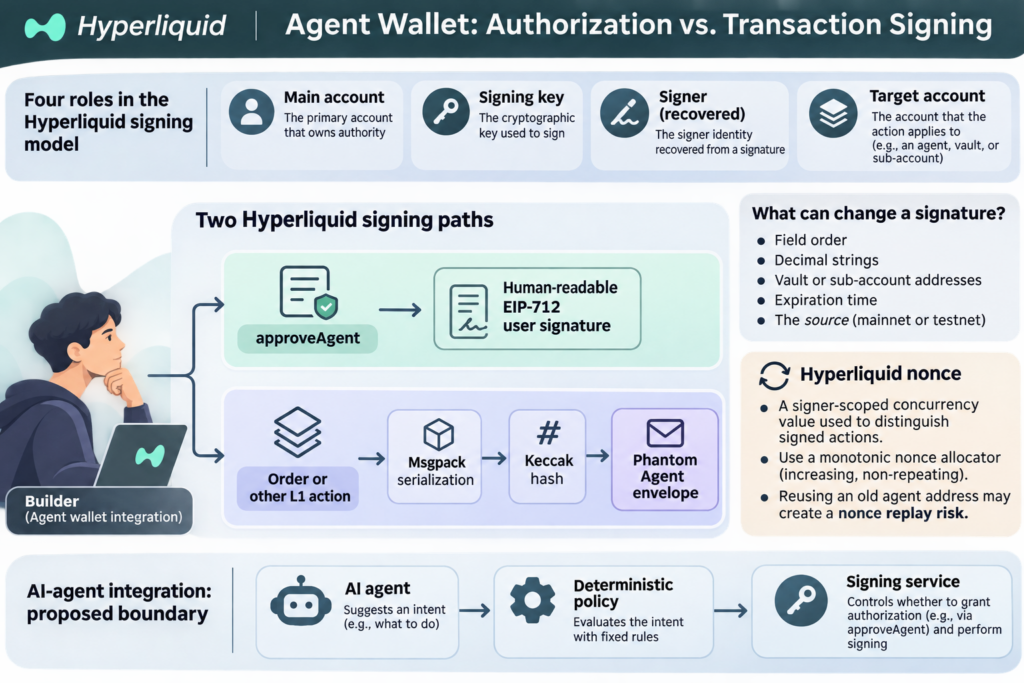
A builder integrating a Hyperliquid agent wallet needs to keep authorization separate from transaction signing. In a discussion published on November 22, 2026, the fifth article in a Hyperliquid signature series distinguishes four roles: the main account, the signing key, the signer recovered from a signature, and the target account.
The article describes two signing paths. approveAgent uses a human-readable EIP-712 user signature. Orders and other L1 actions instead use Msgpack serialization, a Keccak hash and a phantom Agent envelope. Its Python examples demonstrate signing and signature recovery, and show that field order, decimal strings, vault or sub-account addresses, expiration time, and the mainnet or testnet source can change a signature.
The article also treats Hyperliquid’s nonce—a value used to distinguish signed actions—as a signer-scoped concurrency concern. It calls for a monotonic nonce allocator and warns that reusing an old agent address may create a nonce replay risk. For AI-agent integrations, its proposed boundary is to let the AI agent suggest an intent while deterministic policy and a signing service control whether it receives authorization.