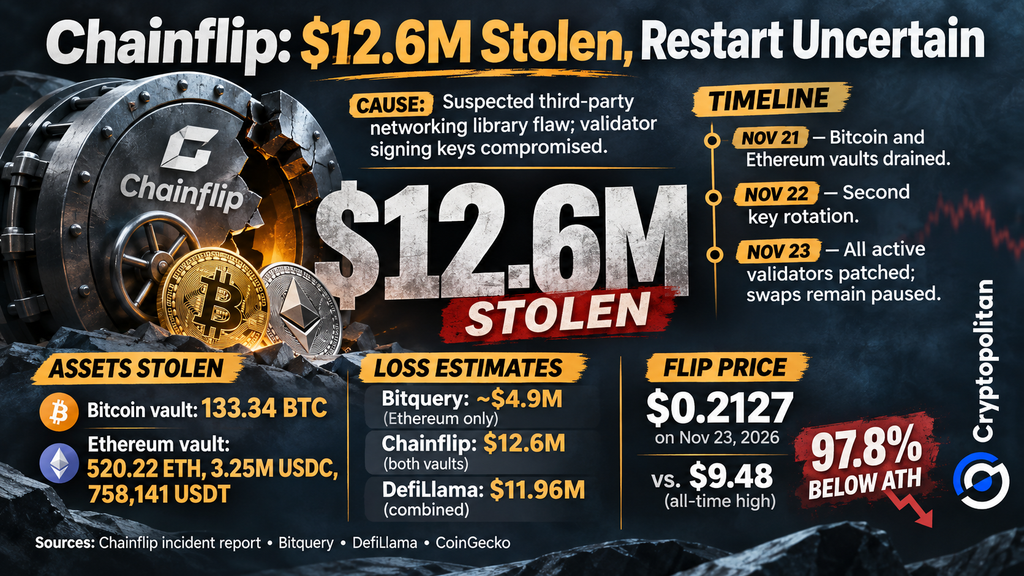
Reporting published on November 24, 2026, described Chainflip after it had already changed the software on its validators and replaced vault signing keys. Swaps were still off, and the protocol had not given a restart date.
What operators changed, and what users still could not do
On November 21, assets were taken from Chainflip’s Bitcoin and Ethereum vaults. Chainflip then fixed the software running on all active validators and replaced the signing keys used to authorize transactions out of those vaults. An earlier key rotation had not been enough. The keys were replaced again on November 22. By November 23, every active validator was running the fixed software.
Swaps, deposits, and withdrawals were still unavailable. A patched validator set and a new signing key are not the same step as turning the exchange back on.
Chainflip also had not said how it would repay affected liquidity providers — the parties who supply the assets used for swaps — or how it would win traders back. It said it intended to look for financing options and incentives so those providers could recover capital. That was a stated plan, not a completed repayment.
How a vault withdrawal gets a signature
Chainflip lets users exchange cryptocurrencies across blockchains without wrapped tokens, which are stand-in tokens that represent an asset from another chain. Up to 150 validators share control of the signing key that authorizes movements from the protocol’s vaults. The attacker did not need to become an active validator.
According to Chainflip Labs’ November 23 incident report, the attacker exploited a flaw in third-party software that validators use to communicate with each other. The report says that flaw let the attacker obtain portions of the signing key and authorize withdrawals. Chainflip Labs said: “The transactions were authorised with valid vault signatures that the Chainflip protocol never requested: the attacker produced them outside the network.”
In this setup, a signature can be cryptographically valid and still be one the protocol never asked for. The report’s claim is that these signatures were produced outside the network.
A sequence number outside the usual count
Blockchain analytics firm Bitquery reviewed the Ethereum vault’s transaction history. It found that the transaction used to drain the vault carried a sequence number outside Chainflip’s usual signing sequence. Bitquery said: “Of the 299,677 signatures the Vault has accepted since 2023, that one alone broke Chainflip’s running count.”
The observable mismatch was in that running count of accepted signatures, not in the absence of a signature.
What left the vaults
On November 21 the attacker drained 122.86 BTC from the Bitcoin vault. The Ethereum vault was hit next, losing 520.22 ETH, 3.25 million USDC, and 758,141 USDT. Within eight minutes of that second theft, the attacker had transferred 2,909 ETH to the mixer Tornado Cash.
The first key rotation failed to prevent another 10.48 BTC from being taken. The signing keys were replaced again on November 22.
Loss totals in the reporting do not agree, and each figure stays with the party that gave it:
- Chainflip said losses from the Bitcoin and Ethereum vaults reached $12.6 million.
- DefiLlama put the damage at $11.96 million.
- Bitquery estimated the Ethereum vault losses at about $4.86 million.
These are separate reported figures, not one reconciled sum.

A return offer that had not been met
Chainflip allowed the attacker to keep 10% of the funds in exchange for returning 110.58 BTC and 2,618 ETH by 18:38 UTC on November 23. As of 20:44 UTC that day, no recovery had taken place. The stolen Bitcoin had not moved from the addresses holding it.
An earlier Tron loss that validators did cover
On September 12, Chainflip lost 736,442 USDT because of double withdrawals from its Tron vault. Validators later approved Proposal 008, which used surplus assets to cover those losses. The November incident involved much more money. As of the November 23 report, Chainflip had not set out an equivalent repayment for liquidity providers.
Activity before the halt, and the FLIP price on November 23
DefiLlama recorded $1.1 billion in swap volume and $629,000 in protocol revenue over 30 days. Assets locked in the protocol stood at $13.6 million. The reporting presents those figures as trading activity before the hack. Chainflip believes it can restore previous trading volumes with only a fraction of the stolen capital. The open difficulty it described is persuading liquidity providers to commit funds again.
According to CoinGecko, FLIP traded at $0.2127 on November 23, nearly 97.8% below its all-time high of $9.48. That is the reported market level on that date. The source does not measure how much of the gap from the all-time high came from this incident.
A longer shutdown elsewhere, and where the reported risk sat
The same reporting pointed to THORChain, which resumed trading after a 39-day shutdown following a $10.7 million vault exploit in May. Security upgrades and compensation measures were in place, but its token price and liquidity were still below pre-hack levels when trading resumed.
CertiK recorded $232.9 million in cryptocurrency security losses between November 1 and November 23. CoinGecko’s 2026 security report found that infrastructure and supply-chain vulnerabilities accounted for more than $1.8 billion in losses between January 2025 and July 2026. The reporting uses those findings to argue that decentralized exchanges have to look beyond smart-contract security. In Chainflip’s case, the incident report located the flaw in third-party validator communication software, and the withdrawals carried valid signatures the protocol said it never requested.
For someone checking the result rather than the patch notes: by November 23 the active validators were on fixed software and the signing keys had been replaced a second time, while deposits, swaps, and withdrawals remained disabled and liquidity-provider compensation had not been defined.