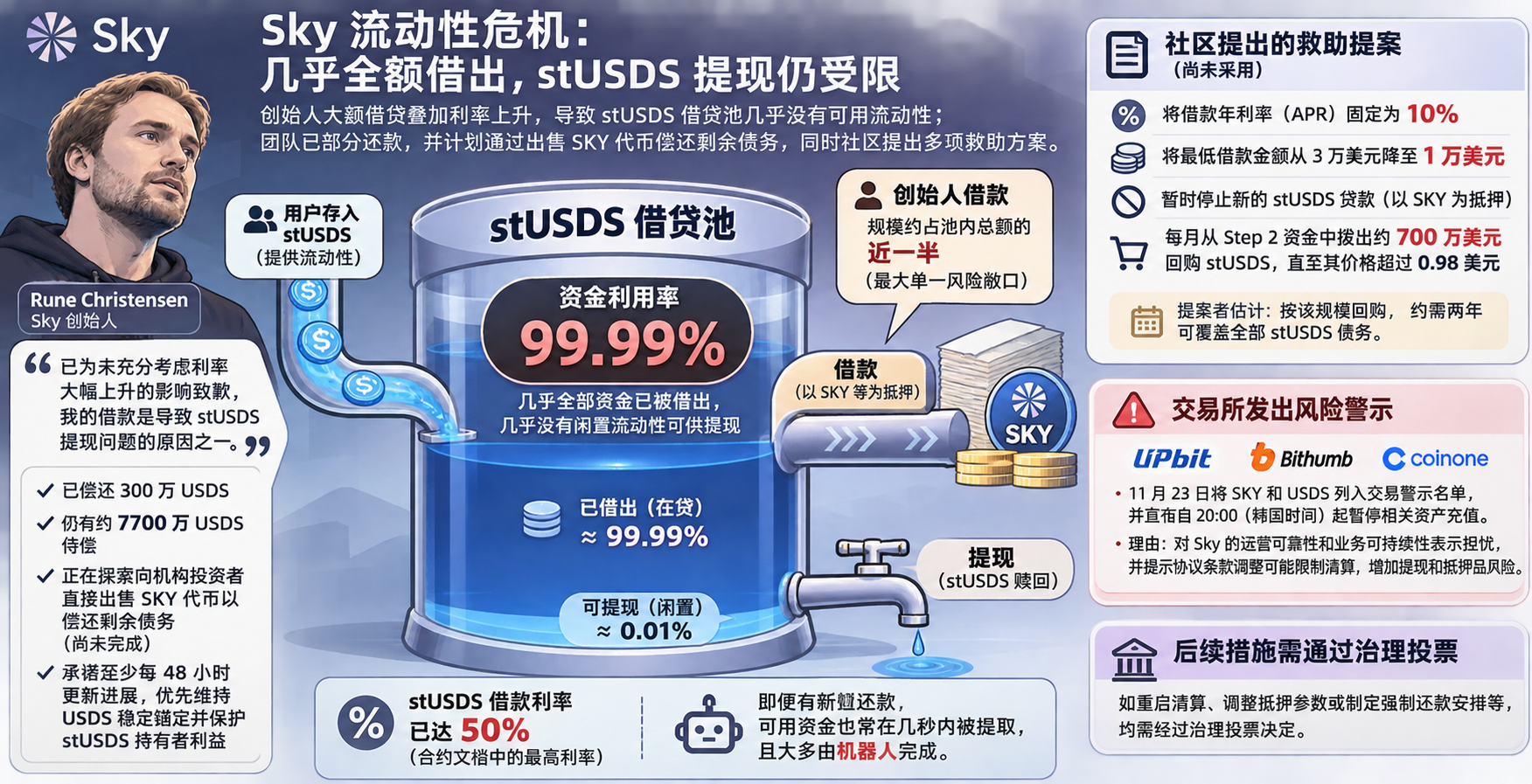
With almost all deposited funds lent out, stUSDS holders have little liquidity available to withdraw. As of the original report on November 24, 2026, Sky founder Rune Christensen said he had repaid 3 million USDS against a loan backed by staked SKY, leaving about 77 million USDS outstanding. He said he was exploring a direct sale of SKY to institutional investors to repay the rest; no sale was reported as completed.
Christensen apologized on November 23, saying he had failed to account adequately for the effect of sharply rising interest rates. He described his borrowing as one cause of the stUSDS withdrawal problem. He said he would provide updates at least every 48 hours while a broader solution was developed, with maintaining USDS’s peg and protecting stUSDS holders his priorities.
Why a repayment has not restored withdrawals
Sky’s website showed roughly 160 million stUSDS supplied to the pool from November 9, falling to about 158 million after Christensen’s repayment. Pool utilization stood at 99.99%—meaning nearly all deposited funds were on loan, leaving almost none idle for withdrawals. His borrowing represented nearly half the pool and its largest single exposure.
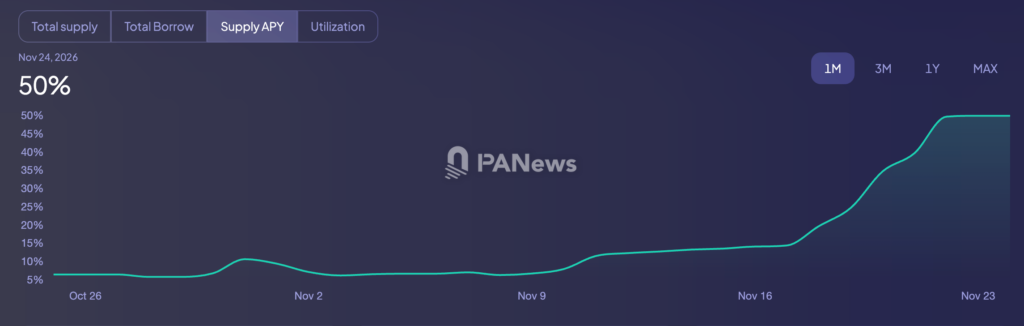
The stUSDS borrowing rate had reached 50%, the maximum rate described in Sky’s contract documentation, without prompting enough repayment to resolve the shortage. Community user @punkquidity argued that raising the rate alone would not give holders a reliable exit: they said recent additional repayments amounted to only about 0.2% of outstanding debt, and available funds were often withdrawn within seconds, mostly by bots.
A proposal, not a rule change
On November 23, forum user misher proposed fixing the borrowing annual percentage rate at 10%, lowering the minimum loan from $30,000 to $10,000, and temporarily stopping new stUSDS loans backed by SKY. The proposal also called for Sky to allocate about $7 million a month from Step 2 funding to buy stUSDS until its price exceeded $0.98. Its author estimated that purchases at that rate could cover all stUSDS debt in about two years.
These measures had not been adopted. Further steps discussed in the report—including restarting liquidations, changing collateral parameters or requiring repayment—would need governance votes.
Exchange warnings and the proposed SKY sale
On November 23, South Korean exchanges Upbit, Bithumb and Coinone placed SKY and USDS on trading-warning lists and announced a halt to deposits from 20:00 Korea time. The exchanges raised concerns about Sky’s operational reliability and sustainability, and warned that changes to protocol terms could restrict liquidations and increase withdrawal and collateral risks. Their reviews could lead them to extend or lift the warnings, or end trading support.
Amid the deposit and withdrawal restrictions, the report quoted USDS at 3.8 USDT on Upbit, versus a market benchmark of about 1 USDT, and SKY at about 0.062 USDT, versus about 0.039 USDT. Those were exchange-specific prices, not evidence that USDS’s broader peg had moved to 3.8 USDT.
Christensen said the team had been coordinating privately rather than ignoring the issue, seeking a solution without causing market panic or governance-security risks. The SKY he had pledged was valued at more than $140 million in the report. A completed over-the-counter sale followed by debt repayment could reduce his exposure to the pool, but that outcome remained uncertain. Vernal Capital founder Du Jun said he had messaged Christensen and was interested in buying his entire SKY position; an expression of interest is not a completed transaction.