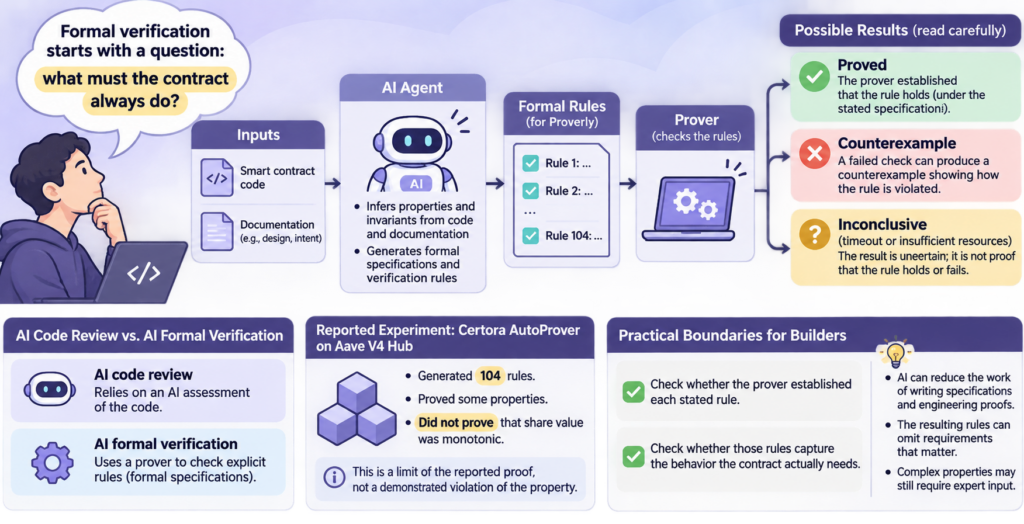
For a smart-contract builder, formal verification starts with a question: what must the contract always do? A November 11, 2026 article describes an AI-assisted workflow in which an AI agent infers properties and invariants—conditions intended to remain true—from code and documentation. It turns them into formal specifications and verification rules for a prover to check.
The prover’s result needs careful reading. A failed check can produce a counterexample showing how a rule is violated. A timeout or lack of resources leaves the result uncertain; it is not proof that the rule holds or fails. This differs from AI code review because a prover checks explicit rules rather than relying only on an AI assessment of the code.
The article reports that Certora AutoProver generated 104 rules in an experiment involving Aave V4 Hub and proved some properties. It did not prove that share value was monotonic. That is a limit of the reported proof, not a demonstrated violation of the property.
AI may reduce the work of writing specifications and engineering proofs, but the resulting rules can omit requirements that matter. Complex properties may still require expert input. The practical boundary for builders is therefore twofold: check whether the prover established each stated rule, and check whether those rules capture the behavior the contract actually needs.