
Developers preparing to deploy contracts or create storage slots on Ethereum may need to revisit their gas estimates if EIP-8037 is adopted. As reported on November 16, 2026, Vitalik Buterin backed the proposal for the planned Glamsterdam upgrade and warned that it could break applications with hardcoded gas limits, including some bridges.
EIP-8037 would charge more gas for creating state—the account, storage and contract data that Ethereum nodes must retain. In Buterin’s examples, creating an account would rise from 36,600 to 197,900 gas units; creating a storage slot, from 22,100 to 110,020; and deploying a 24 KiB contract, from 4.95 million to nearly 37.8 million. The account-creation charge would also apply when an ETH transfer creates a new onchain account. These are proposed costs, not enacted rules.
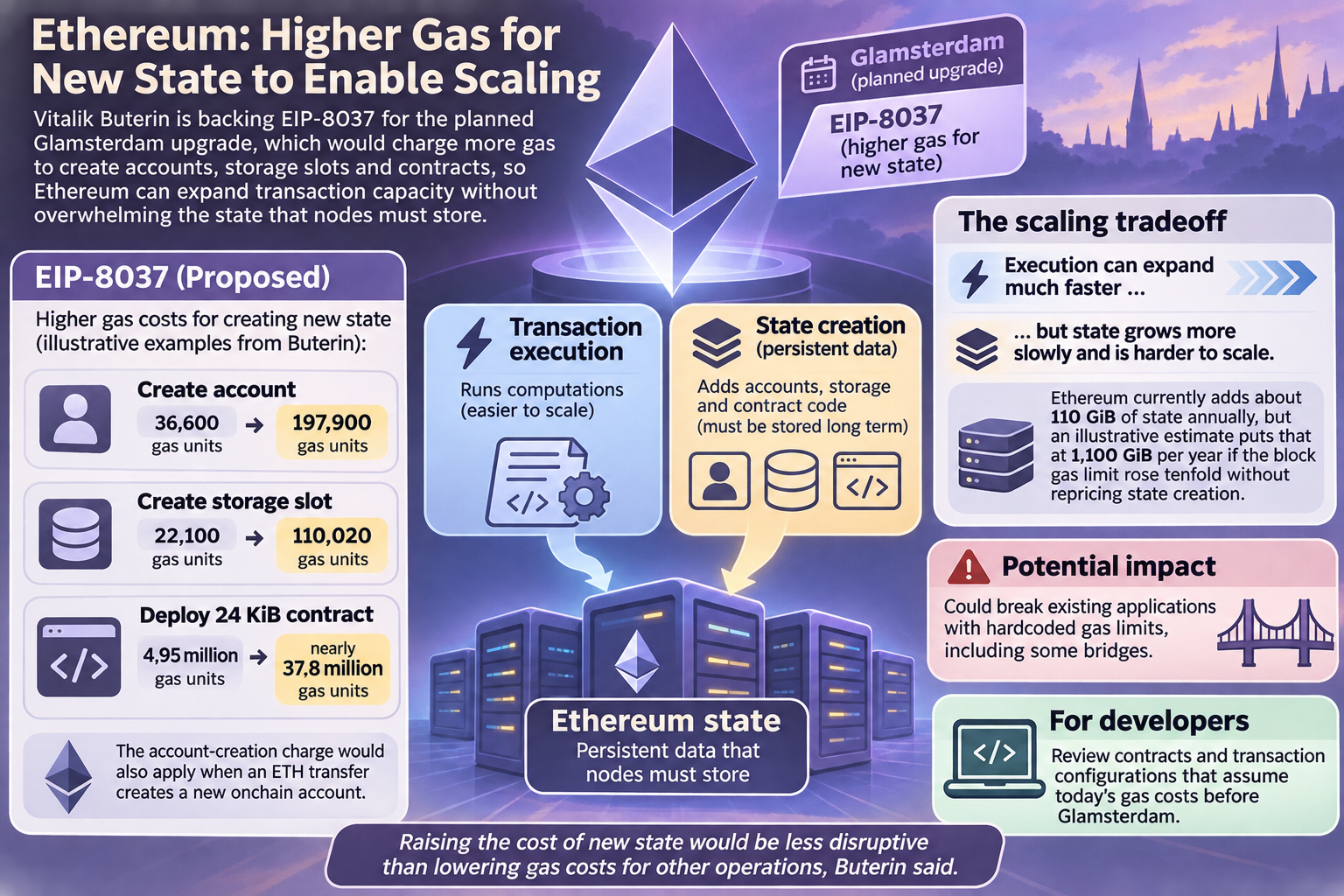
Buterin argued that Ethereum can expand transaction execution faster than it can expand the state nodes must store. He estimated that the network currently adds about 110 GiB of state annually. If the block gas limit rose tenfold without repricing state creation, his illustrative estimate put annual growth at 1,100 GiB, increasing pressure on disk storage, initial synchronization and state-related operations.
For builders, the immediate task is to review contracts and transaction configurations that assume today’s gas costs before Glamsterdam. Buterin said raising the cost of new state would be less disruptive than lowering gas costs for other operations.