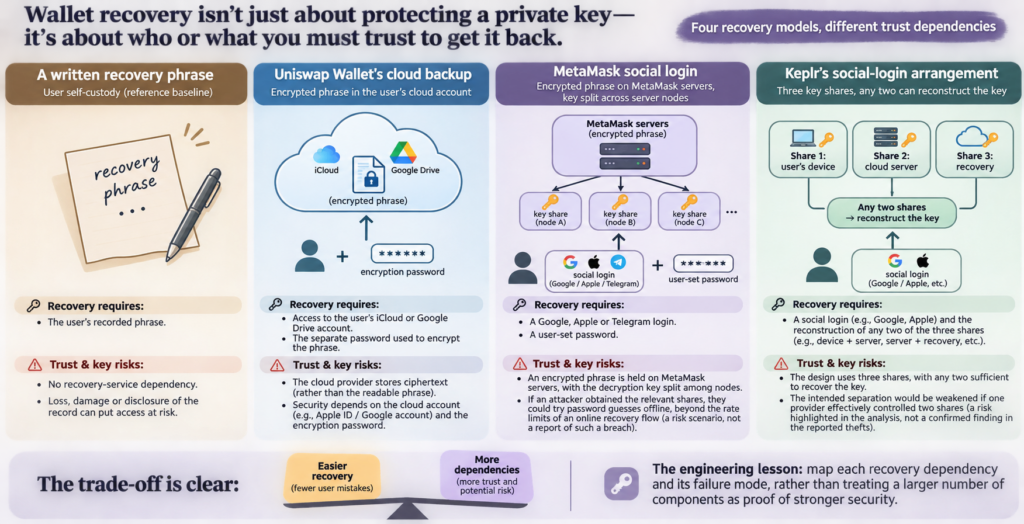
For builders designing wallet recovery, the practical question is not just how a private key is protected. It is also who or what must be trusted to restore access.
In an analysis published on November 10, 2026, Liu Jiaolian compared four approaches after reporting that assets had been taken from several thousand Keplr social-login accounts. Liu said Keplr had pointed to a vulnerability in Web3Auth infrastructure, but the technical cause had not been disclosed in detail. Liu’s suggestion that control of multiple key shares might explain the incident was a hypothesis, not a confirmed finding.
Four recovery models
- A written recovery phrase: The user records and safeguards the phrase. This avoids a recovery-service dependency, but loss, damage or disclosure of the record can put access at risk.
- Uniswap Wallet’s cloud backup: In Liu’s description, an encrypted recovery phrase is backed up to the user’s iCloud or Google Drive account. Restoring it requires access to that account and the separate password used to encrypt the phrase. The cloud provider stores ciphertext rather than the readable phrase; the account and password remain important security dependencies.
- MetaMask social login: Liu describes an encrypted phrase held on MetaMask servers and a decryption key split among server nodes. Recovery requires a Google, Apple or Telegram login and a user-set password. Liu notes that if an attacker obtained the relevant shares, they could try password guesses offline, beyond the rate limits of an online recovery flow. That is a risk scenario, not a report of such a breach.
- Keplr’s social-login arrangement: Liu describes three key shares—one on the user’s device, one on a cloud server and one for recovery—with any two sufficient to reconstruct the key. The analysis argues that the intended separation would be weakened if one provider effectively controlled two shares. It does not establish that this happened in the reported thefts.
The engineering lesson is to map each recovery dependency and its failure mode, rather than treating a larger number of components as proof of stronger security. Easier recovery can reduce mistakes made by users, while adding services and credentials whose risks users may find harder to assess. The available account does not establish which dependency failed in the Keplr incident.