
For Ethereum staking operators, the task EIP-8502 addresses is consolidating multiple validator positions into larger ones. In a report published on November 19, 2026, TechFlow said Ethereum Foundation researcher Anders Elowsson had submitted the consensus-layer proposal to an Ethereum repository. EIP-8502 remains a draft, not an active fee rule.
The proposal targets communication costs on Ethereum’s beacon chain. Validators send attestations—votes used in the consensus process—and their signatures must be checked and aggregated. According to the proposal’s technical explanation, that work rises with the number of active validators rather than simply with the amount of ETH staked. The report put the November 19 totals at approximately 815,000 active validators and 44.01 million ETH staked, or about 54 ETH in average effective balance per validator.
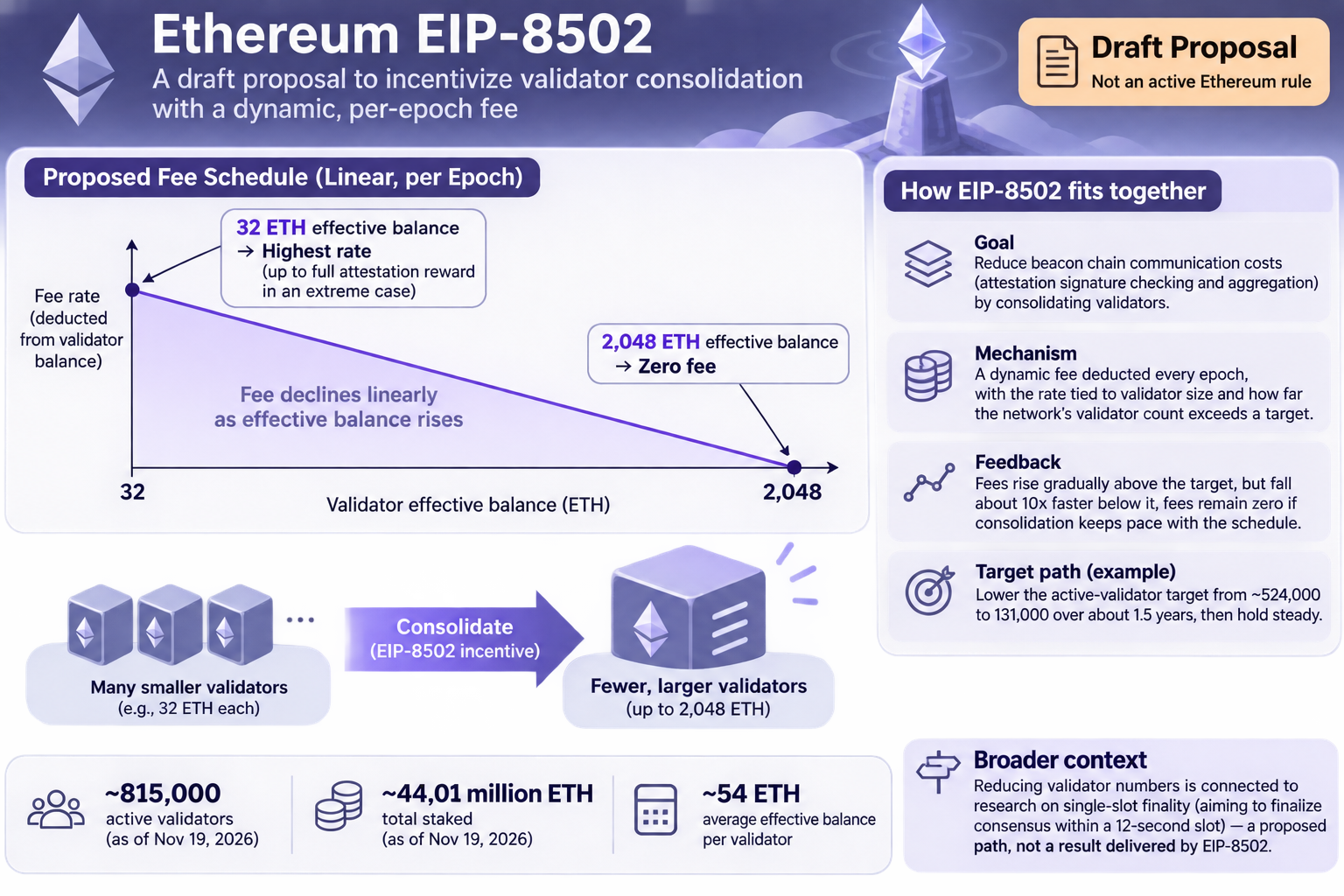
EIP-7251 already allows voluntary consolidation. EIP-8502 would add a fee deducted from validator balances each epoch, a recurring period of consensus activity, with the rate tied to validator size and how far the network’s validator count exceeds a target. Under the draft’s linear schedule, a validator with the minimum 32 ETH effective balance would face the highest rate—potentially its full attestation reward in an extreme case. The fee would decline as effective balance rises and reach zero at 2,048 ETH.
The draft’s example schedule lowers the active-validator target from roughly 524,000 to 131,000 over about 1.5 years, then holds it steady. Fees would rise gradually above the target but fall about 10 times faster below it; they would remain zero if consolidation kept pace with the schedule. The report connects reducing validator numbers to research on single-slot finality, which aims to finalize consensus within a 12-second slot. That is a proposed path, not a result delivered by EIP-8502. The report identified activation-parameter review, client benchmarks and consolidation exercises as subsequent work.