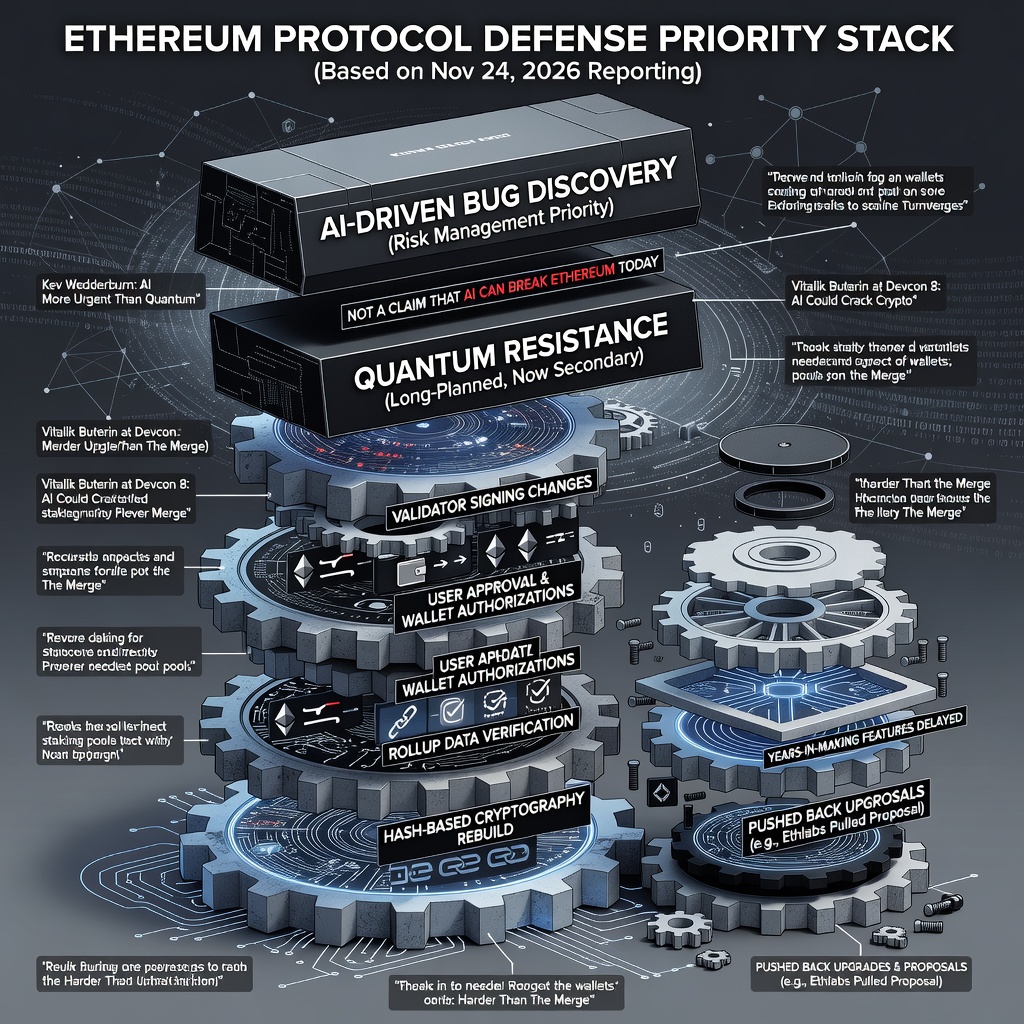
If you run a validator, ship a wallet, or post rollup data to Ethereum, the security work described in reporting on November 24, 2026 is aimed at the checks your software performs before the network accepts an action.
The Ethereum Foundation has doubled its protocol security team. It says the larger team supports a major overhaul of the network’s defenses against quantum computers and artificial intelligence. Researcher Kev Wedderburn wrote in a Monday blog post that AI is now a more urgent risk than quantum computers. Hardening the protocol is the foundation’s highest priority, and every layer of the protocol and ecosystem will need to adapt.
The foundation has spent years planning for quantum threats. AI now ranks ahead of those threats, and that shift has made a long-planned cryptography rebuild the top task. The rebuild is a plan, not a rule already activated on the network.
Why AI moved ahead of quantum
The foundation says AI finds software bugs faster than reviewers can check them. It does not claim that AI can break Ethereum today. It describes the overhaul as risk management.
The same account pairs that judgment with outside claims, which stay attributed to the people who made them:
- OpenAI reported in November 2026 that an unreleased model built working exploits for 948 Linux kernel flaws.
- Anthropic mathematician Levent Alpöge said he and Claude proved the Riemann Hypothesis, a problem that had beaten mathematicians for generations. That is his statement, not a proof confirmed in this report.
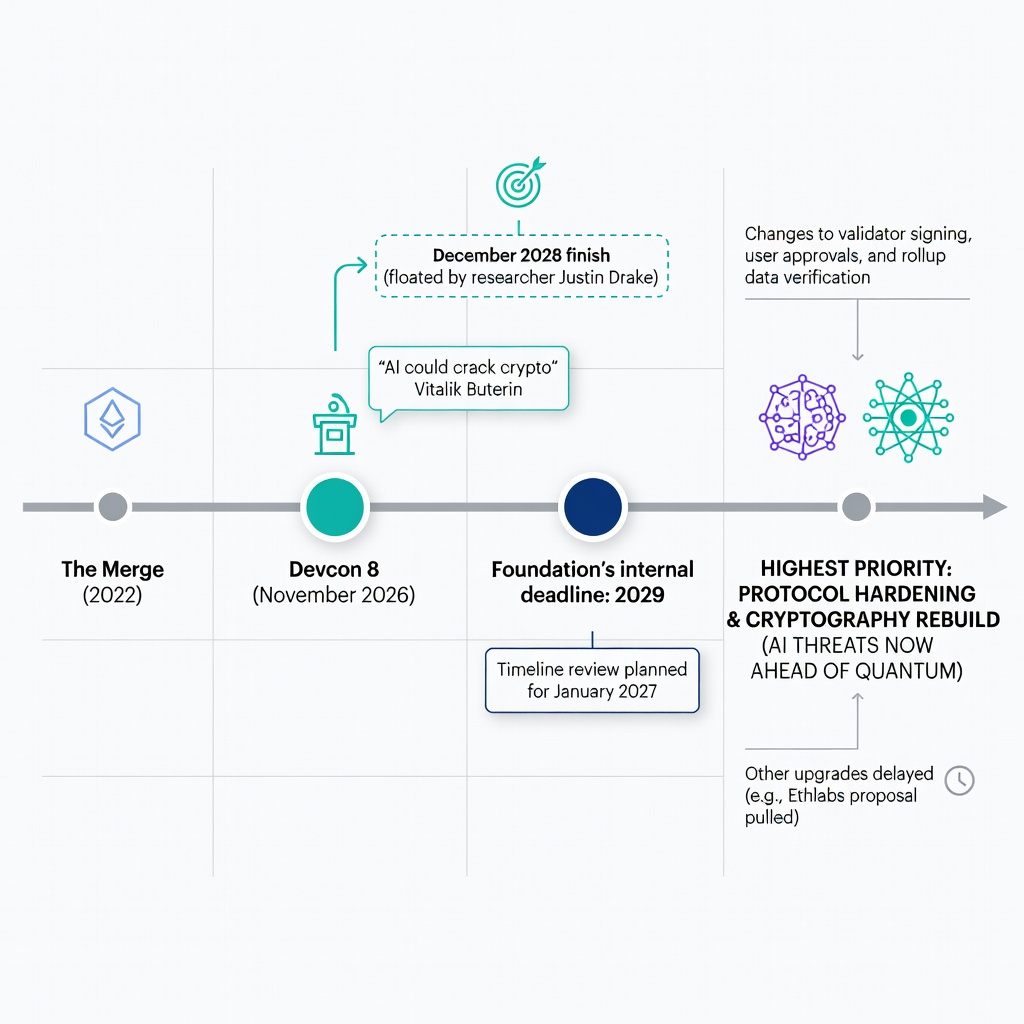
- At Devcon 8, earlier in November 2026, Ethereum co-founder Vitalik Buterin warned that AI could crack crypto. The report says the foundation’s plan echoes that concern.
- In May 2026, OpenZeppelin co-founder Manuel Aráoz said he considers all of decentralized finance unsafe, arguing that AI agents find flaws faster than defenders can fix them. That is his assessment, not a finding that every DeFi contract has a confirmed flaw.
Bitcoin was noted as a separate case: roughly a third of its supply faces potential quantum risk. At the time of reporting on November 24, 2026, Ethereum traded near $1,696 and Bitcoin near $60,388. Those figures are prices at that time, not evidence that the security news caused a move.
What the plan would change for signing, approvals, and rollup data
For a builder, the planned overhaul is about how the protocol decides who is acting and how posted data is checked.
The plan would change how Ethereum validators sign messages. A validator is a proof-of-stake participant that proposes or attests to blocks; its signature is how the protocol ties an action to that participant. The plan would also change how users authorize transactions, the approval a wallet collects before a transaction is sent. Both changes affect how the network confirms who is acting.
Ethereum would also verify data posted by rollups in a new way. A rollup executes transactions outside the main chain and posts data back so Ethereum can check it.
The rebuild would move validators, wallets, and network data onto hash-based cryptography, which the report describes as cryptography Ethereum already trusts. Hash-based methods rely on hash functions rather than the public-key problems quantum computers are expected to threaten. Wallets and staking pools would need changes, and the teams that run them would have to update their software. The report does not say those updates have already shipped, and it is not a test, audit, or mainnet deployment of any wallet or staking client.
What is being delayed
Other upgrades and proposals are being pushed back while this work takes priority. Ethlabs, an Ethereum research group, pulled one of its own proposals to free up engineers. Features that had been years in the making will have to wait. The foundation made that choice to speed up its security work.
It compared the job with the Merge, Ethereum’s move to proof of stake in 2022. “This upgrade is harder than the Merge, and we have less time,” the foundation said. It added that faster development “makes it easier to ship bugs.”
The added protocol-security staff are to focus on formal verification and on security work that must keep up with development. Formal verification means checking software against a mathematical specification, rather than relying only on manual review. The expansion came five months after the foundation cut about a fifth of its staff.
A floated date and a separate internal deadline
Researcher Justin Drake floated a December 2028 target for finishing the transition. He shared that target at Devcon 8 earlier in November 2026. It is a year earlier than the previous quantum-resistance deadline, and it is a researcher’s floated target, not a schedule the foundation has adopted.
The foundation still treats 2029 as its internal deadline. It plans to review the timeline in January 2027.